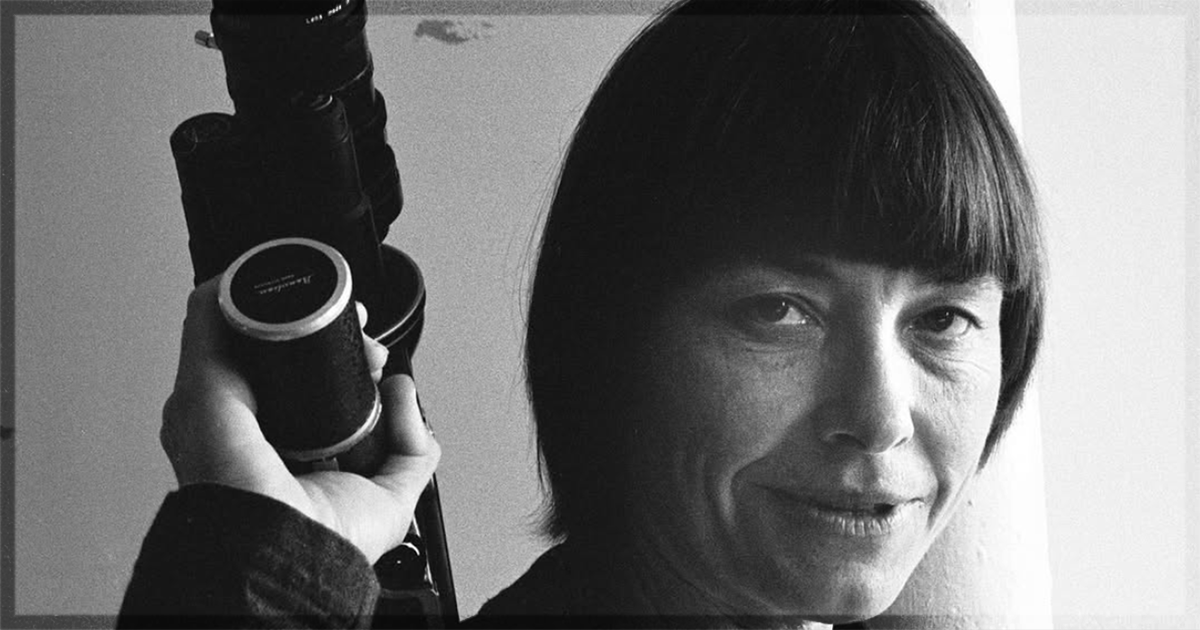
When discussing pioneers in cinema, Barbara Hammer’s name is quintessential for any discussion. The avant-garde filmmaker is essential for the feminist cinema alongside names like Chantal Akerman, Lizzie Borden, Barbara Loden, and Sally Porter. In a sense, all of those directors provided different multitudes for the feminine representation on the big screen, organized theoretically by Laura Mulvey’s opposition to the male gaze, a term coined in her essay “Visual Pleasures and Narrative Cinema”. Hammer is vital for two crucial movements in the second half of the 20th Century: the feminist cinema and the New Queer cinema, which is a wave that happens twenty years after the director began her career. In Barbara Forever, Brydie O’Connor expands her study of the American pioneer career following Love, Barbara, her 2022 short film. In O’Connor’s debut as a feature filmmaker, the director decides to approach the career of the American Lesbian cinema idol in chronological order.
The film begins with the imagery of Hammer’s final years; the director passed away in 2019 after fighting ovarian cancer for thirteen years. Excerpts of her visual experiments introduce the audience to the universe of the director and visual artist, such as the timely study of her naked body throughout the years, expanding on the visual impacts of the treatment and age. From the first minutes, O’Connor exposes the different approach of the director to her corporeal understanding, featuring herself nude in multiple moments of her films, which spans a prolific career of seventy projects in fifty years. In a society and industry used to the Hays Code for thirty-eight years, a series of guidelines censored content like violence, sex, and bodily exposure, among other rules. Hammer was a shocking addition to the newest currents of American filmmaking with the New Hollywood movement and the establishment of avant-garde canon with the Structural Film, featuring names like Michael Snow, Ken Jacobs, Ernie Gehr, and Barbara herself.
Hammer combines multiple movements boiling during the cultural shift in the American culture, positioning herself as a vital Queer filmmaker. O’Connor organizes the director’s career around her love life, a crucial source of inspiration and material for her films. In the voice-over, which is the most prominent aspect of Hammer’s telling of her life, she narrates how each passion leads to the production of each of her films. Yet, the most fascinating excerpt from her memory is the reasoning behind her decision to begin. In her twenties, she got married to a man and embarked on motorbike trips in California; one day, she discovered that she did not want to be a housewife, but an artist. The dissatisfaction with the social pattern of being a housewife and mother led to the beginning of one of the most important American artists in the 20th Century.
Therefore, underneath a rather simplistic and conventional structure, the director combines the rich archive from the experimental legend to craft a holistic view of her life. Thus, indeed, its structure tires the audience within its traditional framework of a biographical documentary. Still, there is a thrilling nature to its archive usage, particularly through the curating process by the director and the editing work by Matt Hixon. It is more engaging to learn about her breakthrough with Dyketactics, her 1974 short film that is a symbol of that period of filmmaking, considered by Hammer as the first Lesbian film made by a Sapphic filmmaker. Another crucial point is the constant effort by Barbara herself to maintain relevance and excitement as an artist. She produced her 1982 Audience while talking to the women waiting to watch a retrospective screening of her career as part of a homage by the Frameline festival in San Francisco.
Throughout her entire life, Hammer envisioned her work as her legacy, her mark in the world. As she mentions, “I want to live forever”. Indeed, she achieved that. Dyketactics, Audience, and Nitrate Kisses are essential to discuss queer, structural, and avant-garde American cinema. Besides that, the Beinecke Rare Book and Manuscript Library at Yale University acquired Hammer’s archives. A crucial organization in the American library system overlooks her legacy, the almost fifty years of her work with visual art and film. Additionally, it is impossible to mention feminist cinema and forget Barbara Hammer. She wrote her name as an essential name for the queer and female filmmaking, but as an example of an artist whose love exploded throughout the textures, scratches, and marks of her films.
Despite the conventional and occasionally tiring structure of her documentary, Brydie O’Connor eternalizes the figure of Barbara Hammer. As she wished before, she is going to live forever, and the impact of her work spreads in Barbara Forever, a love letter to the pioneers.
Barbara Forever played at the Sundance Film Festival.
Learn more about the film at the Sundance site for the title.
You might also like…