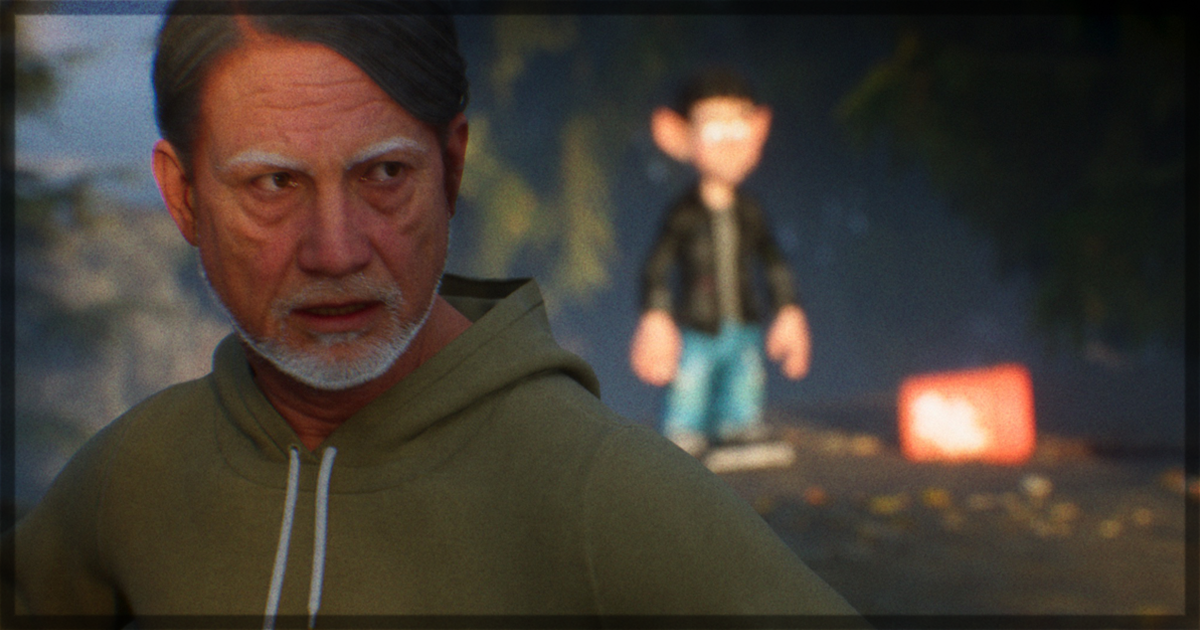
As the discussions surrounding Artificial Intelligence sparked the daily conversations of society, mostly of the aesthetically different artistry might be appointed as GenAI by the untrained eye. Our difficulty in absorbing the artistic content of unconventional art leads us to confuse the various artistic styles with a new, harmful tool pushed by corporations to undermine job positions and the payment of royalties to those who own previously crafted arts and models. A film like The Misconceived by James N. Kienitz Williams (The Plagiarists) sparks this necessary conversation. In the new project by Williams, he utilizes a 3D rendering model to portray the interactions within the construction of a barn. Similar to his other acclaimed feature, the already mentioned The Plagiarists, Williams co-writes the film with Robin Schavoir, with the writing focusing more on the dialogue as the central structure of the project rather than multiple plot lines, predominantly because the film utilizes close-ups to deepen its emotional impact.
The Misconceived tells the story of a failed filmmaker attempting to construct a barn as his labor because his plans to work with his artistry failed. Hence, the film revolves around his interaction with the people who hired him to build the room. The most fascinating aspect is the nature of the animation. Williams taught himself to animate for the production of The Plagiarists. Therefore, he cast well-known actors in the American independent community, such as Jesse Wakeman, John Magary, Callie Hernandez, Jess Barbagallo, and Rachel Lin, recording them in motion capture for the film; hence, he uses their models to animate the characters. His intentions are clear: specifically in this project, he showcases the limitations of individual artistry. More importantly, he uses the lack of polish in the animation as a style, his personal signature of the animated medium. Inevitably, there is a strangeness in the film’s visuals, an uncanny valley throughout its entire length. Williams restrains himself within the limitations of the technicality of the modern film production. At times of generative AI, multiple engines that rendered the frames at an impressive ratio, the director chooses the DIY approach, the particularly impressive deprivation of options to test one’s abilities and the possibilities.
As an experiment, a chamber piece, as the director mentions in his statement, it is an imperfect museum piece. Therefore, the do-it-yourself quality of it feels appropriate to a post-2010s era, the one where the YouTube tutorials taught people to make absolutely anything. Hence, plenty of people learned to animate through software on the social network, leading to experimentation with the form, and an exercise of learning, and also teaching by those recording the tutorial videos. Yet, there is a boldness that shifts to another level when a filmmaker produces a feature film alone in a video game engine, the Unreal Engine. In recent years, the world praised the small team that produced Flow (Straume), directed by Gints Zilbalodis, which animated the film using Blender, an open-source software. However, unlike the Latvian hit, The Misconceived is a much more unorthodox experiment.
The video game engine provides a visual that emulates humanity, yet it leaves room for the lack of fidelity in the humane traces. The film challenges you to accustom yourself to that appearance, which is not a prominent one in animations. Furthermore, the manufacturing production of the film benefits from its mumblecore narrative disposition, which prioritizes dialogue and a low-effort unveiling of narrative tropes. The style of the DIY animation and the mumblecore intertwine well together because the genre prioritizes the realism of the reactions rather than the craft of overly complex narrative arcs. Hence, it is a film that provides the experiment and a reflection on the poor conditions of artistry, using the individuality of the production to expose that. Yet, it is a film that tires the audience with the insistence of the gimmick, which does not expand at all, but delivers a fascinating insight into the tough reality of artists.
At the end, The Misconceived is a mumblecore experiment that works well at expanding the DIY aesthetic the director already worked with on his acclaimed The Plagiarists. The MoCap and the video game engine differentiate it from the overly polished or the 2D independent animations that populate the animation discourse over the last few years. There is a welcome element to the elements that James N. Kienitz Williams utilizes to craft his new project. It is a film that comments on the poor conditions of artists by limiting the options, leaning towards a creative DIY approach that is bold in an era of GenAI.
The Misconceived recently played at The International Film Festival Rotterdam.
Learn more about the film at the IFFR site.
You might also like…
‘The Story of Documentary Film: 1970s’ Documentary Review: A Joyful Look at the Past of Non-Fiction