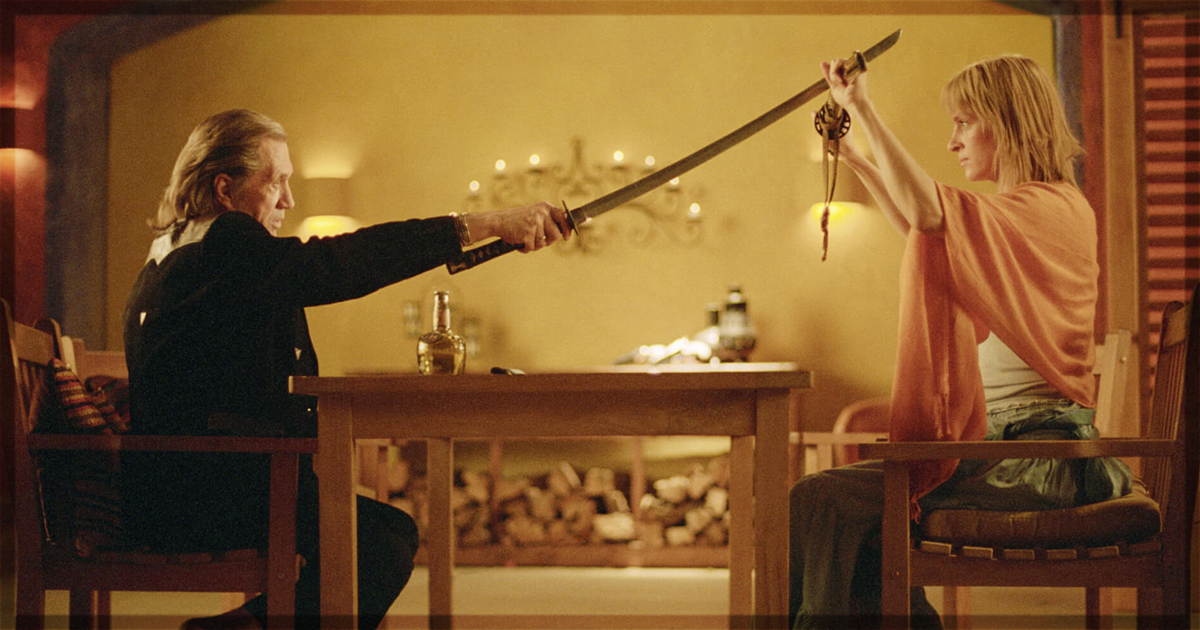
The year was 2003, one of the most formative years of my life as someone trying to discover their own taste in movies. The Matrix Reloaded overwhelmed the cinema zeitgeist for months. Michael Bay arguably made one of his best action films, Bad Boys II, before throwing himself into the Transformers rabbit hole. This was also the same year that gave us Return of the King, Finding Nemo, and Elf. What a time to be alive! And yet, the one movie experience that remains with me after all these years is my theatrical viewing of Kill Bill: Volume 1. Naturally, when the chance to watch Kill Bill: The Whole Bloody Affair arose, I had no hesitation in jumping at it.
Walking into Kill Bill in 2003 was an unforgettable event. It was a time when rated R movies still drew huge crowds on weekends. Teenagers would go to great lengths to get into the multiplex because seeing Tarantino’s latest ultraviolet masterpiece felt way cooler than watching Pirates of the Caribbean. On that release weekend, no one in the theater was ready for what was about to unfold. To this day, the reactions to the sword fight between Uma Thurman and the Crazy 88s is something I haven’t experienced since October 2003. Kill Bill Volume 2 didn’t deliver the same explosive spectacle as Volume 1, but it still served as a fitting conclusion to the story. Given their runtime, it’s not surprising that Miramax decided to split the films into two.
Yet, the question that’s lingered for all these years is: when will we finally see the complete version Tarantino has long promised? Furthermore, does watching the movie as a single, continuous story enhance the overall experience?
For the most part, Kill Bill: The Whole Bloody Affair is precisely what one would expect, a complete mash-up of both Volumes with minor changes throughout. It is not a recut in the style of Ridley Scott‘s Blade Runner, with little intention of reshaping how the original film was shown theatrically. In fact, The Whole Bloody Affair tries to add more than it subtracts. The existing changes are subtle and will only be noticeable to viewers with a fresh memory of the movie.
The story hasn’t changed, so there’s not much to recap. And chances are, if you are here reading this review, you have probably seen Kill Bill volumes 1 and 2. It’s the same narrative as before: Bill and his vicious assassins ambush the Bride/Beatrix Kiddo at her wedding, and she loses her child in the process. She wakes up from a coma 4 years later, extremely furious and ready to come out of retirement as a killer to hunt everyone down.
The first significant change is evident in the aggressively mean-spirited animated segment detailing O-Ren Ishii’s backstory. The original version depicted a horrifying murder of a mother and father as their child (11-year-old O-Ren) witnesses the massacre underneath the bed. The sequence then shows one of the assassins, Riki, the right-hand man of Boss Matsumoto, burning the house down by firing his gun at a bottle of liquor, then kicking a lit cigar at the flammable liquid. The movie used to show O-Ren getting revenge on Matsumoto by taking advantage of his pedophile behavior, then cutting to adult O-Ren (played by Lucy Liu) who now has the skillset to sniper targets. The new version gives O-Ren full vengeance, with a violent scene unfolding between O-Ren and Riki in an elevator, then transitioning to adult O-Ren as a sniper. While the sequence offers complete justice to O-Ren’s childhood, it does not add anything the viewer needed in the original film. The whole point of the segment was simply to convey how O-Ren became a dangerous assassin, and the Matsumoto death justifies O-Ren’s dark side without disrupting the pacing.
The rest of the changes are small and will only be recognizable to audiences who know the movie fluently. One example happens during the amazing Kitana battle between the Bride vs. the Crazy 88s. The original theatrical version displays the entire blood-soaked segment in vibrant color until the Bride rips an eyeball out of a man’s head. The movie abruptly pops into black and white as the violence escalates. Kill Bill: The Whole Bloody Affair abandons the black-and-white shift and keeps the fight in color. While it’s fascinating to experience the sequence in clear, bloody red detail, removing the black-and-white hinders the brilliance of the moment. The sudden shift into black and white throws the viewer into the nastiness of the fight, creating an intensity that makes the sword battle seem too sadistic for the human eye to comprehend. And having that denial of color makes the limb-chopping sequence feel more violent than it actually is in color.
Other small details include an added scene showing a few more seconds of the Bride torturing O-Ren’s lawyer, Sophie, and the removal of the Bride’s opening monologue in Vol. 2, as she drives a convertible while recapping her intentions to the audience. Instead, after a brief intermission, The Whole Bloody Affair returns to the past in the middle of the wedding rehearsal, before Bill (played by David Carradine) and the rest of the assassins kill everyone in the chapel. The complete four-and-a-half-hour experience also includes an animated sequence called Yuki’s Revenge, centering on Gogo Yubari’s younger sister, Yuki, who flies to the United States to track down Beatrix/the Bride and kill her for murdering Gogo. The sequence is said to be a lost chapter from the original screenplay. The sequence plays after the credits, and to be honest, there’s nothing essential that would require someone to stick around after a 4-hour movie. It’s a fun sequence, but you can also find it online since it premiered in Fortnite before the release of The Whole Bloody Affair.
The significant difference is how the movie feels as a complete package. Back during its initial release, the six-month gap between the two movies made the shift in vibe between 1 and 2 feel jarring. The first film is high on action, hyper-violent, and thrilling. The second movie has deeper character moments and long segments of Tarantino dialogue, with a finale that felt anticlimactic after the hype for Volume 1. Combining both movies enhances the transition to Volume 2, making it feel like a story taking a deep breath after a bombastic sword fight. Still, like many titles of the early 2000s, some elements have aged poorly.
Looking back, many of the misogynistic details hit differently after Harvey Weinstein’s scandal. It’s an awkward shift to see Weinstein’s name in the credits and then suddenly move to a scene where a nurse is selling the Bride’s comatose body for pleasure. Then, there are degrading bits of dialogue, such as a scene with Michael Parks calling the Bride a “c word” and Michael Madsen’s character Budd valuing Uma Thurman’s Bride only by her genitalia before burying her. The characters were always intended to be villains within the story. Still, there’s something about Tarantino’s excessive writing that makes it seem like he might actually speak this way and make borderline inappropriate remarks in real life. Additionally, Tarantino reportedly caused serious injury to Thurman during filming, forcing her to drive an unsafe blue convertible down a sandy road before crashing the vehicle.
However, it’s the smaller details that truly hold up while experiencing Kill Bill: The Whole Bloody Affair. The sound design is often overlooked in a Tarantino film, but here, it feels like its own character, with every stab, gash, kick, or crunch taking priority in the audio foreground. A great example of this is the scene between Gogo Yubari (played by Chiaki Kuriyama) and the Bride. The fierce Yubari slowly moves towards the Bride while spinning a meteor hammer in the air. The weapon prop itself probably weighs less than a chihuahua, but with each passing spin, we can feel the metal ball breaking the air through the sound. It is a testament to Lionsgate and how they remastered the audio from the original 35 mm print. Revisiting the movie will evoke emotional nostalgia for the days of Sally Menke. While Tarantino has maintained a cinematic pedigree since her passing in 2010, the energy she brings to the edit was unmatched. The only movie that might compare is Django Unchained.
Kill Bill: The Whole Bloody Affair demonstrates that Quentin Tarantino always intended for the film to be experienced as a complete narrative. While some aspects of the early 2000s Miramax era may not sit well with contemporary audiences, the film remains a landmark thanks to its visceral action sequences, flashy editing, and limb-slicing sound design. Above all else, the four and a 1/2 hour saga should serve as a refresher for anyone who has forgotten about the brilliance of Uma Thurman. For all the praise given to Tarantino, at the end of the day, it’s Thurman who made herself iconic by enduring physical and emotional stress to capture Beatrix Kiddo. The role needed her to be tough, vulnerable, endlessly angry, and yet somehow funny. Tarantino made the film, but this is, without a doubt, Uma Thurman‘s movie.
Kill Bill: The Whole Bloody Affair is now in theaters.
Learn more about the film at the IMDB site for the title.
You might also like…

‘Rosemead’ Film Review: Lucy Liu Shines in Thought-Provoking Drama