Alejandro G. Iñárritu might have won the discourse game with Digger, but Romain Gavras has won the metatextual satire on the climate crisis with Sacrifice. The critically maligned character study on a vacuous actor suddenly caught in the middle of a terrorist attack during a climate change convention was largely forgotten after its world premiere at the Toronto International Film Festival last year and has now been dumped on Netflix with little to no fanfare, but the film is miles ahead of anything presented in Iñárritu’s unwatchable Digger. Instead of pretending a movie has to be bad on purpose to provoke, Gavras tells an all-too-familiar story with zero subtlety, but infuses it with as many arresting images as he can, evoking a wide array of feelings.
Compared to Digger, which features some of the year’s most unimpressive (and ugly VistaVision) photography, Sacrifice brims with meaning in every ounce of the frame. Seeing it on the big screen (which this critic had the privilege of doing, since a different distributor handles its release in Canada) acted like a massive shock to the system. The metaphors might be extremely obvious, but one can’t entirely dismiss such formal daring, especially when it leads to an emotive conclusion that’s as powerful as Gavras’ last feature, 2022’s Athena.
Sacrifice may not be as memorable as Athena, but does it have to? Gavras knows he will never make something as politically timely as his father Costa’s Z, but he’ll at least try to take the piss out of the rich and famous who fly in their private jets to show how much they care about the planet at a gala where everyone eats caviar. Invited to this gala is washed-up actor Mike Tyler (Chris Evans, playing Guillaume Lemay-Thivierge), who seems to be here out of sympathy for Project Poseidon’s founder Ben Bracken (Vincent Cassel as Jeff Bezos). Tyler is attempting a comeback after doing a Lemay-Thivierge of himself by showing up to a ceremony, uninvited, and having an episode of total psychosis live for the world to see.
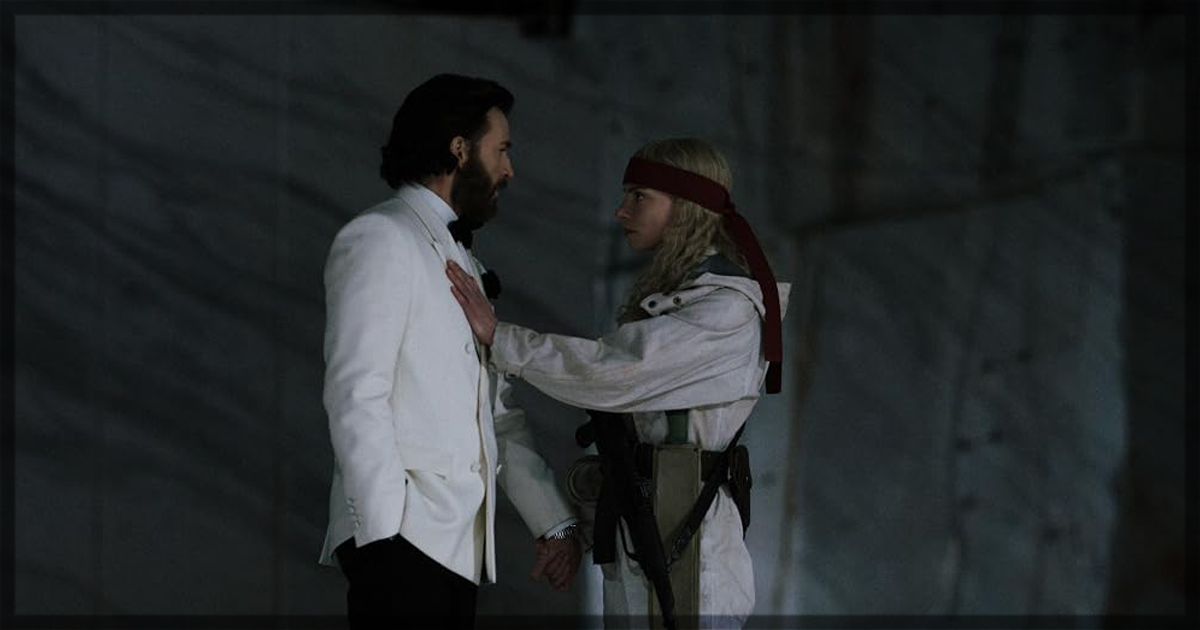
He’s now on his best behavior, but what he doesn’t know is that a group of eco-terrorists plans to hijack the gala and kidnap three people – the villain (Bracken), the lover (Katie, played by Ambika Mod), and the hero (Tyler). These three are to be sacrificed by throwing themselves in a volcano to prevent a cataclysmic disaster the likes of which the world has not seen before. Believing a prophecy they created, Joan (Anya Taylor-Joy as Greta Thunberg and, eventually, Joan of Arc – it’s in the name, of course) leads the group of terrorists to the volcano, despite the dispproval of her father, Gunnar (John Malkovich as Werner Herzog).
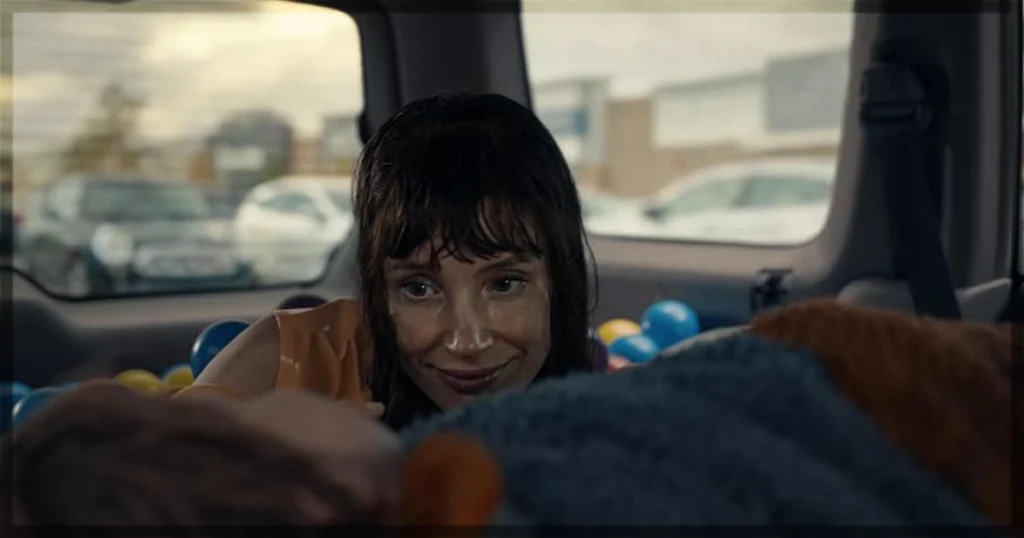
The plot isn’t the most interesting aspect of the movie, nor is the climate parable Gavras, and co-screenwriter Will Arbery barely develop. Instead, Sacrifice gets interesting as it approaches its satire by examining Mike Tyler’s quest for resurrection, both literal and figurative. He’s an actor no one likes anymore, despite a career, we hear, that was quite fruitful during its prime. Everyone hails his performance as Octavius in a film called Centurion, which he still wears on his sleeves during a drug trip that’s the most audacious thing Gavras has ever crafted, more so than the opening oner of his Athena.
That required technical wizardry, but Sacrifice seems like the first film where he plays with religious iconography in meaningful ways. He’s not subtle about it, but he doesn’t try to be. Joan parallels Joan of Arc: a leader of a movement she hopes will change the course of history and, eventually, a martyr. Mike Tyler is the film’s answer to Jesus Christ, but Gavras complicates it by putting us in the headspace of a washed-up actor with nothing to offer society but the hypocrisy of the climate gala he’s in. Hey, at least the film says something about the climate wall we’re heading toward and the fact that no reunion, either from our political class or the wealthy, has resulted in action to prevent (or lessen) the impacts of climate change.
Mike’s only answer to that hypocrisy is to try to make art again, which he’s failing at (the parallels to Digger write themselves, but again, this film is vastly superior). What if, by joining this eco-cult, he truly becomes the hero the world deserves? It’s all for a selfish goal – his mind is filled with insecurities and self-doubt, all revolving around himself – but perhaps this shift will ensure his trip to wherever he goes next will be more pleasant than his current trajectory. It’s the kind of active character study Gavras has never fully excelled at, but he seems to have fun experimenting formally with Chris Evans, giving the best performance of his post-Avengers: Endgame career (that said, his next role is a return to the MCU, which is quite disappointing).
As Mike Tyler, Evans gets to show a side of himself he’s never been able to illustrate on screen, and have fun with a character so antithetical to the climate cause that it’s almost comical he would say yes to sacrificing himself. If it means ultimately becoming the hero of his own story, why not? However, the real star of the picture is Anya Taylor-Joy, who gives the most profoundly soulful performance of her entire career as a Joan of Arc-esque figure whose blind allegiances to a cause may or may not have corrupted the essence of who she was. It’s a complex turn that reveals something different about the actor, just as Evans’ self-referential portrait of an actor who always wants to be the hero (he’s certainly played one of the biggest) allows him room to play that most films of his career didn’t.
The supporting cast may not be as strong as both Evans and Taylor-Joy, but Gavras’ aesthetic impulses are so attuned to the needs of the picture that they almost don’t matter. There’s a bravura sequence featuring Charli XCX as Mother Nature (because of course), who performs a cover of Cerrone’s “Supernature” that’s in perfect sync with the music video lineage Gavras came from before directing features. The way he understands a sense of musicality in the photography and editing is second to none, and it’s the primary reason why the film functions so well as not only an allegorical parable of the dangerous times we live in, but as a scorching repudiation against so-called “activists” who have done nothing to improve the state of the world.
Everyone goes through the wringer, and Gavras isn’t afraid to take his satire to extreme, almost cartoonish territories. But he has something to say. Not, “this movie is supposed to be bad on purpose!” He doesn’t beat you over the head with the same idea either, even if his commentary is blunt. Rather, he confronts the public with what he believes is happening to our planet and why the people in charge are hurting it more than they are helping prevent the climate crisis. It will be a tough pill to swallow for many, and that may be why so many audience members are rejecting it. I can’t reject such incredible images and a thematic core that hits hard through Chris Evans and Anya Taylor-Joy’s generational performances. There’s too much good in this to dismiss Sacrifice so heavily. The TIFF audience couldn’t handle it, but perhaps the world can.
Sacrifice is now streaming on Netflix.
Learn more about the film at the IMDB site for the title.
You might also like…