
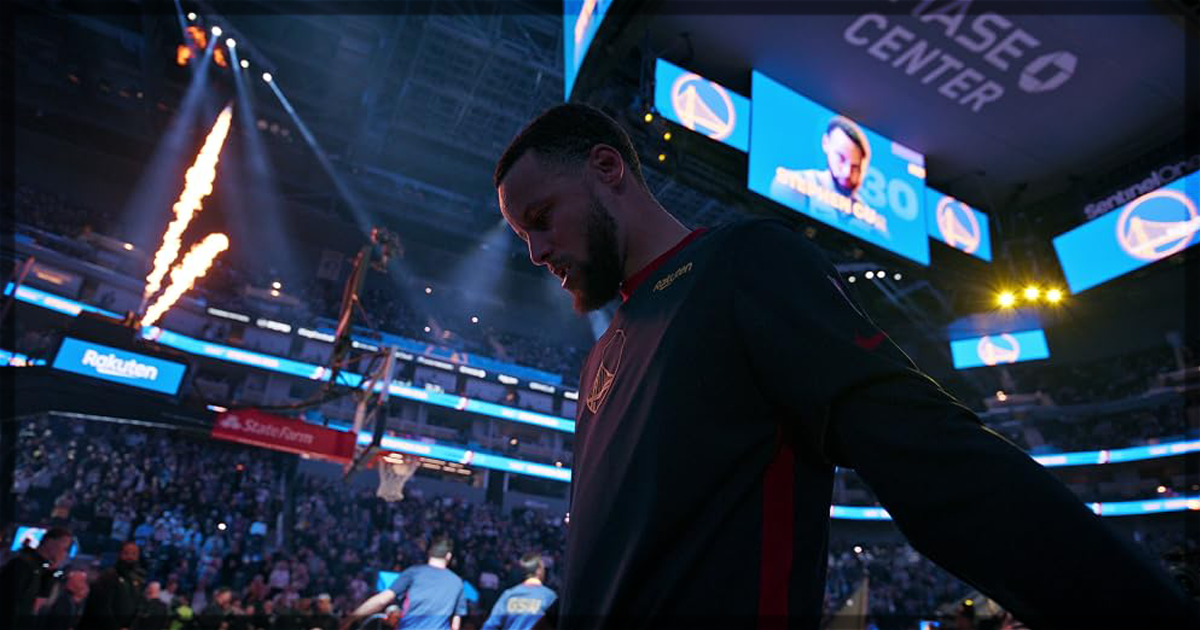
Gotham Chopra appropriates the classic language of IMAX documentaries in his free-flowing essay, Portrait of an Artist: Stephen Curry. What could’ve been a traditional piece of hagiography actually elevates its extreme glazing of Stephen Curry through a larger-than-life framing of a basketball giant as he accomplishes one of the greatest feats of his athletic career. Against odds that were more or less stacked against him, Curry’s resilience helped him become the figure he is today, inspiring millions of aspiring basketball players to go the distance.
The movie tracks Stephen Curry’s historic record-setting of 4,000 three–pointers in the most pivotal game of his career, as Chopra’s IMAX frame captures him performing feats of derring-do that we haven’t seen a basketball player accomplish since Michael Jordan. At least that’s how the documentary showcases him: as a Godlike superhero, especially when the images slow down to let us bask in the moment, even when the cards aren’t in his favor. That movie might have lasted forty-five minutes or so, but the movie attempts to portray Curry as one of the greatest living artists by paralleling this accomplishment with testimonials from filmmakers, actors, and musicians such as Steven Spielberg, Christopher Nolan, Michael B. Jordan, Viola Davis, Brian Eno, Nina Simone, Paul McCartney, and Autumn Durald Arkapaw.
Perhaps it’s a little excessive. Perhaps it’s a little propagandistic in making us feel that Curry is unstoppable, but the movie also recounts how his passion for basketball started and how it became an art. Chopra divides this almost essayistic, experimental approach into five chapters, showing how the calling for basketball came to Curry, how he put in the work, began to doubt himself at the height of his powers, learned a flow in his athleticism, and how all of us have an innate gift that we must give to the world. Again, all of this seems excessive, but there is a single scene where we don’t understand what the filmmaker is doing to reinvent the traditional beats of a 30-for-30 documentary, especially with a runtime much shorter than our usual ESPN features.
Perhaps it’s a little excessive. Perhaps it’s a little propagandistic in making us feel that Curry is unstoppable, but the movie also recounts how his passion for basketball started and how it became an art. Chopra divides this almost essayistic, experimental approach into five chapters, showing how the calling for basketball came to Curry, how he put in the work, began to doubt himself at the height of his powers, learned a flow in his athleticism, and how all of us have an innate gift that we must give to the world. Again, all of this seems excessive, but there is a single scene where we don’t understand what the filmmaker is doing to reinvent the traditional beats of a 30-for-30 documentary, especially with a runtime much shorter than our usual ESPN features.
Given the shorter runtime, Portrait of an Artist: Stephen Curry doesn’t deepen the poetic ruminations on Curry’s connections to artists the way it should, or on how his central relationship to the art of basketball has helped him find purpose in his life. However, Chopra doesn’t pretend this documentary is a complete account of who Curry is and his importance in basketball; it is more of a personal statement from the athlete about what he believes is most important in his life.
In that regard, the IMAX photography that captures Curry’s biggest accomplishment is unreal, almost intimidating. There’s a real sense of scale in how Chopra frames this moment as the stuff of legend, and it’s emotionally powerful (and artful), like anything in Zack Snyder’s Michael Jordan’s Playground or, more aptly, Don Kempf and James D. Stern’s Michael Jordan to the Max. They’re probably the best hagiographic basketball films ever made in terms of visual construction, and Chopra seems inspired by both to draw his “portrait.”
It’s not objective at all. Each voiceover testimonial from any of the figures the film presents serves Curry’s story and is always framed around what he’s accomplished and what he will likely achieve, as the history books are still being written about him. Chopra doesn’t strive for perfection or a real documentarist’s eye for distance; instead, he bathes in Curry’s subjectivity, becoming the audience’s guide to his story. It’s an interesting way to reframe the portrait, and it aligns well with what the title promises, despite some glaring flaws.
Some of the testimonials from various voiceover interlocutors don’t feel like they’re actively linking to Curry’s story, which often makes the documentary feel like it’s grasping at straws, but it still doesn’t overshadow its emotional impact. While brief, it remains a compelling, often emotionally stirring look at the process behind Curry’s genius and why his athletic feats deserve the same pedestal as some of our greatest artists. Behind every great athlete is an art they’ve perfected over decades. When one delivers feats at the height of their powers, they perform true masterpieces. In his field, Curry is a master. And he’s not done making his mark on the art of basketball yet.
Portrait of an Artist: Stephen Curry is now in theaters.
Learn more about the film at the IMDB site for the title.
You might also like…