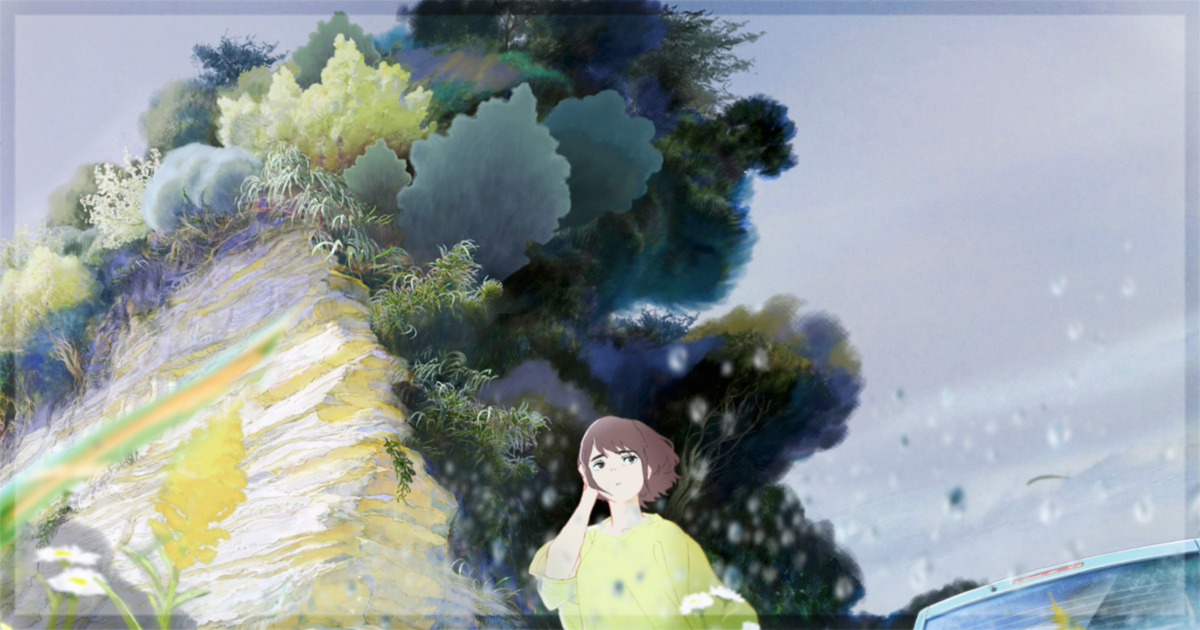
Animation is the best art form we have at depicting messy real life, because it heightens reality through the unreal in a way that never loses its realism. Writer-director Yoshitoshi Shinomiya, who developed his skills as a background artist on movies such as Your Name, now bursts onto the world stage with a movie that combines childhood regret, the march of progress, and fireworks. Even with all the visual effects in the world, it could never have been filmed. It has a precise connection to the specific physical world of its coastal setting while also being a universal metaphor of fear of change. A New Dawn was also only the third-ever Japanese film to be selected for the main competition at the Berlinale (the others are Spirited Away and Suzume). Like those other fantastical animated films A New Dawn is considerably easier to watch than to explain, with a charming beauty and attention to detail that makes a complex plot feel utterly genuine from moment to moment. But A New Dawn has a sense of clutter and real-world complication that’s all its own, which enhances its coming-of-age story in freshly surprising ways.
The first hint this film won’t be straightforward is the reminder that fireworks were invented by pirates, who used them to scare the ships they were attacking into surrender. On land pirates and their descendants used those skills for entertainment purposes, such as an annual fireworks festival that’s the main tourist draw for the little town where they settled. But the movie begins with the town’s 400-year-old fireworks factory, which belonged to the Obinata family that entire time, shutting down. This devastates the family’s sons, Sentaro (voiced by Miyu Irino) and Keitaro (voiced by Riku Hagiwara) as well as their friend Kaoru (voiced by Kotone Furukawa). All are in their late teens and had expected to spend their lives in the factory; Kaoru is the daughter of the factory’s second-in-command and was raised alongside the Obinata brothers virtually as another sibling. Certainly there’s a casual, careless intimacy amongst the three of them that only comes from a childhood together. But the closure of the factory and the permanent cancellation of the festival is so upsetting they have a serious argument, and they scatter into adulthood without looking back.
Five years after the closure of the factory the Obinata land has been compulsorily purchased and the property has been condemned. Town planners and engineers are reclaiming some land along the coastline and the Obinata house is in the middle of the works. (This is illustrated by a stop-motion sequence that uses the hands and arms of the animators to manipulate architecture dioramas and slices through the action as effectively as Will Ferrell’s arrival in The Lego Movie.) In that five years Sentaro put on a tie and in spite of his family’s questionable reputation got himself a boring but steady job with the local government. Kaoru ran away to Tokyo for to art school and has begun building her artistic career, though things are not going well. As for Keitaro? Well, he stayed home.
That’s meant literally: he has become a recluse in that derelict house, largely communicating with others by yelling through chained and bolted doors. What’s worse is he says its destruction will only happen with him inside it. As the deadline approaches, Sentaro finds Kaoru for the first time in years to beg her help getting Keitaro to see reason. But on arrival they learn reason isn’t necessary, as Keitaro has a plan. There was one firework – the Shuhari – their father never successfully made. If he can make it and set it off in time, obviously the house will be saved, the festival will relaunch and things can stay more or less as they are. Sentaro loves his brother but is deeply concerned by this foolishness. But Kaoru knows things about fireworks even the brothers don’t, and realises they might, just might, be able to do the impossible.
Every frame of this movie is extremely beautiful, starting with an unusual sense of history from the haphazard clutter in the Obinata house. It was built on a hillside, with the extensions and improvements of various generations giving it a precarious, teetering feel, and all three of the young people clamber out windows and over roofs as easily as walking up stairs. There’s also a greater sense of privacy on the roof terraces than inside, because the family’s stuff, including the factory’s entire research archive, has been allowed to pile up everywhere indoors. There was always going to be plenty of time to sort things out. But Keitaro has used the house as a shield, choosing to cocoon himself inside it instead of trying to face the wider world. There’s a small but funny subplot regarding social media, which Sentaro is somehow extremely good at, and despite her art career relying on it, Kaoru is not. But you can put your phone down any time you want. The whole history of the house and generations of the family’s belongings are about to be smashed through with a wrecking ball and Keitaro hasn’t so much as packed a suitcase. How do you decide what parts of your past to hold on to? In order to grow into the person you want to be, what do you need to let go of? And all that must be reckoned with in a few days while the encroaching construction works and the unsafe building around them cannot be ignored. Neither can the weather.
The unusual characters and the specificity of this setting is so unique and charming its overstuffed nature hardly matters. The giant finale, which only could have been achieved through animation, achieves a level of beauty that’s rare from any style of film. Its sense of wonder is also enhanced by the little moments Japanese films are famous for, such as a raincoated toddler pulling their mother up a hillside in excitement, or a worker turning deeper into a nap instead of gawping at the skies like all of his colleagues. The too-muchness is the point. Every life and every place is this layered and complex if you know how the whole story, and that means A New Dawn sees further than most. The ending also combines cold reality with a sense of optimism that’s unusual indeed. It’s so messy and complicated in the best possible way that I can’t wait to see what Mr. Shinomiya does next.
A New Dawn (花緑青が明ける日に) recently played at the Berlin International Film Festival.
Learn more about the film at the IMDB site for the title.
You might also like…