In 2023, the CBC (Canadian Broadcasting Corporation) released a list of the fifty greatest Canadian films ever. At the top of the list, it was not the name of David Cronenberg, Sarah Polley, Jean-Marc Vallée, or Atom Egoyan. It was Zacharias Kunuk with his historical 2001 film, Atanarjuat: The Fast Runner. Atanarjuat is the first film ever written, directed, and acted entirely in the Inuktitut language. The director is probably the most expressive name of Canadian native cinema, representing his origins as the Inuit. His career has multiple works that document the traditions and myths of the tribe, such as in films like One Day in the Life of Noah Piugattuk and The Shaman’s Apprentice. This year, Kunuk presents Wrong Husband (Uiksaringitara), his latest film, which premiered at the 2025 Berlinale and later on the Toronto International Film Festival.
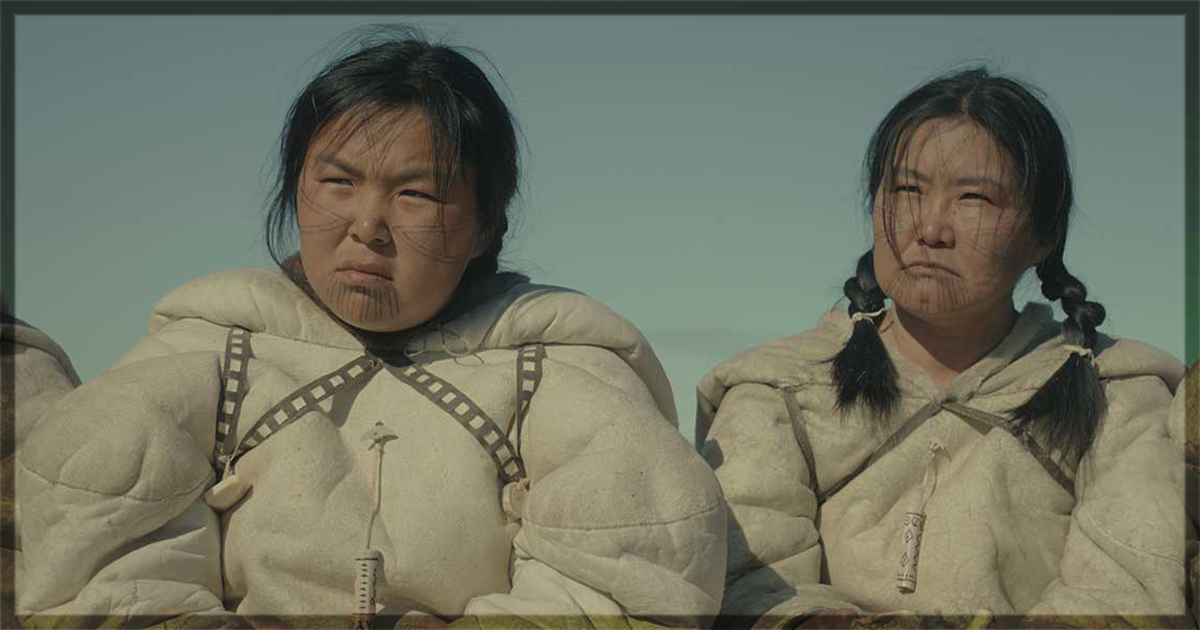
The director narrates the story of two children, Kaujak (Theresia Kappianaq) and Sapa (Haiden Angutimarik), who were promised to each other since their birth. However, following mysterious deaths in the Arctic, they separate from each other. The director tells a love story that involves different families, and a dreadful threat surrounds that region during their childhood. A shaman supports suitors to win Kaujak’s hand. In this sense, Kanuk tells a tale of love, death, and tradition. In the first moment, the film is a traditional drama about relationships and societal hierarchy. The families understand the importance of marrying their children and establishing an ordinary bloodline for the well-being of the community. Yet, the Inuit dramaturgy provides a mythical element, the evil in an unknown creature, the same that takes Kaujak’s father’s life. Therefore, it has a crucial component to the rest of the story, which balances the dispute of the girl’s love and the presence of this entity.
Furthermore, the film is about a rite of adulthood in this culture. It is about a marriage that resonates with that particular tribe’s tradition. Kanuk controls the natural and supernatural. The natural activities of fishing, peeling a fish, and administering the necessities for the group’s survival during the severe winter. Visually, Jonathan Frantz and Thomas Leblanc-Murray portray the magnitude of the region’s size through the immensity of the polar layer in the Inuit region. The cinematographers’ duo uses an open lens that captures a visual field, usually the immense geographical space, to affirm the distances between the tribes. Often, when the opposing suitors for Kaujak’s hands meet, they are in an open frame, similar to a western during the setup of a gunfight. Hence, the director states the rivalry when it comes to earning her hand. Yet, he films corporal combats that feature eminent humor, predominantly because of the bodily expressions, and how both lose each fight. Thus, there is a particular humorous aspect to each combat, denoting the silliness in their confrontation.
Therefore, Wrong Husband is a fascinating film on the tradition of the Inuits, exploring the story of a community in a complex situation. Additionally, the Canadian trailblazer filmmaker achieves the captivating combination of drama with magical realism, which draws from the indigenous traditional mythology to provide a different narrative on the original communities. In the canonical narrative structures, stories would follow a pristine configuration, following patterns that would continue the Eurocentrism in artistry. Yet, it took a century for an Inuit film to be in production in its own language; hence, the film community did not welcome the particularities of the native storytelling. Kanuk creates a story that reminds one of Shakespeare’s Romeo and Juliet, but it has its own intricacies in the context of his community. The director delivers a slowly developing film, but with varied components that showcase the power of indigenous filmmaking, and features different aspects of the story. Hence, there is a magicality to the mythical; the distinct elements that represent exterior factors are present in the indigenous imagination. Kanuk is a veteran director, but he still proposes an out-of-the-ordinary filmmaking, which transmits his difference in visioning the world and his artistry. Thus, it is a rough film to watch at first, but as it unveils, it is a unique experience.
Wrong Husband is Zacharias Kanuk’s exercise of imagination in visualizing evil through the magical. Yet, he brings a different vision to the drama about marriages, filming some of the funniest combats for someone’s hand, but that works as a whole. Therefore, it is a slow film, but it is nevertheless a fascinating glimpse of the Canadian indigenous filmmaking, which is on a grand level, and deserves more spotlight.
Wrong Husband (Uiksaringitara) recently played at the Toronto International Film Festival.
Learn more about the film at the official TIFF site for the title.
You might also like…