When discussing American Independent Cinema from the 1980s and 1990s, Hal Hartley’s name is a central one for the conversation. Releasing his low-budget NYC-shot film The Unbelievable Truth in 1989, the New York director launched his arguably most well-known works in the following years with Trust, Simple Men, and Flirt. However, he has not released a new film since 2014, when the director premiered Ned Rifle at the Toronto International Film Festival. It is the third part of a trilogy also featuring 1997’s Henry Fool and 2006’s Fay Grim. In the same year, Hartley released the documentary My America, a film composed of 21 monologues by American playwrights that form an image of the United States. Eleven years later, the New Yorker visual poet is back with Where to Land, a seventy-five-minute small-ish film about a film director in crisis.
The film follows Joe Fulton (Bill Sage), a once well-known director of romantic comedies. Lately, he lives alone in his flat, where he receives frequent visits from his niece and his girlfriend Muriel (Kim Taff), a famous TV actor. Suddenly, Joe is engaging in two priorities in his life: writing his testament according to the advice of his lawyer, Laura (Gia Crovatin), and arranging a day job at the church’s cemetery to occupy his free time. A misunderstanding builds up when his niece and his girlfriend hear about the testament writing and the cemetery visits. Meanwhile, a student director questions whether Joe might be his father. Thus, Hartley creates a film about a man and the perceptions of the people around him.
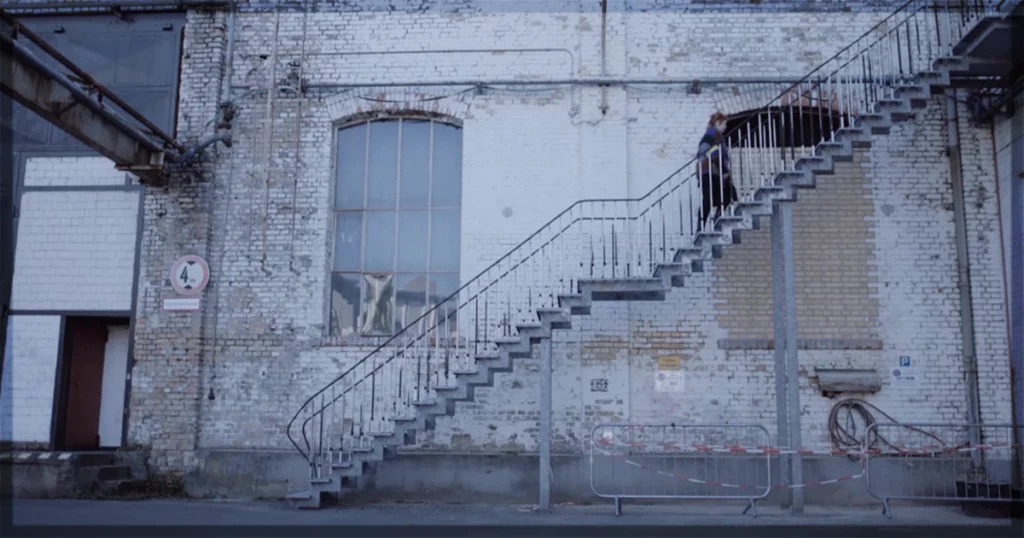
Firstly, the NYC indie veteran crafts a small, condensed film set between small venues and the wide streets of New York. The setting contrasts with Joe’s life; it is immense and overly significant, yet irrelevant to most. All the mentions to his triumphs are in the past tense: were, was, has been. Parallel to that, his current partner holds the attention from the moment of the engagement of the TV show she is a part of – in this sense, Where to Land might feel a reflection of the director upon himself and his trajectory. Coming off an eleven-year hiatus, Hartley releases his latest film in a different industrial landscape and society. The self-financing from his latest work, Ned Rifle, has become a new form of developing projects by veterans, such as Francis Ford Coppola with his Megalopolis and Tom Ford with the upcoming A Cry to Heaven. Consequently, Hartley’s last film got a limited theatrical release and then a self-release on the filmmaker’s website. It is a new way to launch independent works that allow different audiences to meet names like Hal’s.
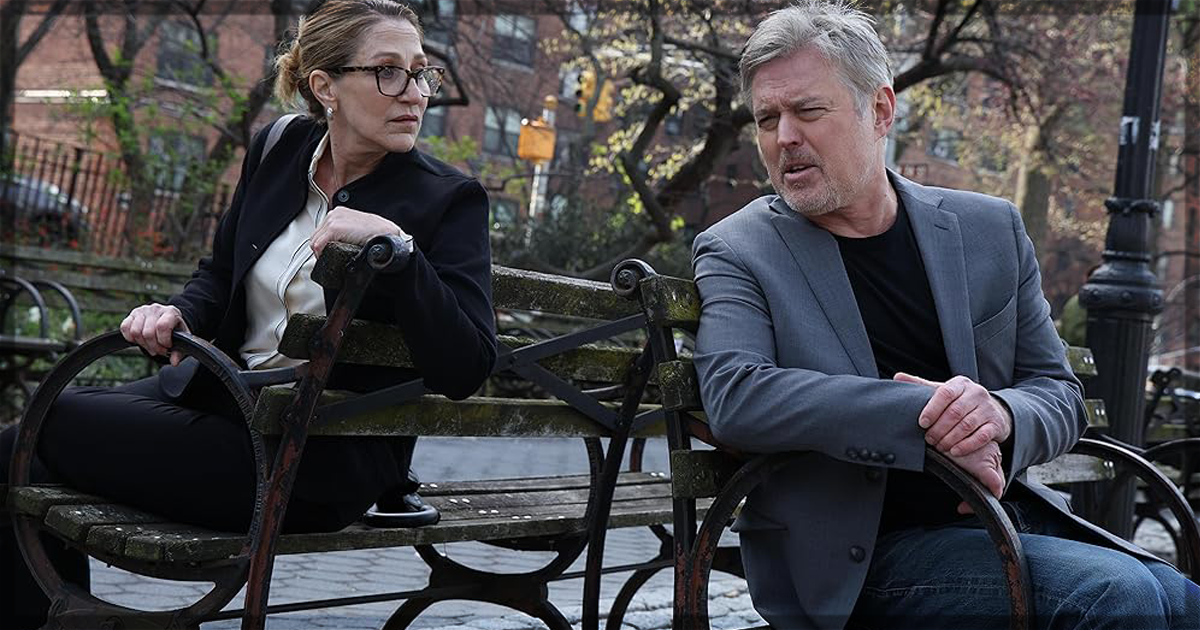
On another note, the film has a simplicity that feels too singular. Throughout Sarah Cawley’s digital cinematography, the filmmaker captures a sentiment of the daily life. The New York of the 2020s feels too distant from the one in the director’s first films, and at the same time, it remains unchanged. Hartley positions Joe and his ex-partner, Clara (Edie Falco), conversing on opposite benches in a park, while thousands of people circle them. Although a four-time Emmy winner and a lead actor of the legendary The Sopranos is performing in a public venue in the city, the New Yorkers (born and arrived) continue to live their lives and rush to the next daily activity. This sentiment of the film gravitating towards people and the city is an equivalent of the lead character’s journey, particularly due to his uncertainty about where to land.
As previously mentioned, there is an underlying impression that Hartley is reflecting on himself through Joe. Still, the character’s sentiment is understandable. Despite the past graces, he is unsure where to move on next. Then, working in a cemetery is a step closer to understanding where to sail, although the close circle around him confuses this decision with an imminent death. The film’s charm lies in the irony of the situations, the unveiling of the dynamics, and Joe’s journey back to the individuals from his life who might deserve inheriting the rights to his films. Hence, the film possesses the substance to argue on the previous failures and successes of his career and relationships. It becomes an exercise of rediscovering the past to determine how you would like to leave what you have done to someone’s future.
Despite the inherent comedic nature of the final farewells to someone who is not dying, Where to Land is an invitation to (re)discover Hal Hartley’s career and delve into the funny misunderstanding of a man who only wants to work in the church’s cemetery.
Where to Land is now streaming.
Learn more about the film, including how to stream it, at Hal Hartley’s website.
You might also like…