In modern Ukrainian filmmaking, Valentyn Vasyanovych is one of the best-known names on the festival circuit. His films Atlantis and Reflection premiered at the Venice Film Festival. In this sense, the director has already been discussing the Russia-Ukraine conflict in his work. Reflection narrates the kidnapping of a Ukrainian surgeon by the Russian forces, studying the aftereffects of the violent abduction. On the same wavelength, Atlantis tackles the PTSD of a volunteer who helps a city in combat. Thematically, Vasyanovych addresses Russian aggression long before March 2022, when the war officially began. He analyzes the aftermath of the annexation of Crimea and how it sparked regional conflicts on a grand scale. In his first work since the war began, the director confronts the invasion in To the Victory!, his latest effort, which had its world premiere at the Toronto International Film Festival.
Despite its title, the film is not a contemporary comment on the conflict. Vasyanovych explores a post-war reality in which Ukraine is victorious and a thoroughly new country. Hence, the director plays Valyk (Valentyn Vasyanovych), a filmmaker who is still in the country with his son. Yet, his wife and daughter moved from Ukraine to Austria, escaping the conflicts in the territory. Consequently, in the post-victorious lap, Valyk is questioning whether he will continue his career as a film director or do something else. To the Victory! represents the narrative of a divided person, someone mourning the political event that shaped the last few years of his life and the entire country’s.
Vasyanovych decides to approach the docudrama style to tell his story. In a sense, the film is an exercise of his own life, career, and questioning. Surely, any film draws parallels to the filmmaker’s ideology, life, and ideas. However, this one is a more profound reflection of how someone’s experience affects them. His last film, Reflection, was released in 2021, months before the conflict emerged. Accordingly, it is the personal culmination of three years of ideas, observations, and other sentiments expressed in his anecdotes. The result of this is To the Victory!, which more directly and precisely than ever maintains the thematic axis of his filmmaking, narrating the effects of Russian aggression on the country. In his past works, the commentary was tangible of the post-Soviet Union dismantling. Particularly, how the relationship between Russia and Ukraine changed after the separation, the latest film is a frontal critique of the idiocy of war.
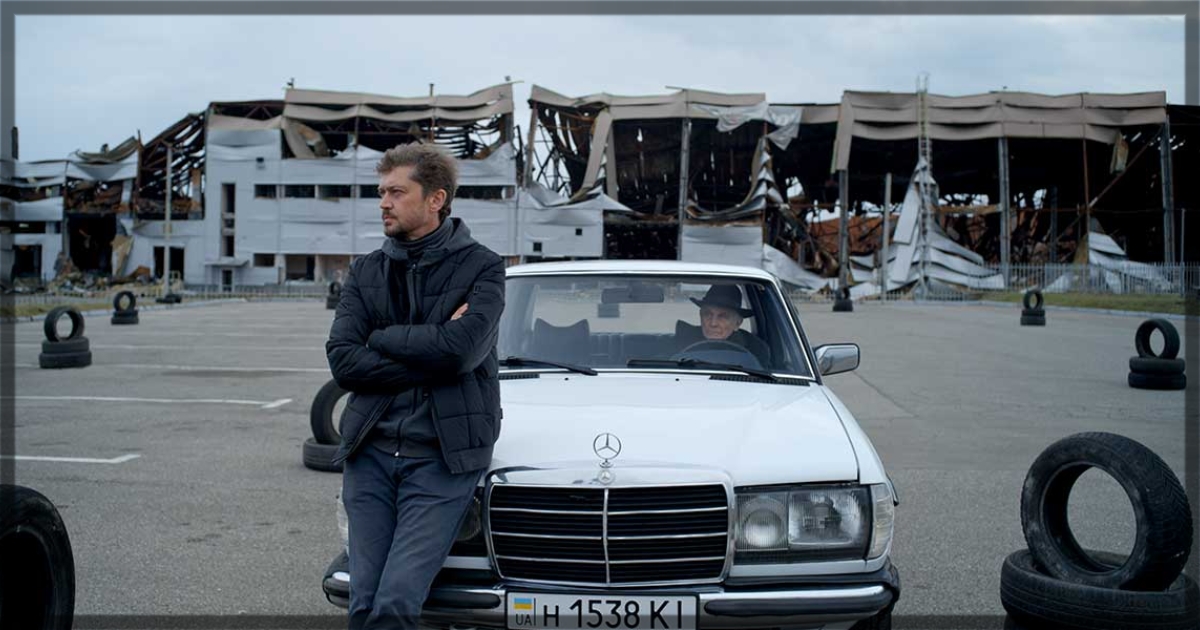
Yet in his new film, Vasyanovych adopts a theatrical approach. The first scene is a reproduction of daily life, in an interaction between a father and his son. Despite its slow duration, the scene is a fascinating inflection of the metalanguage. It is a scene about the shooting of a scene, acted by a director playing a filmmaker who is giving notes to someone else. It is a funny exercise of meta filmmaking, interpreting the cinema screen as a stage. However, the subsequent setups are derived from the open framing that imagines the screen as a stage. The film leans towards repetitiveness, the exercise of the lead character’s existential crisis, which reflects the cinematic setup. Thus, the director, arguably voluntarily, seeks the repetition in the form. The war act is redundant, cyclical, and tiring. Vasyanovych replicates these emotions inherent to the combative mode of conflicts. The point is the excessive nature of boredom, the tiring repetition of the character’s actions and confusions. The audiences feel it.
Another point is a washed-up cinematography by Vasyanovych and Mykhailo Liubarskyi. It emulates a particular colorless reality that those individuals are living in. Consequently, it is a mixture of a reaffirmation of the statement that the director attempts to narrate with his text, visual choices, and other elements. Therefore, it is a determined optical choice by the director, who is also the cinematographer, editor, screenwriter, and producer. Across his multiple roles, there is an overall sense of redundancy in his thesis, which echoes throughout his creative work. Yet, the film feels profoundly personal, linked to the director’s broader attempt to spark discussion about the aftermath of the war, creatively, psychologically, and personally.
Over the last three years, almost four, filmmakers have shared their visions of Russia’s aggression against Ukraine. Vasyanovych, whose work frequently comments on the horrors of war. To the Victory! is the result of his reflections on direct combat, a metalinguistic effort in the artistic labor after the Ukrainian victory. It becomes an overly redundant effort that stretches the multiple effects of the war but fails to create a cohesive thesis about it.
To The Victory! recently played at TIFF.
Learn more about the film at the TIFF website.
You might also like…