
The young Chilean filmmaker Diego Céspedes has a vigorous relationship with the Cannes Film Festival. His first short, El Verano del Léon Elétrico (The Summer of the Electric Lion), was part of the Cinefondation selection in 2018, which dedicates its program to films produced during the film school period. Four years later, the director exhibited Las Criaturas que se Derriten Bajo el Sol (The Melting Creatures) at the Semaine de la Critique, a crucial sidebar at the festival. Hence, it was natural that in his debut feature, Céspedes would return to the French event, and he did. This year, the director presented La Misteriosa Mirada del Flamenco (The Mysterious Gaze of the Flamingo) as part of the Un Certain Regard program. It is the second most acclaimed section of the event, only after the main competition, and he won the Prix Un Certain Regard, the principal award.
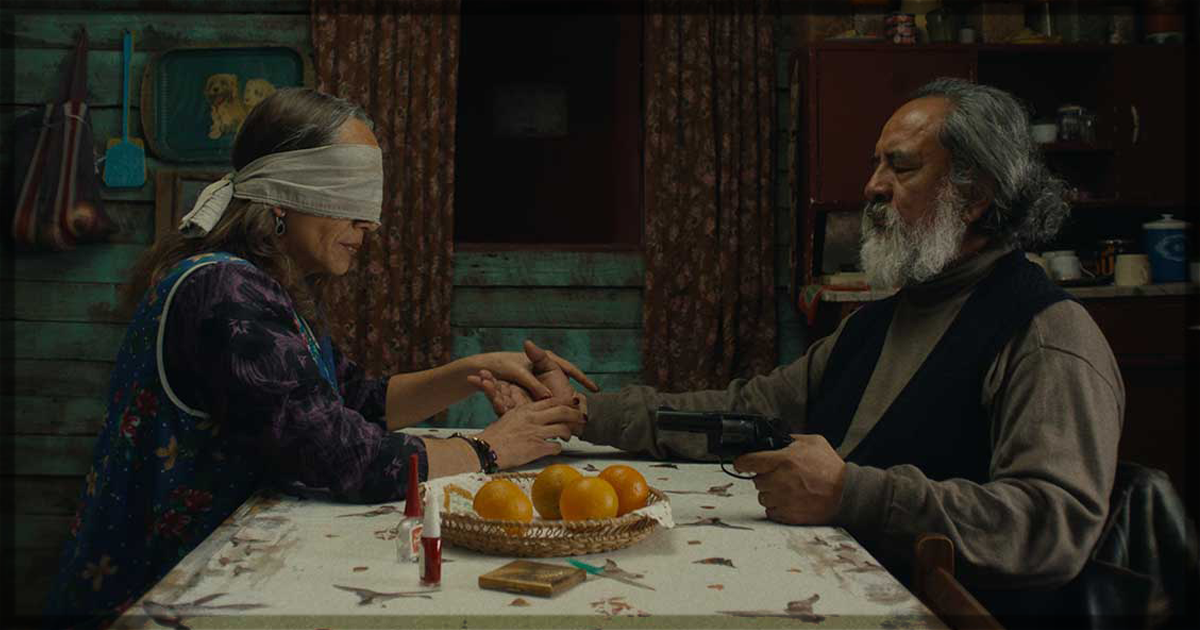
Similar to his short films, the director approaches LGBTQIA+ stories in Chilean society. In Flamenco, he travels back to 1982 in the country’s desert, where few people live, most of them are miners. Among the mining venues is a house where transgender individuals live together and own a bar. We follow the story of Lidia (Tamara Cortés), a twelve-year-old girl adopted by one of the women, Flamenco (Matías Catalán). The girl is the youngest individual in the house and observes a mysterious illness weakening the women who raise her. Suddenly, a brutal hate crime happens in the lake near the house, and the whole dynamic changes for Lidia and the group.
The crucial context to this story is understanding the political landscape of the country and Latin America as a whole. Nine years before the film’s timeline, the army general Augusto Pinochet overthrew the left-leaning government of Salvador Allende. It was part of a more complex geopolitical conflict; the American government funded several coups d’état to prevent socialist revolutions from occurring on the continent and to deter the proximity to the Soviet Union in the Cold War era. Hence, Pinochet became one of the most brutal dictators in the South Cone regimes, staying in power for seventeen years, and promoting plenty of massacres, kidnappings, tortures, and persecutions. Consequently, due to the Chilean geography, the long deserts, particularly the Atacama, became venues to hide bodies and bones of those murdered by the regime. At the same time, the AIDS epidemic would surge worldwide and quickly take the lives of many people. Beyond bringing death, the virus would escalate the stigma and prejudice against the LGBTQIA+ community.
In this sense, Diego Céspedes creates a melodramatic fable on death. By setting a queer house in the middle of a desert during the Pinochet period, the director incorporates death as a crucial character. It is the sum of the unknown epidemic, which would kill the individuals, and people’s ignorance would spread unhinged rumors about its transmission. Consequently, the shocking death is not from the illness, but from the prejudice and violence towards the community. The director, who demonstrates plenty of ability to insert emotion, designs a melodrama surrounding the AIDS virus and the stigma around queer love in the 1980s, particularly in the Latin environment, where men are encouraged to be machos. Death comes from love, the uncontrollable feeling of the carnal desire, not in the conceptualization of the transmission, but the brutal act of rather kill than lose. Therefore, the newcomer filmmaker films a beautiful tale of love between Flamenco and Yovani, but attributes the codes of melodrama.
The director imprints bright colors, such as red, yellow, and pink, to contrast with the bleakness of the desert sands. In a sense, the use of colors refers to Douglas Sirk and Pedro Almodovár, to cite two masters of melodrama from different periods of cinema. Those directors understood colors as crucial elements to the overdramatic baggage of the sub-genre; therefore, Céspedes creates his universe with contrary forces and complex dichotomies, lifted by a masterful work by Pau Aulí, the costume designer. The dresses and costumes are singular in expressing the personality of those women, even when they are losing their forces. Yet, the performance night is the one that uplifts their spirits, reminiscent of the spirit of cheerful queer competitions, such as drag shows and later ballroom. All elements combined construct a fascinating universe gravitating around the relationship between Lidia and her mother, Flamingo. It is the emotional core of the film, essential in creating the most beautiful moment of the film, a confrontation with death.
In his first feature, Diego Céspedes builds a story about queerness, solidarity, love, and prejudice, all in the context of the Pinochet dictatorship and the AIDS epidemic. Yet, the film’s biggest virtue is the emotional core, which benefits from the subtle and complex performance by Matías Catálan, who embodies the titular character and their journey. Finally, The Mysterious Gaze of the Flamingo is an impressive debut film, exuding Latin culture and the complexities within its contradictions.
The Mysterious Gaze of the Flamingo (La misteriosa mirada del flamenco) recently played at the Toronto International Film Festival.
Learn more about the film at the official TIFF site for the title.
You might also like…
