
In the UK Sense and Sensibility has a U rating – suitable for all – which is the equivalent of an American G rating. For a movie about the romantic choices of two adult sisters this is an incredible achievement, even if it’s an adaption of a Jane Austen novel. Miss Austen was the best at documenting the romantic travails of the repressed English upper classes, whose work has spawned a thousand imitators and formed the fantasy template for millions of girls and women for two hundred years. But this version of Sense and Sensibility, written by Diana Reid and directed by Georgia Oakley, while being appropriate for all ages is very much a modern story by and for adults.
Two other movie adaptions are for me the clear template for this film. Firstly, 1999’s The Winslow Boy, a Terence Rattigan play adapted and directed by David Mamet of all people, which on the surface is about a miscarriage of justice against a schoolboy, but is actually about how his older sister chooses which of her three suitors to marry. In the USA it was also rated G, which remains possibly the most surprising thing Mr. Mamet has done in his career. The other is 2011’s Wuthering Heights, Andrea Arnold’s unhappy adaption of the famously melodramatic novel by Emily Brontë. Largely filmed outdoors, with a great feeling for the weather, it has a rawness and sense of danger that remains palpable fifteen years later. It’s clear that Ms. Oakley decided, possibly because of these two films, to push her heroines onto rocks and hillsides to make it as easy for us to connect to their raw emotion, and that those emotions would be expressed in language to which even the littlest ears can listen.
Again, because it is all so adult, the littlest ears won’t understand much by themselves for a while longer. New widow Mrs. Dashwood (an underused Caitríona Balfe) has three daughters: old before her time Elinor (Daisy Edgar-Jones), high-spirited Marianne (Esmé Creed-Miles) and young Margaret (Bodhi Rae Breathnach, who will have a career as good as that of her sisters here if she continues like this). The family home is now the possession of her stepson John (Tom Brooke) who wastes no time moving in with his unpleasant wife Fanny (Stacy Martin). But Fanny has a most pleasant brother, Edward Ferrars (George MacKay), with whom Elinor falls in love with at first sight. And fortunately Mrs Dashwood has friends of her own, notably distant relation Mrs Jennings (Fiona Shaw), who delights in solving other people’s problems. (She also is permanently accompanied by her little black lapdog, named Fierce, of course.) Mrs Jennings rescues the Dashwoods from Fanny with a cheap little cottage near the sea in Devonshire, where the social circle includes the dour Colonel Brandon (Herbert Nordrum, more on whom later) and the delightful Willoughby (Frank Dillane), who himself rescues Marianne from a mishap on the beach. But there’s a very good reason that Edward and Elinor cannot act on the love they so clearly feel for each other, and a very bad one that Marianne and Willoughby cannot do the same.
The 1995 adaptation of Sense and Sensibility (written by Emma Thompson and directed by Ang Lee) also clearly influenced this film, mainly because of how it manages not to echo it wherever possible. This is most obvious because of the INSPIRED casting of Mr. Nordrum in the part played by the late Alan Rickman in that version. Mr. Nordrum has never worked in the UK before (and in the English language only once). He is most famous for playing the dopey barista boyfriend in 2021’s Norwegian surprise smash hit The Worst Person in the World. He was not in any way the obvious choice for Colonel Brandon, but choosing him means that the spectre of Mr. Rickman is entirely absent. (In London, the major stage revival of Les Liaisons Dangereuses this year was marred by Aidan Turner’s performance being a clear pastiche of Mr. Rickman’s; Mr. Rickman originated the role, but Mr. Turner could and should have put his own mark on it.)
Happily Mr. Nordrum’s work here is exceptional, as an observant, solid and very handsome man who has learned the hard way to tamp down his passions, and who is delighted that the Dashwood sisters make his shields less necessary. Brandon is very taken with Marianne’s heedless expressing of her feelings in public, and he is able to speak as a friend with Elinor from the very beginning of their acquaintance in a way unusual between men and women (then and now). Both Brandon and Elinor are very good at controlling their feelings while making it perfectly clear to anyone paying attention those feelings are still there. Nobody pays either of them that kind of attention, though. They are on the same wavelength, without it ever being said. Elinor is responsible for her family’s finances and therefore has had to put the feelings of others before her own for most of her life. Her attraction to Edward is because he is a kind and funny man, happy to clown with Margaret and obviously attracted to Elinor because of her intelligence and sense of self. Mr. MacKay is charm personified as someone surprised to find himself feeling comfortable and happy in Elinor’s presence – two feelings he clearly has little experience of.
But this is not all people standing around yearning and not talking about their feelings, though there’s plenty of that. There are repeated shots by Arnaud Potier of Ms. Creed-Miles looking so beautiful it’s like the entire country was designed for her to pose in. Just look at the shot of her walking in the woods surrounded by the hunting dogs, or of her reflection in the window as she sees London for the first time. The dances at the balls are unusually physical, with arms being looped around each other, necks rolled from side to side, and the girls picked up and swung around. People behave properly, but nothing’s particularly proper. Nobody brushes their hair, and there are no scenes of anybody getting ready for a ball. Turlough Convery and Eliot Sumner make enormous impressions in small parts. Clothes get stained, children whine, and the mending has to be done. Caterpillars crawl over fingers. Margaret sneaks food off her plate for the dogs. Marianne screams in frustration. And Elinor tries so, so, so hard to always be the mistress of herself in the face of grief, disappointment, boredom and thwarted hopes.
Yet describing it like this removes the humour – and there’s tons of that, very dry and almost entirely based on human nature. Mrs. Dashwood is surprisingly immature and dependent on her daughters, while Fanny’s villainy is expressed via biting remarks and deliberate rudeness. Ms. Shaw gets to have a great time as the gossipy, interfering, well-meaning old aunt whose intrusive kindness is both a genuine boon and utterly exhausting. Mrs. Jennings’ running commentary on everything, most especially Elinor’s feelings for Edward, and her delight in keeping a rowdy home prevents anything from feeling staid or stuck. And even though the plot twirls on whether the romantic hopes of the sisters will come good, at heart this is a sister movie. The relationship between Elinor and Marianne is the most important and valued of their lives, and it’s not a spoiler to say the final shot of the film is of them in a happy embrace. They might marry and have their own families, but they will always be the closest person the other one has, and the way in which they express their feelings will always be perfectly understood (if not necessarily liked) by the other.
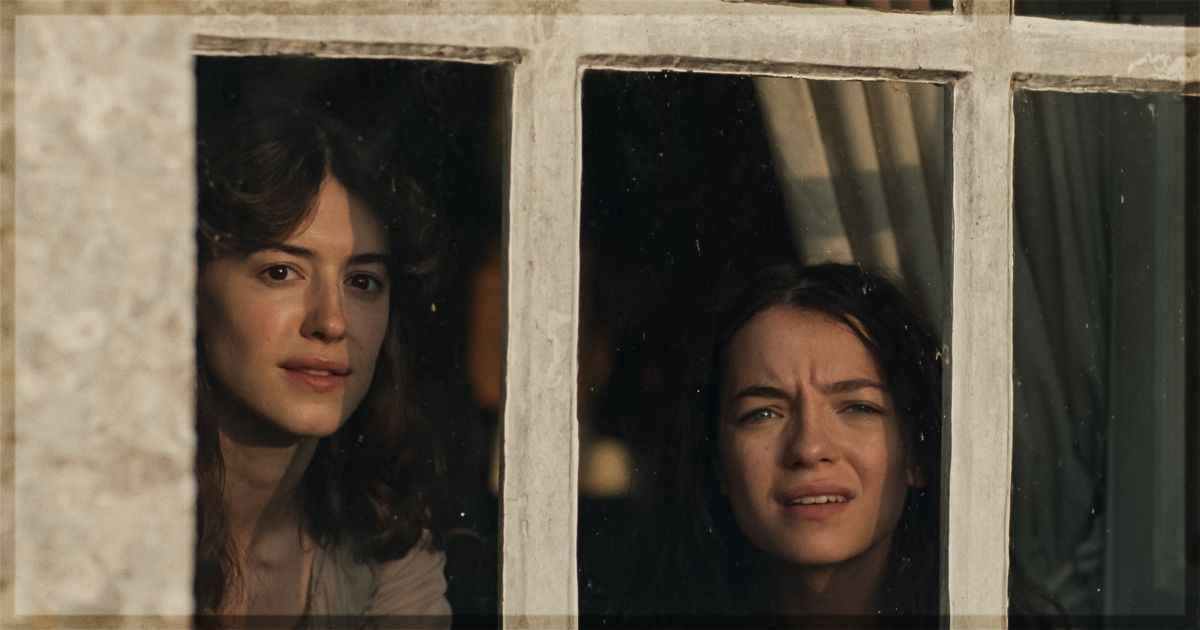
And what makes Sense and Sensibility so perfect for the current moment is that it is an actor’s movie. Most of the dialogue only indirectly relates to how anyone is feeling, and the audience must breach the chasm between what people are saying and the microexpressions on their faces themselves. The scene where Marianne is curt with Brandon while smiling and focused on Willoughby is just one example. The less showy work Ms. Edgar-Jones does throughout as Elinor, who has very clear ideas of the right way to move through the world, and who as discussed always puts others first, is the kind of gentle and subtle acting other people will study for years. When the Dashwoods and Mrs. Jennings must watch something through a window we get to observe four entirely different reactions to what they’re seeing. The scene where Elinor and Edward face the camera instead of each other as they come to some awful realisations is so delightful. We can read their every thought.
Ms. Oakley had the confidence to trust that we could understand the importance of every swallow and blink without anything needing to be spelled out. In a moment where people seem increasingly unable to understand others without subtitles and/or lengthy explanations, Sense and Sensibility makes it very easy to feel what its heroines are feeling. We haven’t had a movie this adult yet this considerate in a very long time. It is profoundly and wonderfully suitable for all.
Sense and Sensibility is now in theaters.
Learn more about the film at the IMDB site for the title.
You might also like…
‘The End of It’ is a Painful Mess (Cannes 2026 Film Review)