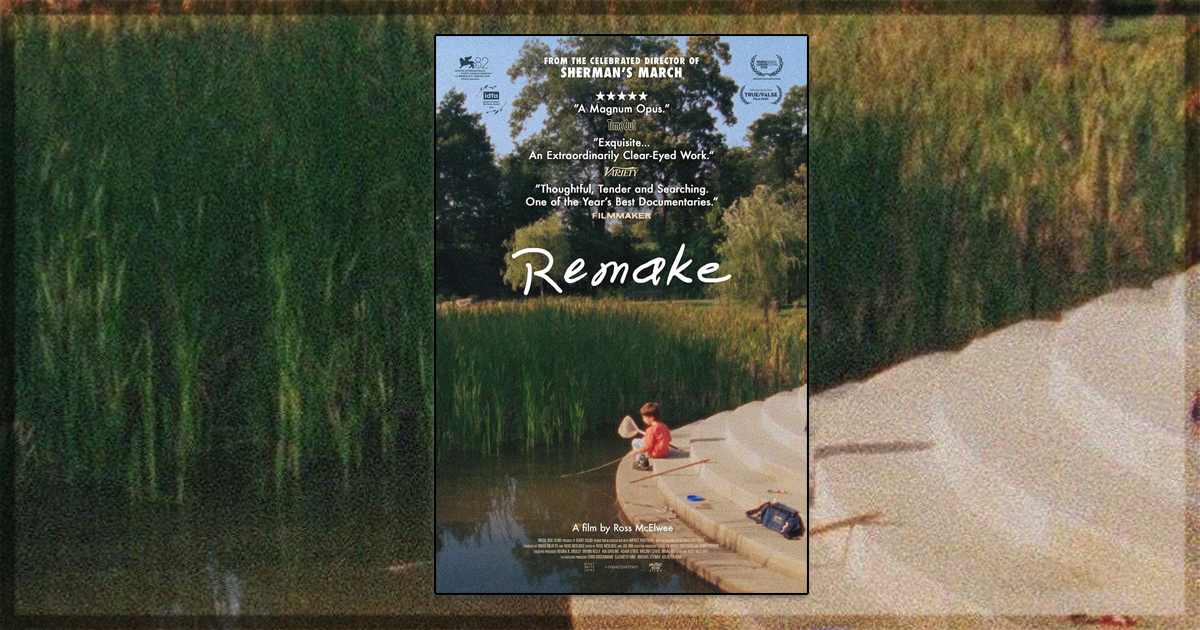
When a documentary film is about a filmmaker and their own family, there is really no way to critique the work of art without critiquing the people in it. That caveat, or concern, is especially important for Remake, the new documentary by Ross McElwee, who single-handedly changed the world of cinema with his 1986 documentary Sherman’s March. One of the throughlines of Remake are attempts, from Hollywood and elsewhere, to remake Sherman’s March in fictional form. Another is Mr. McElwee’s growing discomfort at the idea of fictionalising Sherman’s March despite him being filmed, by his son Adrian McElwee, signing the contract. But the main throughline of the story of Mr. McElwee’s ongoing grief at the death of Adrian in 2016. Adrian was an aspiring documentarian himself, but had also appeared since the moment of his birth in his father’s films. And that means Mr. McElwee has, in spite of himself, innovated again. Back in the 80s it was unusual for someone to have the ability to live their life in public, but now everybody possesses the technology to make public not only their every moment, but also that of their children. But it does not, and never did, give them the right to do so. It is therefore unfortunate that the whole point of Remake is a father desperately asserting his right to control the narrative of the life of his late son, even and maybe especially in that son’s absence. Remake is therefore not an act of love but an act of control, and because of how technology now twists so many personal relationships, not enough people these days can tell the difference.
For some reason, possibly enabled by all this modern technology, it’s become a common belief that parents own the lives of their children from the moment of their conception to the moment of death. But frankly, whether a parent is using location apps to stalk their children’s every move, or monetising their children’s childhoods on social media, or making a documentary about how sad you are that your kid is dead, it is always a betrayal. And it’s not the same as someone examining the lives of their parents in art, because nobody is responsible for their parents. Parents are responsible for their children, for protecting and caring for them while they are children, and ideally loving them as well. But a person of any age is not a possession.
Mr McElwee’s personal beliefs on this are made painfully clear when he is about to marry his new wife, Korean filmmaker Hyun Kyung Kim. In their relationship she has agreed to be documented as part of his daily life as long as he never films her face. But during their wedding she is filming him as well – the only witnesses to their courthouse ceremony are the cameras each holds throughout – and that means we see from her perspective when he asks again to film her face briefly, as a wedding present. All credit to Ms. Kim; once again she refuses. They get married anyway but that dirty little moment casts its pall. It is also perfectly clear that since the success of Sherman’s March not only has Mr McElwee felt that documenting his life was its purpose of his life. He also seems to think the people who love him owe it to him to participate in his work, ideally on his terms. Between Sherman’s March and Remake Mr. McElwee’s other documentaries (all unseen by me) also focused on his family, including the adoption from Paraguay of his daughter Mariah. But there is very little reflection from Mr. McElwee as to why Adrian and Mariah’s mother, followed by the kids, eventually told him they no longer wished to be filmed by him. There is also no information given as to whether or not this boundary contributed to the divorce and the family trouble which followed.
Now. Sherman’s March is an exceptionally frank documentary. If you haven’t seen it, it’s basically about how Mr McElwee got distracted from retracing the historical titular march by various romantic misadventures in the same places. This mostly involved following around old girlfriends in the hopes of winning them back, despite their new boyfriends or other plans being right there. But despite his romantic haplessness, Mr. McElwee, who used a small camera that hooked over his face or belt to film almost exclusively from his perspective, had a filmmaker’s eye throughout. Not everyone would have been capable of zooming perfectly on the mirror reflection while hugging a ex-girlfriend goodbye, for example, or placing a camera for a talking-head piece to perfectly shadow half their face. But the main thing you notice watching Sherman’s March in 2026 is how artlessly everyone behaves in front of the camera. That’s partially because several of them had their own performing careers in mind, but it’s mostly because in the mid-80s the footage having any afterlife was a laughable idea. Nobody was going to see it. And if they did see it – Sherman’s March was added to the US National Film Registry in 2000, an unusually quick turnaround for such an honor, but it is just that good – the internet had not been invented yet. Adults had absolutely no idea how any image out there could be reused and repurposed in perpetuity worldwide forever.
But Adrian McElwee was born in 1989. He grew up alongside the internet and then social media, and had to do so with the knowledge that his father’s filming of him was for public consumption. It’s clear he understood much sooner than his father that once an image is out there you can’t ever get it back. Based on the wedding conversation, M.r McElwee still hasn’t grasped this. I wonder if he has ever spoken with Sally Mann, the once-innovative and always excellent photographer whose frank work with her children – that she maintained for decades was an equal collaboration, despite them being children – has had equally shattering personal consequences.
Because Adrian’s childhood was lived in public, Adrian had to deal from childhood with the perception of others. He had no chance to develop a self that was separate to strangers’ perceptions of him. What’s worse, he had to do this knowing that what the world saw of him belonged to his father’s perspective instead of his own. This is difficult enough for an adult to manage. David Sedaris’ late sister Tiffany Sedaris had some fascinating thoughts about her refusal to appear in his written work. She could not bear the feeling she got from his essays that he was living her life for her. That was a brother, Mr. Sedaris only began writing when they were all adults, and yet because of those essays amongst other reasons they were estranged until Miss Sedaris’ death (which her brother wrote about, of course). Adrian was a child. When parents make a choice on behalf of their kid that the kid doesn’t agree with, how does that kid cope? Is it possible to truly love someone if they are benefiting financially from that love? How do you live with an unfixable mistake? Or is that even possible?
There’s a fair bit of footage Adrian shot in Remake. Some documents his addictions, but others are music video and outdoor sports footage from his PR business. Mr. McElwee included this footage with voiceover from himself. Rather than letting his son’s work stand on its own, he tells us how the footage makes his son continue to feel present for him and wondering how his son felt in the captured moments. And yet in the one heavily staged confrontation between Adrian and Mr. McElwee, which each filmed with their own camera, Adrian refused to directly state what from his childhood he was most upset about. The only clue dropped as to what those issues might be is a brief earlier mention of a ‘wilderness camp’ for young addicts, the kind Paris Hilton was also sent to (and similar to an environment Tiffany Sedaris also experienced).
In that awful conversation, Mr. McElwee seems utterly incapable of understanding that Adrian had a life – and was entitled to a life – that belonged only to himself. Mr. McElwee acknowledges mistakes might have been made regarding Adrian’s childhood, without admitting to or apologising for them. He seemed to think Adrian’s addiction problems were the only topic of discussion, and Adrian could not or would not articulate why the addictions were the symptom of and not the cause of his problems. No wonder they were stuck. No wonder Adrian was documenting his own life, ugly and upsetting as that footage is, to try to assert his sense of self.
Throughout Remake there are many references to Mr. McElwee’s previous documentary, 2011’s Photographic Memory, which was about Adrian and made with his willing participation. But the main sense you have about Mr. McElwee’s grief is that he is annoyed, maybe even angry, at how Adrian turned out without ever facing up to his own part in this sad mess. The fact all of this happened in parallel to various Hollywood executives coming up with ideas for the fictional adaptions of Sherman’s March that upset Mr. McElwee more and more does not appear, in the moment, to have caused any real reflection. Maybe the belated realisation of the importance of that metaphor is why they’re in the documentary, but it’s too little too late.
Mr. McElwee made his career on exposing the people he loved, including his children, to the public eye, and maybe if I had followed his career from the beginning I might feel inclined to be more generous. But standing by itself in the current moment, Remake is only a pathetic attempt to assert that forcing a child to grow up in public without their knowledge or consent was an act of love. But there are always consequences, as Adrian’s absence informs us. And because of that absence Remake is Mr. McElwee’s attempt to do over his relationship with Adrian when Adrian can’t do anything about it. The great shame of this is how Mr. McElwee has absolutely refused to learn the lessons his own life has taught him. But maybe other children whose parents exploited their childhoods for their own careers will learn from Remake how to protect themselves before it is also too late.
Remake is now in theaters.
Learn more about the film at the IMDB site for the title.
You might also like…