
The trouble with the concept of Hamnet is twofold. On the one hand, one of its central characters is one of the most famous artists who ever existed. His life has been mined for every possible scrap over the centuries, and about him there is very little new to say. The other trouble is that he was married to a woman about whom almost nothing is known excepts the dates of her birth, her wedding, the christenings of her children, and their deaths. The mysteries about her include her name. It might have been Anne, or Agnes (pronounced Ann-yes, easy on the g) or possibly those names were considered the same, as Hamlet and Hamnet were. This lacuna means we can reinvent the life of the wife of William Shakespeare to suit our own agendas. What director Chloé Zhao has done here with her adaptation of Maggie O’Farrell’s award-winning novel is to meet the current moment. That moment is starving for human connection, for security in turmoiled and anxious times, and a longing for life’s struggles and disappointments not to be all there is. Hamnet is a triumph, but one soaked in so much sadness that it feels muted. This matches the current moment perfectly as well.
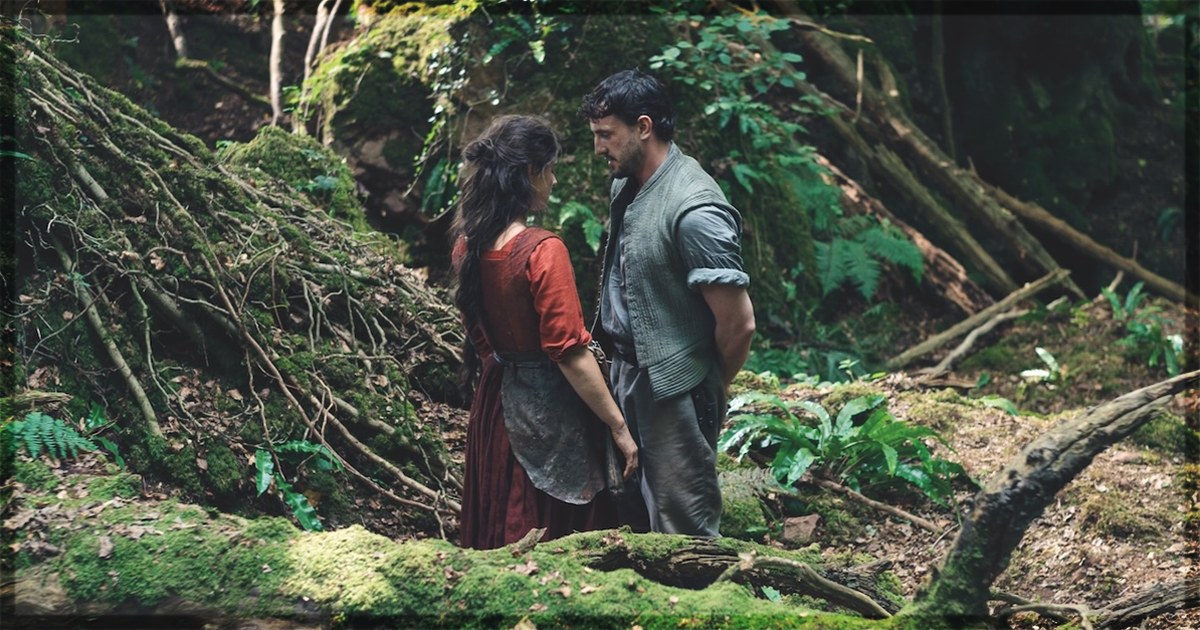
There’s a straight line from Paul Mescal’s beloved introduction in Normal People, where he played a young student of literature who was so incapable of expressing his feelings that he risked his true love with the abused daughter of a wealthy family, to his work here. But whether you know the outlines of Shakespeare’s life or not, his name is not said aloud until the very end. But in a way this does not matter, as the main character of this story is Agnes (Jessie Buckley, more on whom later), who sleeps in the woods, can make medicine from plants and keeps a pet hawk. The Latin tutor hired for her younger half-brothers is enchanted by this wild woman who’s a few years older than him. For Agnes’s part she is deeply impressed by the smart young man, determined to rise above his station, who likes the earthy, hungry parts of her other people try to cover or destroy. Their attraction is mutual, immediate and red hot. Their marriage is begrudgingly allowed when a pregnancy is discovered, though Agnes must talk her brother/legal guardian Bartholomew (Joe Alwyn, the smartest character actor currently working in English-language cinema) into granting permission.
Three children are shortly born, including a set of boy-girl twins while Will is away working in London. Then a decade is skipped until the children, Susanna (Bodhi Rae Breathnach), Hamnet (Jacobi Jupe) and the frail Judith (Olivia Lynes) are as bonny as can be, thriving under their mother’s care and that of their grandmother Mary (Emily Watson, who has never made a bad choice). Of course they are also eager for visits from their beloved father, who teaches them scenes from his plays and eventually builds them the largest house in Stratford; Judith’s health won’t stand life in London. But no idyll lasts forever, and heartrending tragedy strikes despite all of Agnes’s very best efforts.
Ms. Zhao’s previous movie was the misguided superhero extravaganza Eternals, which was at its heart about the consequences of a romantic breakup on a tight-knit family living in England and unprepared for change. And yet that was perfect groundwork for this. At its core Hamnet is about the importance of personal bravery as well as art in times of strife, especially when that strife is personal. Fiona Crombie’s production design makes plain how the hand-built nature of the technology and the times is the perfect home for Agnes’ skills. The eventual emotional distance between Agnes and Will grows not because they don’t have the words to discuss their feelings, but because words are not enough to express the horror of their loss. While Agnes fully accepts Will needs his work in London to sustain him, she also cannot help but rage at him for his absences and the fact his family is not enough.
Malgosia Turzanska’s costumes are an important visual aspect of the film, not least in that Agnes exclusively wears the color red for the first two-thirds of the film. Ms. Buckley does such solid work as a woman who is completely and happily herself, and prepared to defy anyone in order to stay true to herself, that the chance at happiness she found in Will is as much of a surprise to us as it is to her. By the time the twins are born – in a difficult childbirth, shown in full – her feelings are as palpable to us as the palms of our hands. The work Ms. Zhao and Ms. Buckley do to lock us in to how Agnes is feeling is a rare achievement, and it means that her face and her body language carries us the whole rest of the way.
It all builds to a remarkable final sequence of Agnes and Bartholomew in the pit of the Globe Theatre at the world premiere of Hamlet, watching a young actor (Noah Jupe, and the surname situation there is not a coincidence) in the part named after her son. Mr. Mescal does so many of the famous speeches that someone sitting near me at the London Film Festival joked Mr. Shakespeare should have had a co-writing credit, but it’s through those speeches that we understand the full nature of Will’s desperation in his own grief. In case anybody wasn’t paying attention before, it’s plain fact that Mr. Mescal is one of the premiere talents of our own age. But most of all there is a shot by Łukasz Żal, involving Ms. Buckley and several dozen extras, that does nothing less than make the case for the true purpose of any and all art. That is, we want desperately to connect with other people, and if we cannot connect directly with the people around us for whatever reason we will seek out art to meet those needs instead. This is so essential to us that we will pay almost any price. Hamnet is about that price, and how both the price and the journey are utterly worth it. It’s a jewel.
One final thing: Two casting choices of equal importance turned this movie from a provincial gem into one deserving global attention. These are the choice of Irish actors for these English roles, and also the significant use of black extras in the London scenes. Both serve to remind us that history is what we make of it, and that what is hidden is just as important as what is shown.
Hamnet recently played at the London Film Festival.
Learn more about the film at the LFF site for the title.
You might also like…