
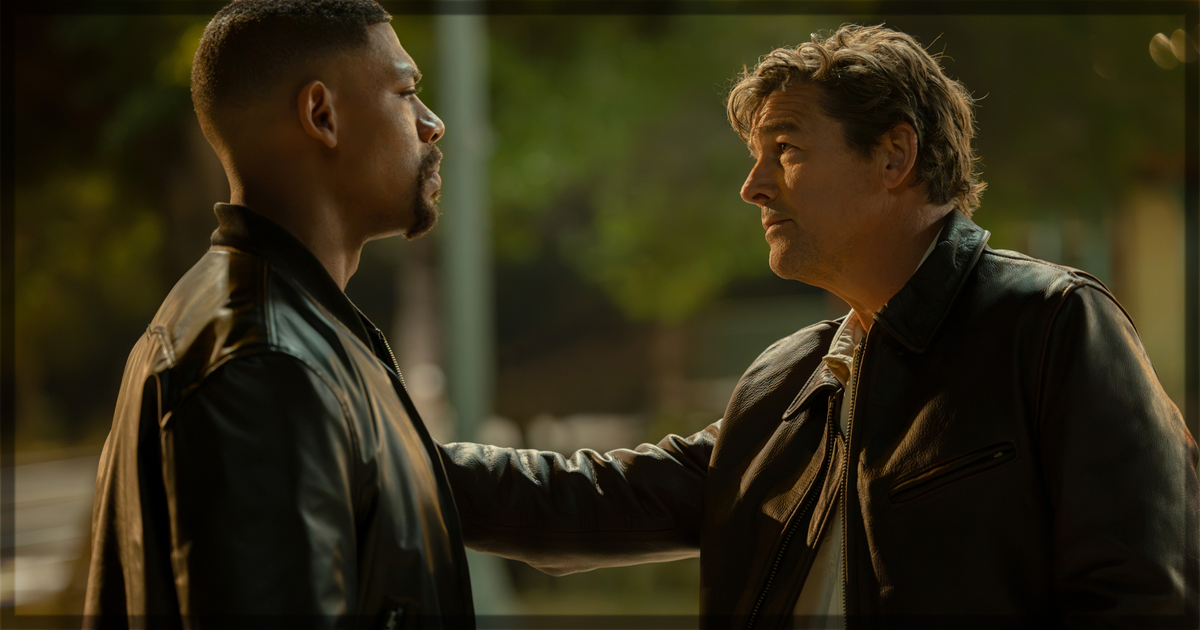
This was a press event sponsored by HBO, hosted by Mallory Rubin from The Ringer, to celebrate the finale of Lanterns, therefore it may contain spoilers. All episodes of Lanterns are available on HBO and HBO Max now. This interview has been edited for clarity and brevity.
Moderator: Hello, everyone. My name is Mallory Rubin from The Ringer, and it is an absolute pleasure to be here with you today to talk about the Lanterns finale, this season of Lanterns. I’m delighted to be here today with Kyle Chandler, who plays Hal Jordan, and Aaron Pierre, who plays John Stewart. Guys, congrats on an awesome finale and an awesome season.
Kyle Chandler/Aaron Pierre: Thank you very much.
The Lanterns Dynamic: Building Hal Jordan and John Stewart’s Emotional Bond
Moderator: I want to open with a question that’s for both of you, and it’s about Lanterns being a love story. Which is what it wound up being, you know, at the end of the day, in a really
deeply moving and affirming way. And by the time we hear Hal and John say “I love you” in the finale, the season has taught them and us as viewers alike that you can’t make progress together if you’re not doing the work individually, but also that you can’t truly better yourself as a person individually without opening yourself up to other people and seeking help from other people. So, I’m curious if that felt true to both of you in a meta sense as performers, both with each other and with the other sterling members of this cast and this ensemble. Aaron, do you want to start?
Aaron Pierre: I think this isn’t a simple question to answer. Or rather, it’s a simple question to answer, but it’s multi-faceted in its answer. And I think, perhaps more broadly first, before I speak about our dynamic, I think what this show does, in my opinion, so beautifully is it highlights us as a global community. And it does so in a way that doesn’t feel like a lecture. It doesn’t feel like you are being imposed upon. I think what it highlights is that our differences and our nuances need not be a point of contention. They can be a point of education. They can be a point of insight. They can be a point of connectivity.
I think Lanterns does that in a way that isn’t didactic, and I think so far as it relates to Kyle and my dynamic, specifically, that’s true as well in the more micro sense. You know, that first one is more macro, how the season engages with that. But I think in a more micro sense, Kyle and I couldn’t be any more different. I think they did that intentionally. You know, Kyle and I are from two different places in the world. We have two very different upbringings, two very different journeys. But what Kyle and I discovered instantly, on a much deeper level throughout the six months that we were filming, is that we have far more in common than anything else, and anything else was just a point of excitement. You know, “Teach me about that, I want to learn about that, what was that like for you, how did that formulate your perspective on this, that, and the third?”
As it is related to the performances, I think that was just imperative. This shoot was 116 days or something like that. You know, these are 12-, 14-, maybe plus, 14-plus-hour days, you know. These are not short days. Yes, the experience, the entire experience was joyful and beautiful, but it required a lot of focus because of the intensity of it, and we needed to be able to be vulnerable with each other. We needed to be able to be completely open and honest very quickly because one of the pillars of this show is our dynamic and our connection as characters and actors. If that fell flat or if that fell short, we were going to be in a lot of trouble.
I think a credit to both of us for being open, to just being so exposed and vulnerable very early on, to be able to access whatever we needed to for these characters within the context of this story. And also, just the icing on the cake was just that we genuinely, sincerely developed a friendship and a closeness and a brotherhood that is not a given in these situations. There are times where that doesn’t happen and you still have to get the work done, and you will get the work done ’cause you’re a professional. But whenever you’re gifted with what we were gifted with, which was a genuine connection and friendship, I mean, it’s just heaven.
Everybody, every single person who had a hand in this show, every single department, from crafty to catering, transportation, wardrobe, lighting, sound, every single department, everyone gave everything. We really were like a football team. We really were like a traveling company. I think it demanded so much of every single department for those six months that we left that first season being like, no matter what happens after this, we are so deeply proud of ourselves and our commitment to this project and we love it. Kyle and I, our faces are in the world as it relates to Lanterns, but there is a village behind us. And without that village, we couldn’t have achieved a fraction of what we did.
Moderator: Kyle, is there anything you want to add on that front?
Kyle Chandler: I don’t think I need to add anything, I think he said it pretty damn well.
I guess I’ll say two things. We were fortunate as two actors to come upon the material that we didn’t have to do much to elevate, and the material was really well-crafted. It was just a joy to do, literally. And the other thing is, after watching it this morning, there’s something that really struck me is the last scene with Aaron and I in the show, because it is like when you win the state championship, tears come to your eye ’cause all the work that you put in, slams into you at one moment on the field, and it happened to me this morning watching it. Saying goodbye to him and the whole thing and all of it, all of it really did compact in just a little shooting star. And I did have to gently wipe away a tear so my wife didn’t make fun of me. But it was like saying goodbye to a lot of old friends and a lot of great memories and a lot of experiences, temporarily until I think about them again.
And the other thing is just real quick, the father/son aspect of this show. I lost my pop when I was 14 and this is just incredible. Hal had that going on with John, that father/son relationship. It became apparent while we were shooting it, and that wisdom and being able to give back a little bit. So that love story is he won my heart over in the end and I was able to do what my father would have done for me.
The Halogram Explained: Timelines, Kerry’s Fate, and Hal Jordan’s Subconscious
Moderator: I want to stay with that for a moment: the relationship that each version of Hal forms with John and how the past informs the present and the future. You know, our primary Hal and the Halogram are ultimately both elemental to the events of the season and the conclusion of the season, and the Halogram is still snarky, still dubious, but he’s less cynical, he’s less jaded. He’s better able to open up, to offer praise, to offer affirmation, and of course we also, you know, we get to see our primary Hal in both the 2016 timeline and the 2026 timeline, where, across in 2026, just mere moments of screen time, we watch him experience a romance, a revelation, a tragedy. We also get to briefly see you embody him earlier in his tenure as Green Lantern, you go through newsreel footage, et cetera. So how rewarding was that for you creatively to get to portray that many different versions of Hal across just eight episodes of a season when, you know, for many actors, you would just hope and dream to get to access that over years and years and years of a show? And what was most crucial for you in making the Halogram and Hal feel like figures who undeniably had a shared past, right? Who had been shaped and molded by the same history, the same relationship with his father, Martin, but had a genuinely distinct present and relationship to John in the present.
Kyle Chandler: I’ll give an example that’ll sum up all of what you said, if I can. I think it’s Hal as a young man going through all those experiences and then finally learning in the end what it’s all about. He could never pluck that string as Hal in the show. But as Halogram, he learned with Hal, and he could pluck the string. That’s how I sort of look at it. Like the two of them were never fully separated, he is his subconscious, so there’s a lot to play with there. This all was seamless because the trust that goes into the material, you don’t have to think too hard on it, you trust the writing, and it worked in this case every time.
And so when Hal says, “What was the last thing that Kerry said to me?” And of course, you know, you know what John says, and then then Hal says, “I love you too.” I mean, that just sums up Hal. It sums up Halogram. It sums up the two meshing together.
When you were talking earlier about the values and the moral compasses of Lanterns, if you will, the goodness in the show, the doing-the-right-thing in the show, it could get very over the top, but they never allowed it to. They just never allowed it to, but there are a lot of good things to be said in the show. There are a lot of good things to be said in the show that I think are, if I may, relevant to today.
John Stewart’s Origin: Why Episode 5 Changes Everything for the Green Lantern
Moderator: I love it. I actually wanted to ask on that front of balance and entwining all of those different elements of the performance, of the experience, of just human evolution. Aaron, I wanted to ask you about that, because, you know, this season, it delves into so many deeply internal and emotional elements. From what we fear to how we’re raised to whether we’re defined by other people or by our own intentions, and it’s a story about choice and consequence and inherited trauma and missteps and second chances and, of course, as we hear so memorably at the end, about not being afraid to be afraid.
I ask this as someone who just genuinely adores the superhero genre. I spend a lot of my time consuming it and thinking about it. But sometimes the need to really spotlight a hero’s strength and mightiness can mean suppressing the elements that might play more tenderly, that might unlock some of the stuff that we’ve been talking about. And Lanterns defies that impulse. So, John, in other words, is a hero who shows us that strength can come in the form of a tear or a hug or a quiet conversation just as well as it can come from firing a bullseye shot. What kind of gift is that for you as an actor, that nuance and that complexity in the character? And what did it mean to you to get to bring not just such a fully realized person but hero to the screen?
Aaron Pierre: I think to call this opportunity to portray John Stewart a gift would be a massive understatement. I said before and, I’m going to repeat it now, that if I had the choice to portray any superhero, I would always choose John Stewart. And Season 1 of Lanterns, among other reasons, but speaking specifically about this season and how, you know, Chris (Mundy) and Damon (Lindelof) and Tom (King) and all of the other creatives molded this and put it together, is one of the key foundational reasons.
John was not born with superpowers. He is just like any of us, yet he is so mighty. And I think that is what appealed to me so much, is the constant opportunity, in portraying him, to excavate his humanity. To explore his flaws, to explore his shortcomings, to explore his learning moments. That’s what is so exciting to me. That’s what energizes me. And I think that’s also what makes audiences resonate with him. And in fact, I think resonate with the entire Lantern Corps so far as it relates to John and Hal and Guy.
I think one of my hopes from the very beginning, when I first got the opportunity to read the pilot, I was like, “I really hope that folks watch this at home and they’re so excited by it that they kind of almost are like, ‘If I can just figure out where to get my own application, maybe I can be a Lantern as well. Maybe I can be part of the Green Lantern Corps.’” I think that’s what it’s about for me. I think what the writers did was amazing.
Episodes 1 to 4, we set the stage, and Episodes 5 to 8, it’s like the game really begins. And one of the greatest challenges for me was that John Stewart really appears from episodes 5 through 8. That’s John Stewart. Episodes 1 to 4, yes, he’s technically John Stewart, but I had to figure out who the man was before he became the man. I had to sort of reverse-engineer him. And that was really challenging as a task, because everything in me, when I’m reading Episodes 1 to 4, you know, as a John Stewart fan myself, I’m going, “Ah, John wouldn’t have that.” But I had to remember that that’s the boy. That’s not the man yet. I had to really lean into that truth and that reality.
Episodes 1 to 4, yes, he’s had a wealth of experience within the context of life: the Marines and being an elite Marine sniper. But in terms of understanding what it is to be a hero, in terms of understanding what it is to be in the business of saving lives on the scale of being in the Green Lantern Corps, he’s green, no pun intended. And I think that was really challenging, but also really rewarding, because when Episode 5 comes along, I felt like John had earned those moments. I felt like he had those moments of confidence, those moments of being sure, assertive, being able to take educated risks. So, I think it was just a massive gift for them to allow me to do that, and it was really fun to do. We had a great time.
Rewatching Lanterns: Hidden Clues in Hal and John’s Key Scenes
Moderator: Thank you for sharing all of that with us. It makes me want to shift here to
one of our pre-submitted questions which hits on a little bit of what you just shared,
Aaron, from your perspective how John evolves over time across the episodes, but
actually from the audience perspective. So, this question comes from Christian Alvaro,
who asks this for both of you. Now that you’ve seen where Hal and John end up in the
finale, is there an earlier scene, either between them or any scene, that carries a
different meaning for you? And what do you hope viewers notice about it on a rewatch?
Aaron Pierre: I think the first thing I want to say is, I’m really excited that people are even considering rewatching it. And I hope they see things that they didn’t see before, ’cause they now have the full context. But I think for me, one of the things I hope that people catch about John Stewart in 1 to 4 is the conception of him understanding how much he has to learn. I think that’s what I hope people catch. John’s superpower, in my opinion, is not being fearless. It’s the ability to acknowledge fear and overcome it. And what I hope people catch is that in 1 to 4, he sort of quietly, quite stoically accepts the fact—maybe he doesn’t articulate it to Hal—but he’s like, “Yeah, I’m not ready for the job yet.” But he leans into it so heavily. He doesn’t lean away from it. He doesn’t lean away from it with arrogance or with delusion. He leans into it and actively searches for ways to become everything he knows he can become, if he just makes himself the student that absorbs versus deflecting when he doesn’t know something.
Moderator: Mm, mm-hm. Kyle, how about you?
Kyle Chandler: Yeah, I don’t know what episode it was, but when John and I are traveling in the car, and we have this long conversation—I think it’s the second time I jump out of the car. Do you know what I’m talking about?
Moderator: Oh, yeah, sure. Yeah.
Kyle Chandler: So, this was a really great, honest moment for me that was very exciting to play. There was none of the wonderful humor I got to do, it was just straight up a real question, a real statement when I said to him, I said, “I really did trust you.” And that moment for me was a different moment in the show, because I made it very real. I really did trust him. And that was kind of a great moment for me to fall back into. It gave me a restart, if you will. And of course, I like the moment that comes at the very end of the show, when I trick him into saying “I love you.” I thought that was just brilliant, that they wrote that for me.
Behind the Scenes of Lanterns: Damon Lindelof’s Collaborative Mystery
Moderator: I wanted to ask you about just the creative team, the hive mind and the overall collaborative group that made the show. Something that Damon Lindelof has talked about a lot over the years is the idea that the most satisfying answer to a question is another person—this is something he says when talking about how he has crafted his own stories. You had the privilege of working with so many wonderful performers and so many brilliant storytellers on this season, you know, from showrunner Chris Mundy and his co-creators, Tom King and Damon Lindelof, to writers like Justin Britt- Gibson and Vanessa Baden Kelly, to directors like Stephen Williams and Geeta Vasant Patel and James Hawes and Alik Sakharov, and just so many others. And I’m curious if there was any sort of creative insight or lesson or idea or worldview from a writer or director or any creative stakeholder in the project in that, “The greatest answer to a mystery is a person” mold that really impacted how you thought about not only making this season of television, but storytelling more broadly.
Kyle Chandler: I’ll just jump in really quick, and I’ll just put one word that encompasses everything that you just came up with—trust. I mean, when a performer can go into a piece with trust, he can do anything, and he can give 110 percent because he’s got that trust. That’s what they imbued us with: trust, kindness, and respect. I experienced this in a few different ways that were very important to me. They imbued that trust and that kindness and that love and that compassion and their intelligence. And, you know, as my dad used to say, they’re good people.
Aaron Pierre: In addition to what Kyle just mentioned, you know, trust being the first thing, this series categorically does not work if I as the actor or Kyle as the actor or any of us as actors make it about ourselves in the scene. Everything had to be about the other person. Otherwise, the whole thing just collapses in on itself, like a cake that you take out of the oven too early.
Both Kyle and I, we’re kind of obsessive with the minutiae of things. But as soon as all of that’s done and that’s sort of absorbed by osmosis or what have you, then everything had to be about Kyle. And then for Kyle, everything had to be about me, or whoever we were in the scene with, Kelly or Nathan. And all of a sudden, it becomes so much more interesting, because it’s not inwardly focused.
How Lanterns Tackles Identity, Culture, and Modern American Divisions
Moderator: I love that. Aaron, this next question from our pre-submitted questions is
for you. This one is from Anaïs Bordages, who asks, like Watchmen, this show is a story about Black identity and political divisions in America. In your opinion, what makes Lanterns and superhero stories more broadly, particularly suited to exploring such themes?
Aaron Pierre: Hm. I don’t want to speak on any other superhero piece. I want to speak specifically about Lanterns. I think it goes back to the answer I gave to the first question. I think Lanterns, as a creative team, what they did so beautifully and so masterfully is they created conversation. They created critical conversation, they created necessary conversation, and they give insight. They give insight to a number of perspectives, whether that’s John’s perspective, whether that’s Hal’s perspective. They give insight into a particular experience.
And I think that does two things at the same time. It allows people whose experience that is, they feel seen, they feel heard, they feel understood, they feel respected. And to those whose experience it isn’t, it gives a number of beautiful access points to be able to empathize with it, to be able to understand it a little more. I think that happens for both characters throughout the season, and I think that’s what’s so special about the writers who came together to do this. They did it in a way that it didn’t feel like they were imposing themselves on anybody. It felt like an invitation to a conversation.
Moderator: It’s just incredibly thoughtful, both of you, about the characters in the show. I think that thought and care is part of why people have responded so strongly to the season. A huge thank you to Kyle and to Aaron for your answers and your insights, and congrats again on the finale.
The Lanterns is now streaming on HBO Max.
Learn more about the show at the IMDB site for the title.
You might also like….
‘Ted Lasso’ Season 4 Review: A Rocky, Redeeming Return