
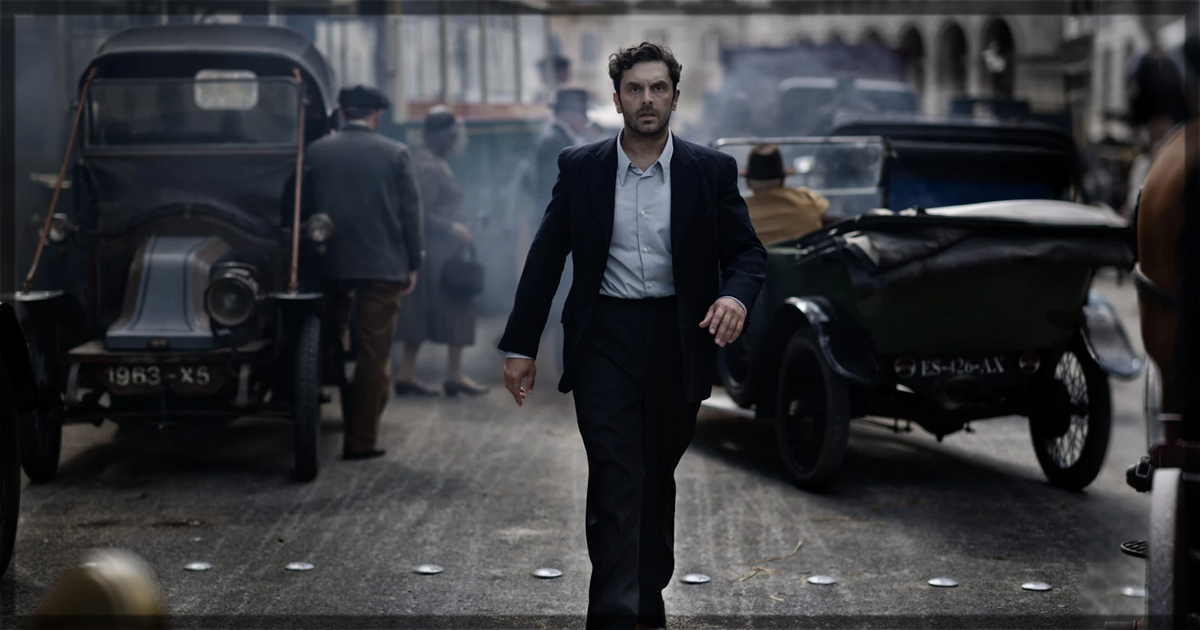
The Cannes Film Festival normally chooses a lighthearted French movie as its opener, mainly to celebrate the kind of movie that doesn’t always get its due. Tragedy can be very easy to make, but comedy – especially romantic comedy – is tough. You need great control over mood, you need actors willing to do the kind of work that is well-loved by audiences but rarely results in awards, and you need stakes that are real, but not too high. La Vénus Électrique (whose English-language title is The Electric Kiss) gave itself a further layer of difficulty: it is a period piece. But it is also a celebration of everything good about French culture built around two complex performances by Pio Marmaï and Anaïs Demoustier. And, in a really sweet touch that isn’t in movies enough, the heroine has a best friend to discuss all her adventures with. If you are looking for a lighthearted grown-up romance about the power of art and the power of love, look no further.
It’s the late 1920s and Suzanne (Ms. Demoustier) works in a carnival beginning a long stay on the outskirts of Paris. She is the “Electric Venus” – a woman who stands on a plate between two static-electricity balls and manipulates the charges with her hands. This is the same job that Rooney Mara had in Nightmare Alley a few years ago, but Suzanne is French. That means her gimmick is that men from the audience pay 30 centimes to kiss her so as to share in the electric shock running through her body. Hard work for sure: offstage she always wears fingerless gloves to hide the burn marks on her palms, and her hawker Titus (Gustave Kervern) charges so much for room and board she’s essentially indentured to the carnival. One night Suzanne sneaks into the clairvoyant Claudia’s wagon for a hit from her hidden cache of opium, and is surprised there by a very drunk, very upset man begging to speak with his dead wife Irène. He offers a 10-franc note, paper money and more than Suzanne earns in a week, so of course she obliges.
A rummage through his pockets reveals his name is Antoine (Mr. Marmaï, more on whom later). He is so desperate for comfort that the platitudes Suzanne-as-Claudia spouts actually calm him down. They agree to meet again, at his large and lovely house in Montmartre, where it becomes apparent Antoine is a painter of some renown. When his gallerist Armand (Gilles Lellouche) discovers that whatever Suzanne-as-Claudia is doing has gotten Antoine painting again, he does her a deal. If Suzanne gets Antoine to paint enough for Armand to put together a show, Armand will pay Suzanne commission. The commission will be enough for Suzanne to pay off Titus and leave the carnival, so of course she accepts, and begins to see Antoine regularly. But when a rummage through Antoine’s house leads Suzanne to find Irène’s (Vimala Pons) diaries, things change in more ways than one.
For one thing, Suzanne is best friends with carnival strongwoman Camille (Madeleine Baudot), so they read the diaries together. They start thinking of Irène as a friend, become big admirers of her courage and talent, and are enchanted by her romantic adventures. For Irène was much more than an artist’s model, and in fact took this work so she could study different painting techniques up close. Irène first meets a buck-naked Antoine secretly improving a painting for which he is posing. (Because they are French, she compliments his buttocks, for which he thanks her without embarrassment.) Her coaching of Antoine makes him a better painter still, which he is thrilled about instead of threatened by. In the present Antoine remains so grief-stricken he is suicidal, but what Suzanne says when she pretends to channel Irène gets through to him. He stops drinking, starts practicing self-care, and starts getting excited about his art again. The ways Suzanne uses the secrets from Irène’s diaries to help Antoine feel better feels an awful lot like therapy, which had of course not quite been invented yet. And it’s hard to convey in this description than none of the manipulations here feel exploitative. Right on the line, but never once over it.
This is because of the emphasis on physical comedy, and how fast Suzanne must think to keep Antoine believing in her without ever hurting him. Ms. Demoustier must use every ounce of her charm to make Suzanne’s desperation to keep Antoine alive and working amusing instead of cruel. The fact her sessions rely on white contact lenses which effectively blind her is also a fine source of physical comedy, especially when the camera shifts to show things from this point of view. Mr. Lellouche, as the wealthiest man here, is also the kindest, who provides a sincerity to all his manipulations. When he says he’s only trying to act in his friend’s best interests, we believe him. Armand also walks with a cane thanks to losing a leg in the war, and when he mentions he’s lost too many people to be haunted his tone keeps the sad past present without being overwhelming. Ms. Pons has the difficult job of building a character through other people’s memories as well as their interpretations of Irène’s diaries, but does this with a guarded consideration that hides an enormous intelligence. The ways in which she uses her physicality to joke about her modelling is also deeply charming, especially in the scene when Armand compliments a painting without realising Irène is the model in it he so admires.
But the movie belongs to Mr. Marmaï. His speciality is playing gruffly macho types with a surprisingly tender core. Antoine’s drunken sobbing at the start is so sincere Suzanne faking that first séance becomes an act of kindness. If Mr. Marmaï didn’t get that tone exactly right the whole movie would be sunk. The scene in which Antoine and Irène argue over a sketch Antoine is doing of Armand, complete with competing instructions as to how Armand should pose, contains tight physical comedy within the ugly row. When Antoine was a struggling artist, he loved having Irène boss him around, but when her guidance brought him success he forgot how much of it was owed to her. Mr. Marmaï makes Antoine’s desperation valiant instead of pathetic, his remorse over his mistakes sincere instead of self-serving, and his willingness to use his body for cash a noble compromise to benefit his art instead of sordid. What’s more, I can’t remember another movie in which the lead actor cries this much. Mr. Marmaï’s performance here is physically brave, emotionally bold and incredibly appealing. It won’t win awards, but it is moving the needle for how men can appear in movies, and that’s unbelievably valuable.
Is The Electric Kiss perfect? No. Julien Poupard’s cinematographer must maintain a golden hue at all times to ensure the mood is literally light, Camille Bazbaz’s music veers dangerously close to circus stereotypes for comfort, and the pacing of the final third is awful. But watching Ms. Demoustier and Mr. Marmaï worry about the attraction each is secretly developing for the other remains more than worth the price of admission. The Electric Kiss has just the right power to completely enchant you.
Two final things: director Pierre Salvadori was scowling so hard on the Cannes opening night red carpet (presumably from nerves) that Jane Fonda, from the stage as she opened the festival, signed to him that he needed to SMILE. And two years ago Mr. Marmaï and Ms. Pons played another married couple in The Ties That Bind Us, one of my favourite movies of the last ten years.
La Vénus Électrique (The Electric Kiss) recently premiered at the Cannes Film Festival.
Learn more about the film at the IMDB site for the title.
You might also like…
‘Dua’ Shows What War Feels Like for a Girl (Cannes 2026 Film Review)