
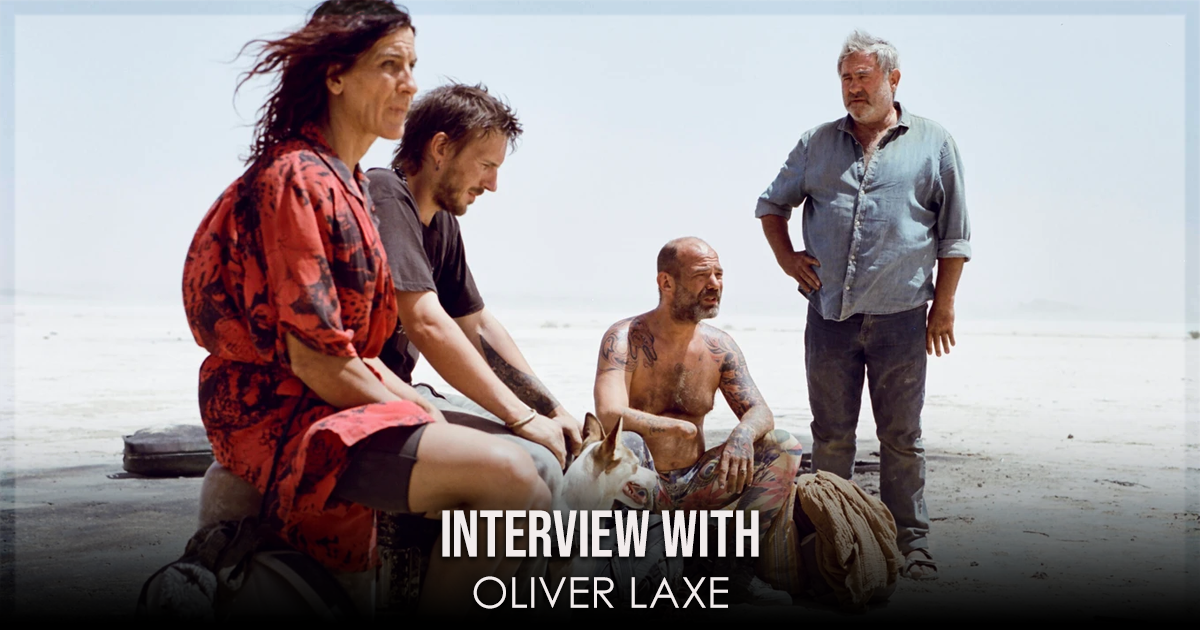
In this year’s Cannes Film Festival, a post-screening reaction surprised tons of cinephiles following the festival’s attendees. Despite premiering after a veteran French filmmaker, Dominik Moll, with his Case 137, the most talked-about film of the second day of the festival was Sirât by the French-Spanish director, Oliver Laxe. In his fourth full-length project, Laxe finally appeared at the competition of the central film festival. All of his previous projects were Cannes-bound. You Are All Captains was at the Quinzaine des Cinéastes, Mimosas at the Semaine de la Critique, and O Que Arde at the Un Certain Regard, the second most prestigious selection of the festival. Consequently, Sirât shared the jury prize with Mascha Schilinski’s Sound of Falling, got acquired by NEON, and got a qualifying release in late November.
Sirât is the journey of a father, Luis (Sergí López), who drives from Spain to Morocco to find his disappeared daughter. He and his younger son, Esteban (Bruno Núñez), drive throughout the raves in the desert looking for her. However, a large-scale war breaks out, and Luis joins a group of ravers thirsty for more dancing. Shot on 16mm Kodak film in the desert, Sirât combines the outstanding visual work of Mauro Herce, who imprints a grainy texture to the temperature of the scalding sands, with the sonic, bouncy musical textures of Kanding Ray’s score. Thus, Oliver Laxe materializes the hellish sentiment of the uncertainty of the destiny of a loved one throughout the sonic and visual violence of his world.
Several weeks ago, Movies We Texted About had the honor to talk to the director of Sirât, Oliver Laxe, in an exclusive interview on Zoom. Read our conversation with him below:
The Interview with Oliver Laxe of Sirât
Oliver Laxe: Hey, Olá, Pedro!
Pedro Lima: Olá, Oliver. I’m Pedro from Brazil. So thank you so much for talking to me. When we are discussing 2025 films, Sirât is already a remarkable project. When you think about Si, you already picture the landscapes of the desert. So could you tell me about how was the process to scout these locations? Because I think the desert became a really iconic scenario. And how was you filming such an adverse environment?
Oliver Laxe: I don’t know if you know Pedro, but I was living in Morocco for 10, 12 years, and after making, when I was making mimosa, I was living at the door of the desert there. So I mean, it is a country that I really know the places, the locations.
Pedro Lima: It’s like home.
Oliver Laxe: Yeah. And I don’t know, I think there are two things. The mountain is a wounded landscape. You know?
Pedro Lima: Yeah.
Oliver Laxe: You feel you are small, you feel your fragility, and it’s powerful. This, I mean, that gave me serenity, and I like it. And the desert is a space for abstraction. The mountain is existentialist, and the desert is more metaphysical, more transcendental. So yes, and I mean, it was difficult to shoot it, but I don’t understand this profession without difficulties, this work. I think it has to be difficult. I mean, you have to suffer doing it if you want that we feel something, Sirât, I mean, in a subtle way it’s really connected with the wound, with the pain of this war. There is something in the images that is there because we weren’t through our limits.
Pedro Lima: Yeah, I completely agree. I think it’s a film about pain and the effects of violence on people in multiple levels. Not only the physical violence, but also psychological, sonic violence, all these sort of violences that affect people.
Oliver Laxe: It’s shock therapy.
Pedro Lima: Yeah, I like this definition of it.
Pedro Lima: And also another element that I like a lot of the film, and actually across your whole career, is because you shoot your projects on film. And I think it’s really powerful to do that in nowadays that digital is the central format. And what difference does it make for you to shoot on film, and how the 16 millimeter Kodak film helped you capture these particular textures of the desert?
Oliver Laxe: Cinema is about alchemy. We are making, I mean, the relation between an image on a cinema, on this temple, and the spectator is magic. Something happened, and an image has a lot of layers. It’s really a complex thing. So the human being is chemistry. So you can’t penetrate chemistry with pixels. Yeah. I mean, I don’t have pixels in my body. I have chemistry. So film is a chemistry that penetrates another chemistry, obviously it’s a DCP, so it’s pixels, but it’s different. It’s still different. Obviously, there are digital images that also penetrate human metabolism, but not in the same way. So that’s why I keep shooting on film. I never did a film, never in digital. It’s something that is a red line for me. I mean, yeah.
Pedro Lima: And you plan to continue shooting on film, and that’s how you do it?
Oliver Laxe: Yes, I will.
Pedro Lima: Muito Obrigado, Oliver. Thank you so much!
Oliver Laxe: Obrigado.
Sirât is available to stream on Apple TV.
Learn more about the film at the IMDB site for the title.
You might also like…

‘Sirât’ Film Review: Oliver Laxe’s Unusual Triumph