
Julian Glander longs for a slow day. Like Billy 5000, the brooding teenager hustling for cash through a food-on-demand app, who’s at the center of his feature directorial debut Boys Go to Jupiter, the director has been on the grind lately, promoting the theatrical release of the neon-tinged animated musical, which had its world premiere at last year’s Tribeca Film Festival and was later acquired for distribution by Cartuna and Irony Point.
The absurdist coming-of-age picture has a curious provenance. At a pool party some X years ago, Glander lied to a filmmaker friend, who at the time just had a successful feature debut at South by Southwest, about a script he never had. That friend asked for a copy of the script, so he sped it up for about a month for the former to read. The story itself is a fictionalized version of a paywalled New York Times article about a family-run citrus juice business called Natalie’s Orchid Island Juice Company, which began in the 1990s and survived “the second-generation curse,” business parlance for family-owned companies failing to establish a solid succession. Glander bloated the narrative because he only read the article’s first paragraph.
Created entirely in Blender, an open-source 3D software, what follows is a lo-fi and surreal comedy about today’s hustle culture and working-class anxiety set in a Floridian suburb — a world bursting with color and whimsy, and casually interrupted by adorable alien creatures. Boys Go to Jupiter continues Glander’s visual palette first exhibited in his previous shorts, which are mostly around one to three minutes. It is the kind of movie that makes a quintessential sleeper hit: micro-budget but daringly inventive.
After the film opened in select theaters on August 8, I spoke to Glander about embracing the musical format for his first-time feature, Florida, slow days, the gig economy, animation constraints, and casting his actors over Instagram DMs.
The Interview with Julian Glander of Boys Go to Jupiter
[Editor’s Note: This interview has been lightly edited for clarity.]
Lé Baltar: Can you speak about the impulse to lean on an animated musical with this movie? Has it always been the vision you had for your debut feature?
Julian Glander: I just really love the musical format — it’s a completely acceptable mainstream genre where the most surreal, non-narrative things can happen. My favorite musicals are ones with a specific sonic palette that matches the content of the movie. I think about Grease a lot and the very campy 1950s sound that they developed for that movie, and I think BGTJ has a similar thing going. Also, 30-year-olds playing high schoolers.
Lé Baltar: Do you think your previous shorts, from Bloop’s Birthday (2017) to Working Myself Into a Puddle (2024), influence this kind of offbeat, absurd visual grammar the film boasts despite its vibrant, bubblegum aesthetic?
Julian Glander: For me the only way to learn how to do a project like this was to do small ones and keep working my way up, from 2 minutes to 10 minutes to 90 minutes. I think one thing all of the shorts have in common with this feature is the way they look at the beauty and brutality of the world — like, life is very hard and demanding but there is a ton of beauty to be found in the mundane things around us. The vibrant aesthetic is one way to sell that.
Lé Baltar: What was it about the gig and grind culture as sustained by the capitalist structure that made it a fitting narrative focus for the film? On a personal level, is hustle culture something you consider a lived experience?
Julian Glander: I’ve been a freelance illustrator/animator for more than a decade and have felt the shift to the gig economy as acutely as everyone else. I really used to tell myself that I was my own boss, but the truth is, everyone in the world is my boss. Anyone with a little bit of money can email me and completely take over my life on-demand. It’s funny how excited we all were about the gig economy, it was supposed to make us all rich and free and I think the bubbly consumer-friendly marketing aesthetic was a big part of that.
Lé Baltar: What about Florida as the movie’s setting? What drew you to its milieu?
Julian Glander: I lived outside Tampa as a teenager and I guess I am still haunted by it. It is truly the weirdest place there is. I had originally wanted the movie to take place on an alien planet but it became undeniable that Florida is weirder.
Lé Baltar: Can you talk about the actual animation process? How big was your crew, and how long did the completion take?
Julian Glander: Tiny crew. It was me and my producer Peisin Yang Lazo wearing most of the hats. Two other animators came in for some of the character animation. We worked really scrappy, and they were long days, and it took about a year to complete animation. All made possible because of the great and now world-famous software known as Blender.
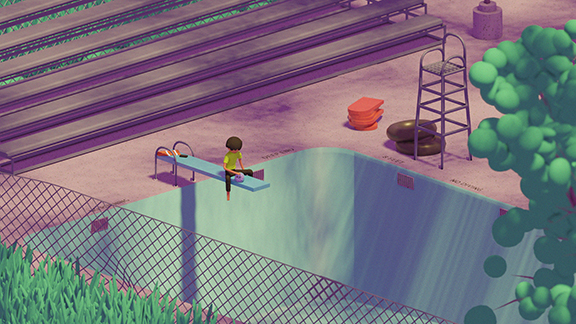
Lé Baltar: Given your animation style, is movement particularly a challenge? How did you work around that?
Julian Glander: It’s true for any animator that character movement is an expensive and time-consuming part of the process. Keen observers will note that almost none of the characters walk in the movie. Creatively this was a fun challenge that actually led to some better results for the story. The way the main character floats around on a hoverboard is technically easier to animate but also is a better sell for his character as this ghostly, lost person floating through the world.
Lé Baltar: The music, which I think propels the film’s emotional spirit, shifts between achingly warm and electronically propulsive. It also recalls the kind of sound specific to the early 2000s. Did you have any sort of guide in terms of the film’s music, and how did you marry that with the sound design?
Julian Glander: The question we had was, what kind of music would a 16-year-old boy make on his laptop in the garage? What does a long and empty day sound like, especially when you’re kind of looking back and half-remembering it? The fuzzy, dreamy electronic sound of the movie came out of that line of thinking.
Lé Baltar: The voice acting is another highlight in the movie in a way that everybody is seemingly hyper-aware of this particular blend of no-nonsense vibe, silliness, and chronically online swagger for the whole thing to work. Can you share more about your collaboration with the cast? I learned that most of the casting was done via Instagram DMs.
Julian Glander: We got very lucky, but yes I basically reached out to the whole cast on Instagram. It was just a long list of people I really admired who I thought would be drawn to the material. The whole script is written around Jack Corbett. I really liked his TikToks for NPR where he talks about economics as this pervasive cultural force that’s all around us and seeps into every element of our lives.
Lé Baltar: The delightful ability of the movie to capture the monotonous allure of slow days, whether in Florida or elsewhere, is I think one of its primary draws. So, I wonder, what are you slow days like?
Julian Glander: I would love to get a slow day. It’s been very busy lately and I’m trying to savor that while also looking forward to a bit of a cooldown. For me, a good slow day has a little bit of gardening, a swim, and I love to luxuriously spend 4-5 hours cooking a nice dinner. A bad slow day is me looking at my phone all day and I do have a lot of those.
Lé Baltar: Anything new you’re working on at the moment?
Julian Glander: I just moved to a new house and I’ve been setting up a new garden. I’m superstitious about announcing my big creative projects though so that’s all you’ll get out of me.
Boys Go to Jupiter is now playing in limited theaters.
Learn more about the film at the IMDB site for the title.
You might also like…