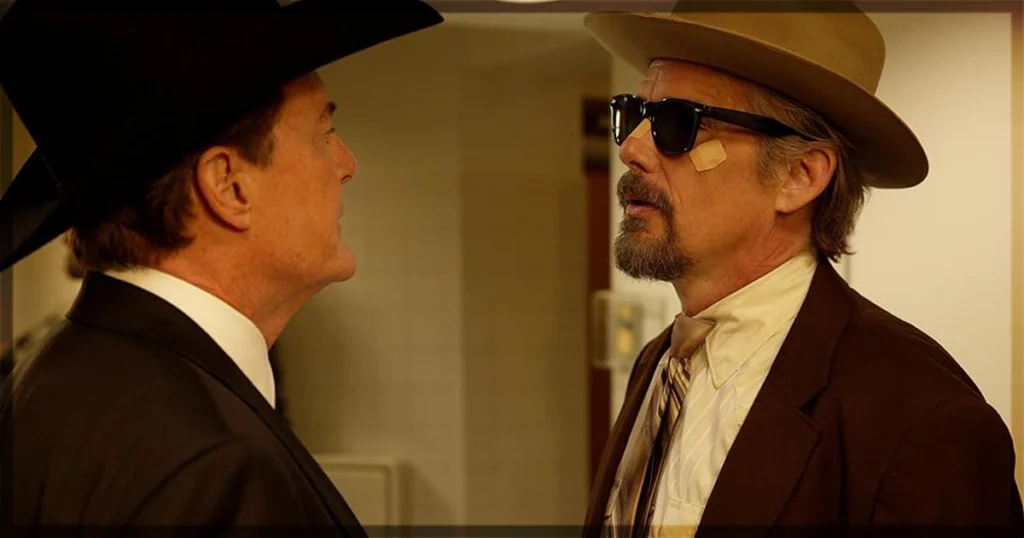
Based on James McBride’s award-winning novel, the 2020 Showtime miniseries The Good Lord Bird takes an uproariously irreverent approach to some of the most tumultuous times in United States history – namely, militant abolitionist John Brown and his 1859 raid on the US military armoury at Harper’s Ferry, events that lead to his death and added fuel to the eventual fire of the US Civil War. “All of this is true,” on-screen text proclaims at the start of each episode. And then, the knowing kicker: “Most of it happened.”
The Good Lord Bird follows Henry Shackleton (Joshua Caleb Johnson), a young enslaved man in 1850s Kansas territory who, early in the show’s opening episode, is unexpectedly freed in the chaos of a shoot-out. Since its opening to settlement in 1854, a move that functionally repealed the 1820 Missouri Compromise limiting slavery’s expansion in the Union, “Bleeding Kansas” had become a hotbed of pro- and anti-slavery advocacy. As both factions tried to culturally and economically settle the territory, their forces often clashed violently.
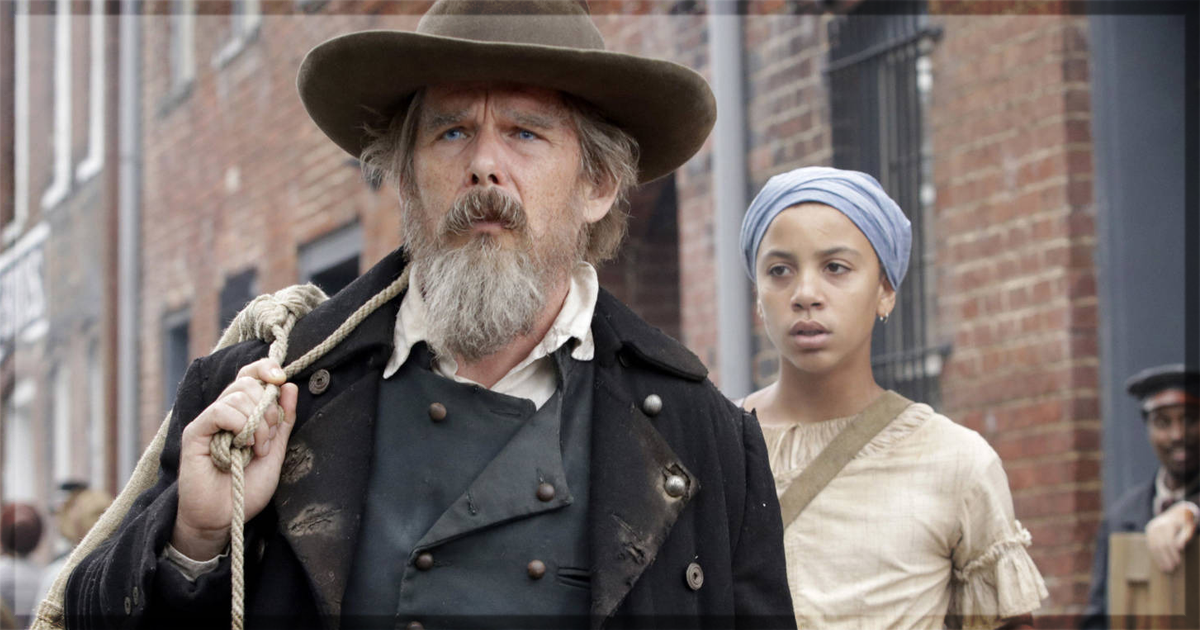
This is the backdrop against which Henry finds his father killed and himself liberated, ending up in the company of John Brown (Ethan Hawke) alongside his ragtag band of vigilantes, five among them Brown’s sons. Mishearing Henry’s name, Brown takes him for a girl, giving him a dress and calling him “Henrietta” – or merely, “Little Onion” after he devours an old vegetable. Henry, suddenly thrust into these chaotic circumstances, sees “Onion” as a good role to play to lay low and figure out his next moves. Unfortunately for everyone, Brown’s holy quest to rid the United States of slavery puts him squarely in the public eye, on a collision course with government forces, and marching inexorably towards Harper’s Ferry.
Mixing factual figures (Brown, much of his crew, Frederick Douglass, Harriet Tubman) with fictional characters (Henry and his friends, including fellow sceptical participant Bob), The Good Lord Bird develops into a riotously funny, surprisingly tender, and terrifically moving portrait of history’s big and little actors. While facing the nation’s original sin head on in ways that echo with today’s greatest social challenges, The Good Lord Bird’s power is not in its continued relevance but in its storytelling prowess.
Portrayals of Brown have varied widely in the decades and centuries since his execution in 1859 (James W. Loewen’s Lies My Teacher Told Me offers a comprehensive overview of how his descriptors say more about the national mood than his true character and actions). Brown, eulogised in quasi-hagiography by antebellum Northern authors, then written off as a zealot and madman through Reconstruction and the early 20th century, now remembered in his own eloquent words as a difficult man of principle post-Civil Rights movement, remains a lightning rod of public opinion (to this reviewer, Brown is America’s only valid white boy). As a work of fiction, The Good Lord Bird doesn’t purport to be a biography, and some may not gel with the eccentricity of this portrayal; Brown is quick to evangelise, at home in nature, and prone to long prayers while the food grows cold. However, there is no denying that Hawke’s performance is electric, capturing a man wholly committed to his righteous cause but still very much of the world and able to be shocked by its beauty and cruelty. There are few actors today with the gravitas to find the man amidst the legend, and Hawke is foremost among them.
Johnson, credited with an “introducing” in the fantastic animated opening title sequence, goes toe-to-toe with Hawke; While Henry is young and in many ways naive, he already knows too much of life from his enslaved years, and Johnson journeys through Henry’s cynicism and scepticism alongside moments of joy and discoveries both wondrous and highly inconvenient. It is an extraordinary coming-of-age journey portrayed with heart, wry humour, and more than a bit of poignancy.
The Good Lord Bird addresses history’s complications through this same combination of sincerity, humour, and pathos. There are wry looks at the dubious efficacy of well-meaning white people, tragic inevitabilities, horrible (and sometimes just plain stupid) mistakes, and tiny moments of kindness that make the whole precarious enterprise worthwhile. What comes to the fore is a sympathetic semi-revised history of Brown and his actions and a clear middle finger held up to Lost Cause mythology. As is the case with many a tale based on true events, the conclusion is evident from the start; the value in retelling is not in the surprise but in what looking at these events through a new lens tells us about the stories we take for granted. Add in a splendid folk- and spirituals-inspired soundtrack and terrific atmospheric film editing and this is living, breathing, storytelling that evokes the now, not the past.
The title of The Good Lord Bird refers to a beautiful black, white, and red woodpecker whose sighting is supposed to bring good luck. The puppet created for this bird looks remarkably like an ivory-billed woodpecker, not seen in the United States since 1944 and likely now extinct (though not officially declared so as of 2026). Henry is told by Brown’s son Frederick that these birds are harbingers of good fortune, and killing one could spell doom without proper atonement. As the miniseries reveals new character depths, every life becomes that rare, strange, and brilliant.
The releases of some truly great films and television series were, to put it mildly, somewhat hampered by world events in 2020; if The Good Lord Bird had come out a year earlier or later, it may have reached a wider audience. As it is, however, it is more than worth catching up on – not least due to Hawke’s recent time in the Oscars limelight and his excellent work on Hulu’s recent The Lowdown (where, incidentally, he plays a man antagonising white nationalist leaders by singing a rousing verse of “John Brown’s Body”). Brown’s story is already one for the ages; it feels right that this raucous seven-episode true fiction gives him a new life in the 21st century.
The Good Lord Bird is now streaming on Paramount+.
Learn more about the miniseries at the IMDB site for the title.
You might also like…