
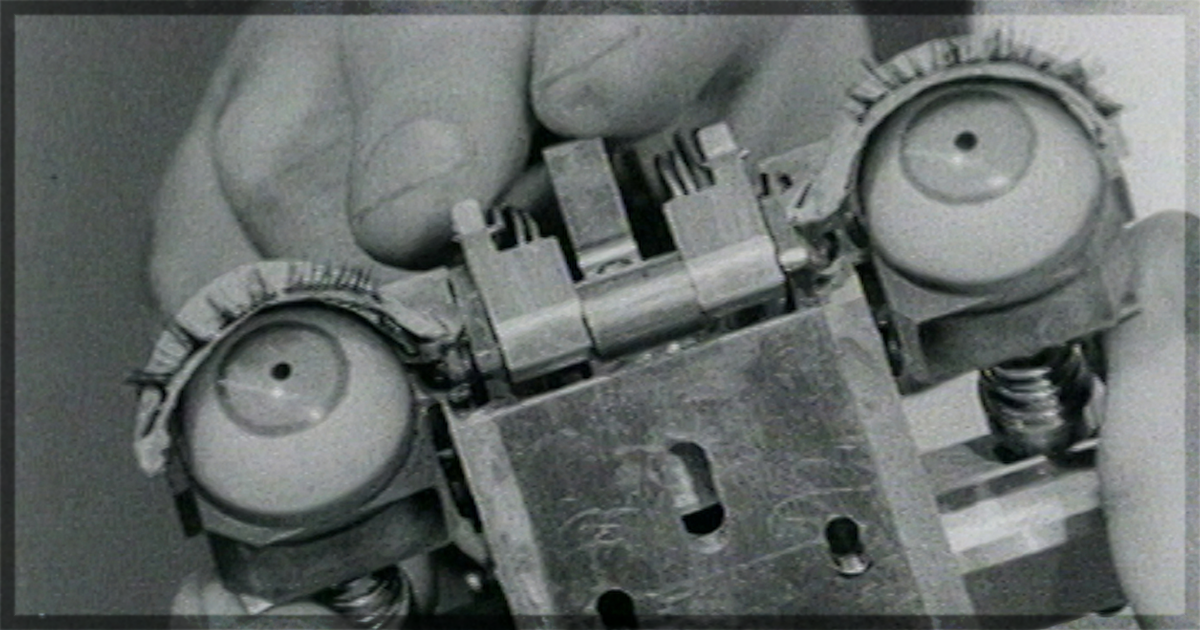
It’s very normal for documentaries to begin and end with copious lists of the various production companies who have contributed to or enabled its making. As director Valerie Veatch pointed out in her Sundance Film Festival Q&A, Ghost in the Machine has none of these. She had to fund the movie entirely by herself. This is something of a surprise since she is not a first-time director, the documentary has a surefire concept and the whole thing is brilliantly constructed, but thanks to its subject matter not a surprise. For what Ghost in the Machine does is demonstrate, disgusting step by disgusting step, how the entire premise of artificial intelligence is based on eugenics and white supremacy.
This is done through a mix of talking-head interviews with approximately forty academics and journalists who have made the various aspects of artificial intelligence their speciality, interspersed with two things. The first is recorded interviews with people like Sam Altman, Elon Musk and others about their shifting plans to use and profit from artificial intelligence. There’s even footage from the 1970s of the academic John McCarthy, who coined the phrase artificial intelligence in the 1950s, explaining that it was originally just a noisy phrase designed to help him and his colleagues get a grant. There are also interviews with the English-speaking workers in Kenya who are some of the hidden workers behind the allegedly artificial programs, one of whom, Kings Korodi says, “It tears the veil of what makes you to be human.” Considering the recent admission by the CEO that Waymo cars, allegedly self-driving, are controlled by workers in the Philippines, the facts have to be believed. The vast impression made is that artificial intelligence companies are designed to exploit both their employees and their service users for their own selfish purposes.
And sometimes, under people describing how artificial intelligence is used, we see brief filler footage generated by AI. It’s very clearly labelled (and everything not AI is labelled as well), so Ms. Veatch can emphasize through their disquieting inaccuracy how obvious it is that the systems are nothing more than their programming. We can feel the uncanny valley, we know when something is wrong, and the reason we are being pushed to give up our own judgement about artificial intelligence is because it is inhuman, and we are not. During all this the various academics explain how things have come to this point: starting from the very invention of the field of statistics during the 1880s, the entire field was designed by racists to enshrine the superiority of white people. And because statistics are easily fed into a machine, these resources became the bedrock of all machine learning which has followed. Perhaps the people who chose to do that were unaware that racism was the ‘ghost in the machine’ from the very beginning. Or they didn’t understand its impact. Or they did but didn’t think it would be an issue. Or they knew, and this was the goal all along. The ongoing distortions of our humanity are incredibly disturbing, in a way that’s tough to think about. And yet the case Ghost in the Machine makes for its thesis is undeniable and very persuasive.
And yet it’s troubling to consider, since it’s very unpleasant to believe that entire swathes of people throughout history could be so indifferent to the humanity of others in order to enshrine their own power. It seems this is a lesson we have to learn time and time again. Unfortunately there’s a further case to be made that, due to the climate impact and water issues use of AI creates, this topic is one of the most urgent humanity as a whole is currently facing. The final section of Ghost in the Machine consists of pleas from many of the experts to remember that we all have our own human agency, and regardless of what the salesmen keep telling us we can control how or if this technology is used. The final word is given to Dr. Johnathan Flowers, a philosophy professor in California and expert in how race and disability issues apply to machine learning, who says he does not see what artificial intelligence adds value to humanity.
But the best possible case for the pointlessness of AI is the backgrounds of the video calls. Almost all of the talking heads spoke from their home offices, which are decorated in their own style and fashion. Bookshelves, plants, artworks of great subtlety or really eye-catching ones, anime figurines, and family photos make it plain: no inhuman intelligence can come close to guessing the unpredictability and the beautiful joy of just one human mind. Anyone who tells you differently is trying to colonise your mind for themselves. Ghost in the Machine might be the very rare documentary that’s too hot to handle, but any human who is trying to figure out artificial intelligence for themselves should take a look.
Ghost in the Machine recently played at the Sundance Film Festival.
Learn more about the film at the Sundance site for the title.
You might also like…
‘Jaripeo’ Documentary – The Film Unveils a Previously Hidden Queer Experience