
In the Brazilian cinema history, there are classic examples of road trip films. One of them is Iracema by Jorge Bodansky and Orlando Senna, a time capsule on the Northern region of the country during the military dictatorship. Regionally, a landmark of the sensorial cinema in the country is Viajo Porque Preciso, Volto Porque Te Amo (I Travel Because I Have To, I Come Back Because I Love) by Karim Aïnouz and Marcelo Gomes, two directors from Ceará, in the Northeastern of Brazil. Those films present different approaches to their themes and formal displays of the cinematic form. Another film added to this list of road trips that present a new, fascinating element to local cinema is the debut feature by Janaína Marques Ribeiro, Fiz Um Foguete Imaginando que Você Vinha (I Built a Rocket Imagining Your Arrival). The film is a selection of the Forum section, which seeks projects that propose something new to the cinematic form and its conventions.
In the feature by Marques Ribeiro, we follow Rosa (Veronica Cavalcanti). She is doing some lab work for her doctor, and during the MRI scan, the technician instructs her: “Lie down, relax, and think about a happy moment.” Rosa’s mind takes her on an adventure with her mother, Dalva (Luciana Souza), a woman who spent years in jail because she allegedly murdered her partner. Rosa and her mother rob a car, steal from a gas station, and wander throughout the roads of Ceará. Still, this trip does not follow the conventional path from place A to place B. They stop at a simple motel on the road, get a lift from a deliveryman riding a horse, and travel on the brink of time, even if there is no logic in their trip or the people they meet on the highway.
Unlike the usual road trip movie, Fiz Um Foguete Imaginando que Você Vinha focuses more on the characters’ conversations and the reminder of each event than on the final destination, per se. In this sense, Rosa tells her mother that they need to go to the house of their friend. Yet, the crossways leading there are not linear. Structurally, the director draws on the imagination setting to explore a fantasy element in each new place that Rosa arrives at. There is no realistic or credible anchor to that character because everything is a representation of her brain’s imagery. The filmmaker even emulates her Cloud Atlas moments, evoking the cinematic possibilities like a travel machine, characters who move from the roads to the dunes in a cut. The central organization of the film is the emotional chord that Rosa has to the memories of her mother, and those events are the utmost desire of living to the maximum with the person who gave birth to her.
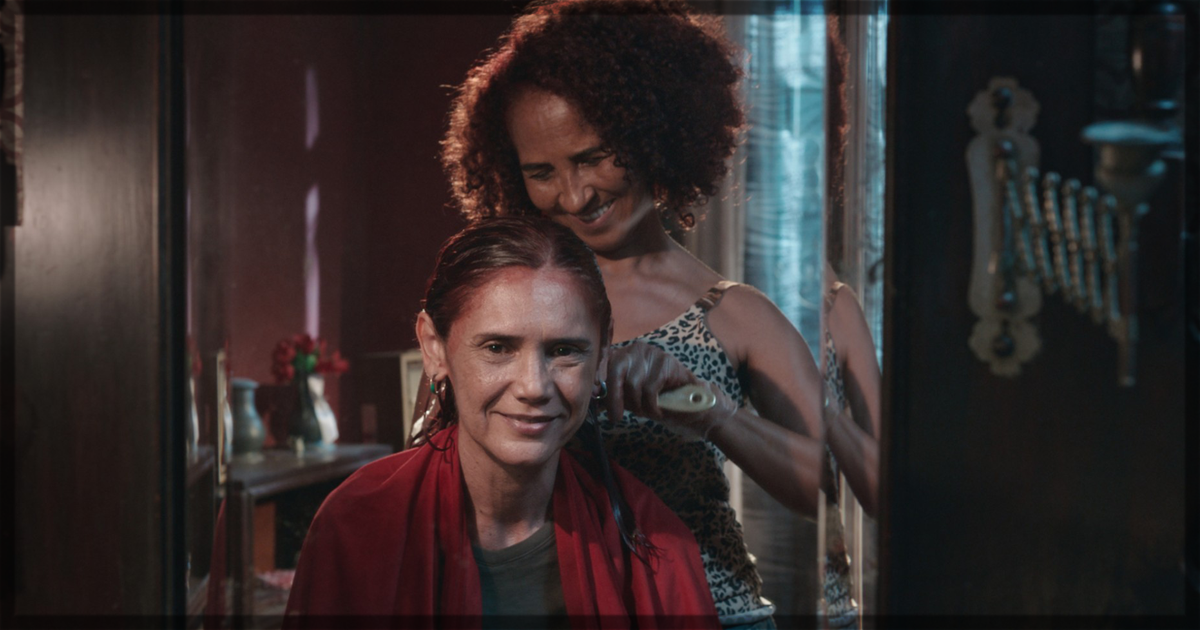
Visually, the film addresses a realism that confuses the audience, which is the intention of the filmmaker. She aims for that blurry line between reality and fact. Marques Ribeiro employs the cinema’s central principle of illusionism, playing with the truth of imagery throughout manipulation and cuts, transforming it into something else. It is present in the moment the character dyes her hair red to look like her mother, erasing the visual difference between them in a few shots that the director composes. Even if the production design or costumes are not the typical science fiction works, constructing bleak pieces, this film approximates the imagination through the common life of the Brazilian countryside. It even results in a film that drags in a few segments, such as the stay of the mother and daughter at the motel, which does not function entirely.
Still, there are fascinating subplots, such as Rosa’s sexuality, which unfolds naturally through her telling of the awful marriage she had with a man, and the passionate kiss she has with a female truck driver. These subplots and intricacies of the character function due to the excellent Veronica Cavalcanti, who embodies a woman searching to create the memories robbed from her. Her chemistry with Luciana Souza is the central pillar of the engagement in this story about a mother and daughter whose time was cut short by a violent act. Nonetheless, the film media allows the filmmaker to expand the possibilities of daydreaming through the ideas of a wounded woman during an MRI scan. In cinema, nothing is impossible; hence, Janaína Marques Ribeiro creates a journey of a woman filling the gaps in her mind. The result of Fiz Um Foguete Imaginando que Você Vinha is an exploration of the possibilities of thinking while it addresses the pains of distance from your loved ones.
Fiz Um Foguete Imaginando que Você Vinha recently played at the Berlinale Film Festival.
Learn more about the film at the IMDB site for the title.
You might also like…