“Assassination can be no more guarded against than death by lightning; it is best not to worry about either.” With these words early in his presidency, James Garfield may have sealed his fate. Shot by Charles J. Guiteau and dying six months after taking office in 1881, the United States never experienced what his presidency might have been like and ensured he would join the ranks of mediocre presidents in Lisa Simpsons’ school play – and doomed Guiteau to a similar mutually assured destruction of infamy.
Even the opening text declares that Death By Lightning is “a true story about two men the world forgot” – the twentieth president of the United States and the man who shot him. (That said, the creators, however, may not have accounted for Stephen Sondheim, whose 1991 dark comedy musical Assassins arguably peaks with his jazz-hands, cakewalk number “The Ballad of Guiteau” and gives that actor the almost inevitably scene-stealing performance, nor with the late great composers’ legions of fans who have forgotten neither Garfield nor Guiteau.) This opening text leads into a scene from 1969, where a national archivist stumbles across a preserved brain in a glass jar. Then Death By Lightning goes back to the history that will occupy all four episodes, wasting no time once in 1880 in introducing and interweaving the stories of Garfield and Guiteau.
The thesis of Death By Lightning takes the “we’re not so different, you and I” trope of action and adventure cinema and turns it upon real historical figures to great effect. Both Garfield (Michael Shannon) and Guiteau (Matthew MacFayden) came from hard and humble backgrounds in America’s heartland, rising through difficult childhoods and dead or difficult fathers in a quest for greatness. Former scholar and Civil War general Garfield, however, saw hard work as its own reward and found each improved position almost by accident, as his skills and qualities were recognised by his peers (though he was a canny player when circumstances demanded it). Itinerant preacher and newspaper con man Guiteau, on the other hand, was hampered by delusions of grandeur and a belief that he deserved the recognition and adulation that came seemingly so naturally to his heroes of the Republican party. While understandings of mental illness are miles ahead of what they were in the 1880s and terminology at the time was greatly different, Guiteau almost certainly would have been diagnosed with something had he lived today – and it perhaps would have saved his life.
The almost-accidentally connected stories of these two men sit against the backdrop of contentious US politics, notably within the Republican party. A decade and a half after Lincoln’s assassination, the party of Northerners, abolitionists, and city-dwellers had split into two factions: the Stalwarts, headed by senator Roscoe Conkling (Shea Whigham), enmeshed in the spoils system and hell-bent on controlling important and lucrative political appointments such as the New York Customs Controller – a position previously held by his right-hand man Chester Arthur (Nick Offerman). On the other side sits the problematically named Half-Breeds, of which Garfield and James Blaine (Bradley Whitford) were members; these reform-minded Republicans sought to end the spoils system and make appointment based on merit rather than personal gain. The election of 1880, when Rutherford B Hayes refused to seek re-election after attempting reforms and facing Conkling’s wrath, was a crucial battle-ground for these factions. The stakes Garfield inherited, and within which Guiteau sought glory in the service of Jesus Christ and the Republican party, could not have been higher.
Michael Shannon’s Take on James Garfield
It is not easy to play the lawful good hero, but Michael Shannon plays Garfield with an easy warmth and substantial self-doubt. He makes it easy to see why the congressman was so beloved by his constituents and quickly became beloved by a nation, even without the Republican backroom deals to secure his nomination and then election. As his wife Lucretia “Crete” Garfield, Betty Gilpin is sorely under-used but brings a steely strength to a rural woman thrust into the spotlight without any time to prepare.
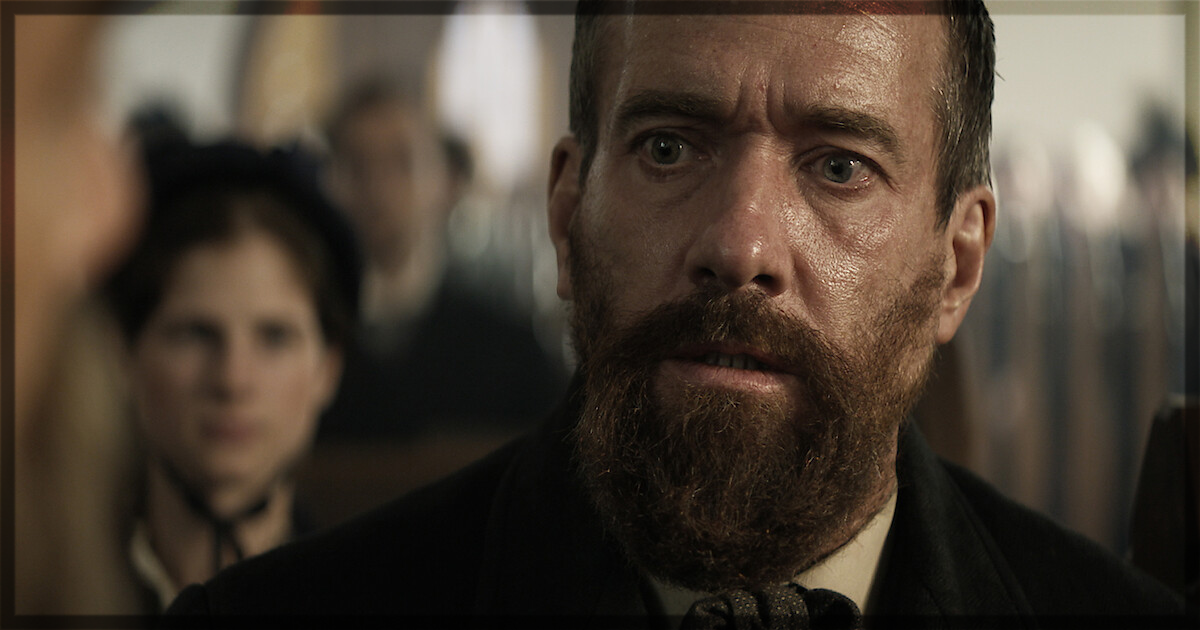
MacFayden adds to an impressive resume with his guileless performance as Guiteau. The wide-eyed, child-like wonder with which he watches the fireworks above the Republican National Convention is enough to move the stoniest hearts – never mind that he was just seen dining and dashing. Juxtaposing innocence and irascibility creates a gut-wrenching portrait of a man who, while capable of great violence and infinitely deluded – was nonetheless failed by the same system that allowed Garfield to rise.
Shea Whigham makes a strong case for his continued presence in period dramas, fully inhabiting the odd mannerisms and fastidious dress of Conkling and stealing scenes as his plotting becomes harder and harder to control. Nick Offerman, whose voice is unmistakable, makes a very modern man of Arthur (another of The Simpsons’ mediocre presidents) and provides one of the most interesting and unexpectedly emotional arcs of the show as his allegiances and beliefs are challenged. As James Blaine, Bradley Whitford is the trustworthy Platonic ideal of a democratically elected representative. Supporting players and bit parts are also colourfully cast, and it feels like the show runs out of things to give them rather than runs out of interesting figures to fill its minutes.
Death By Lightning, largely shot in Budapest standing in for 19th-century Chicago and Washington DC, is handsomely designed and composed, with only the occasional nocturnal scene too dark to make out faces. Ramin Djawadi’s score stealthily modulates brass-heavy, patriotic American tunes into more sinister undercurrents. The dialogue does not always find an easy mix of modern slang and period-appropriate phrases, but watching formerly dignified politicians lose their cool in a string of profanities – or a rain of sheet music when a triumphal march plays for the wrong man – is greatly satisfying. While the camera work similarly juxtaposes the macro and micro – a shot of a handshake, or a close-up on a face, suddenly thrust against the roar of a crowd or a grand government hall – the human momentum of this story slows towards its conclusion.
And this is where Death By Lightning’s solid storytelling techniques – and some odd fact-to-fiction choices – come up against a puzzling lack of perspective as to why these figures fell out of the public consciousness. While Death by Lightning does an admirable job introducing relative newcomers to the heady, ridiculous, and tragic history of two men’s fates intertwined, these missed opportunities dampen the show and sell its true stories of obsession and ambition short.
Death By Lightning takes Candice Millard’s 2011 book Destiny of the Republic: A Tale of Madness, Medicine and the Murder of a President as its main source material, but it pulls in many other sources and ends up with quite a different focus. The first two episodes cover the first seventy pages of Candace Millard’s book, with the second two episodes furiously charging through the history that comprises its remaining 190 pages (not counting notes or indexes). While Millard goes more into medical science and the innovations changing American understandings of (mental and physical) health, show creator Mike Makowsky is much more interested in the political machinations that made Garfield’s rise from congressman to presidential candidate (end of first episode) to president (end of second episode) possible, and likewise Guiteau’s parallel journey in his shadow. The assassination and its not-for-the-squeamish aftermath does not even occur until almost halfway through the fourth and final episode. As a result, the bloody and furious conclusion (which introduces two figures the average American may have at least heard of in other contexts, even if they are not overly familiar with them) feels slightly rushed compared to the preceding hours devoted to negotiation, politicking, and moral quandaries in closed rooms.
A note: this reviewer has been somewhat unhealthily obsessed with the assassination of James Garfield by Charles J. Guiteau for the better part of a decade, with no small thanks due to Sondheim. Death by Lightning has been eagerly anticipated since it was announced in mid-2025, and Millard’s book, An Assassin in Utopia by Susan Wels, and Assassination Vacation by Sarah Vowell were all read and/or re-read well in advance of Netflix announcing the release date of this miniseries this year. It is hard for a four-episode show to fully satisfy such a complex history, or those with special interests who know it so well.
Death by Lightning does not cover Guiteau’s trial at all, which was a media feast as the assassin irritated his counsel into quitting and then erratically represented himself, all the while claiming that he did not kill Garfield, it was his doctors and their unsanitary practices – a claim vindicated by history, though Guiteau never denied firing the bullet. One can imagine the meal MacFayden would make of this material, though it would possibly be fodder for a whole separate miniseries in itself.
Another small misfire is the depiction of the Oneida commune – where Charles Guiteau spent several years, known for its practice of “complex marriage” (e.g., free love) – which was far stranger but less salacious in reality than portrayed here. Granted, public sex is used for good comic effect here, but this was still 19th-century America, and the real Oneidans each had their own private rooms for conjugal activities (An Assassin in Utopia provides excellent and non-sensationalist historical detail). The producers of Death by Lightning do not seem to trust that the historical realities of utopian social projects would be fascinating enough without shock value; that said, the “Charley Get-out” moniker is historically accurate.
The two major missed opportunities are sides of the same coin. Garfield and Guiteau were huge figures in their day, one beloved, the other loathed. The assassination was a huge deal that drew crowds outside the White House waiting for hour-by-hour updates on the president’s condition and, later, a media frenzy around the ensuing trial. Death By Lightning only portrays James Garfield leaving Washington on his final journey to the seaside, seen off by sombre crowds. It does not show the crowds who met his train in New Jersey and who, when its engines could not manage the specially-laid track going uphill to the door of his beach house, unhitched the car and pushed it by hand to his door to ease his journey.
Similarly, (spoiler alert for history) Charles Guiteau’s execution is portrayed with empty chairs in its prison yard audience, when in reality contemporary newspapers noted the hundreds of eager spectators and concession sellers made the atmosphere more like a carnival than a hanging. “So many people that tickets were raffled,” sings Sondheim’s Balladeer – and what a scene could convey in the difference between then and now, remembrance and forgetting, the entertainment of a hanging versus the entertainment of a Netflix miniseries, the love of a crowd versus its jeers, feels a huge missed opportunity. Indeed, his performance on the gallows did much to turn public opinion towards the insanity defense. While the show adds a few other metatheatrical fictional inventions exploring these themes, why Garfield and Guiteau’s story is told now – in 2025 – goes underexplored. Unlike last year’s Manhunt, to which this will inevitably be compared, Death by Lightning does not seek to pull out parallels to omnipresent, continual American preoccupations, and is the slightly weaker of the two shows as a result.
But taken for what is it and what it does, Death By Lightning is a terrific starting point to explore a volatile and vibrant time in US history – a time when promise was in the air and so many rogue actions, from those wielding guns to those wielding bribes from the New York Customs House, could set the nation on very different courses. In its very final minutes, it somewhat subverts expectations of a historical television drama, reminding viewers that these figures are not heroes to be lauded or villains to be feared, but strange, imperfect humans whose legacies are too complicated to be simplified into neat nationalist narratives. Featuring outstanding performances, great design, and keen dramatic emphasis on the almosts and might-have-beens, Death By Lightning is a cracking four-hour ride through truly ridiculous, stranger-than-fiction truths of the nation’s past.
Death by Lightning is now streaming on Netflix.
Learn more about the show, including how to watch, at the official Netflix site for the title.
You might also like…