The legendary filmmaker Robert Flaherty made history with his documentary Nanook of the North, a pioneering film, considered the first non-fiction work. Despite the controversies and claims of its stagings, it establishes the medium’s interest in the study of the human organization and the different cultures. A century later, we are still documenting the various manners of living according to the place’s context; yet, the structure and the ethics of filmmaking have evolved. In To Hold a Mountain (Planina), the duo of directors Biljana Tutorov and Petar Glomazić approach the lifestyle of farmers and pastors on the Sinjajevina mountain in the northern part of Montenegro. Despite being the residence of a group of farmers for centuries, the government, alongside international forces, decided to host NATO military training in the region. Hence, the testing of military power and new weapons happens on the coast of the mountains. Thus, the community fights to protect its area from the potential damage of the operations.
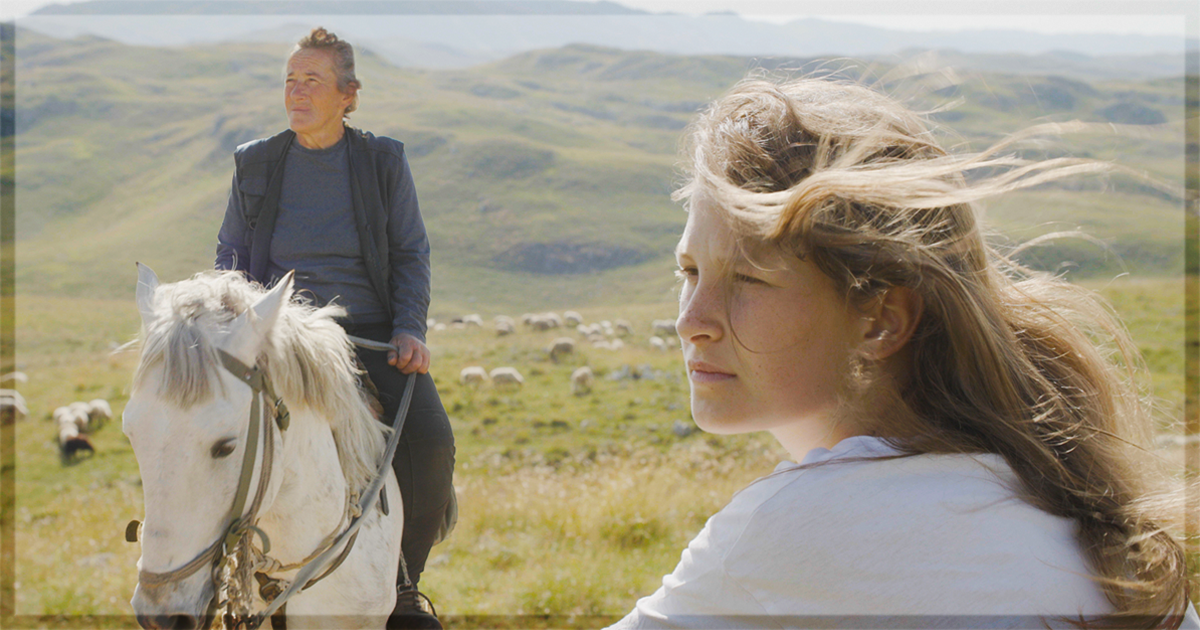
At first, Tutorov’s and Glomazić’s film approaches the life of a farmer, Mileva, who lives in the mountains with her daughter, Nada. They live in a house in the middle of the peaks, while they take care of the cattle, producing milk and cheese. Mileva also lives with the trauma of losing her sister, Mika, to a violent murderer by her former partner, resulting in her death, and his fourteen-year sentence. Her trauma is evident through her relationship with her daughter, becoming an overly protective parent. The girl drives through the mountains with her mother’s pickup to go to school and deliver milk. In its first thirty minutes, the directorial duo calmly introduces the dynamics of the farmer’s household, her connection to the community, acting as a leader in the daily life, inviting the neighbors over to share a bonfire, and drink tea. Mileva attempts to live pleasingly alongside her peers and promote the well-being of their neighborhood.
In this sense, the familiar element of To Hold a Mountain reminds one of the one in Ljubomir Stefanov’s and Tamara Kotevska’s Honeyland, a film about honey producers in the remote area of North Macedonia. Both documentaries approach the female agriculturalists in remote regions of Europe, countries that are not as well documented as the typical scenarios: France, Spain, Portugal, Great Britain, and Germany, among others. Coincidentally, both works narrate the fight of their protagonists against an exterior force, in Honeyland, Hatidzhe’s neighbors, and in this one, Montenegro’s army. In those societies, misogyny is still a considerable part of it, but those women decide to question the status quo and fight for their labor and home. Actually, Mileva’s confrontation with the army reminds one of another high-profile European documentary, Alexander Nanau’s Collective. Nanau’s film is an investigative work on the reasons why the patients of a nightclub fire died in the Romanian hospitals. A crucial aspect of it is the questioning of the authorities on live TV, which is a factor in Mileva’s fight to stop the NATO activities in the mountain.
The second half of the documentary features the movement of the Free Sinjajevina, an organized action by the local community to protest against the NATO training in that territory. Mileva assumes a central figure in it, the leader who stepped up instead of getting elected. She is the one on national TV, in videos for the social media, and speaking to the participants while riding her horse. There is an ancient element to her figure as a leader, the face of the manifestation against a life-threatening action promoted by a council for safety, but risking the lives of locals, considering them less than the Western population, who need the protection with the tested ammunition. Yet, the political nature of the documentary is the background discussion of the film, investing in the dynamic of Mileva, the farmer, Nada’s mother, who still mourns the brutal death of her sister. Despite the familiar plot, it lands in a territory that is not as fascinating as the political campaign against the use of the mountain as military ground. This subplot of the film debates the necessity of political organizing even for groups for which the political actions do not usually happen.
Although it reminds one of successful documentaries about the remote essence of a location and the call for action, To Hold a Mountain prefers to study the daily life and quietness of the life in the Sinjajevina mountain. Despite its competence to document the quiet life, it is not as fascinating as its political study, which becomes a parallel narrative; still, it works well in exposing the effects of politics on the population’s lives.
To Hold a Mountain recently played at the Sundance Film Festival.
Learn more about the film at the Sundance site for the title.
You might also like…