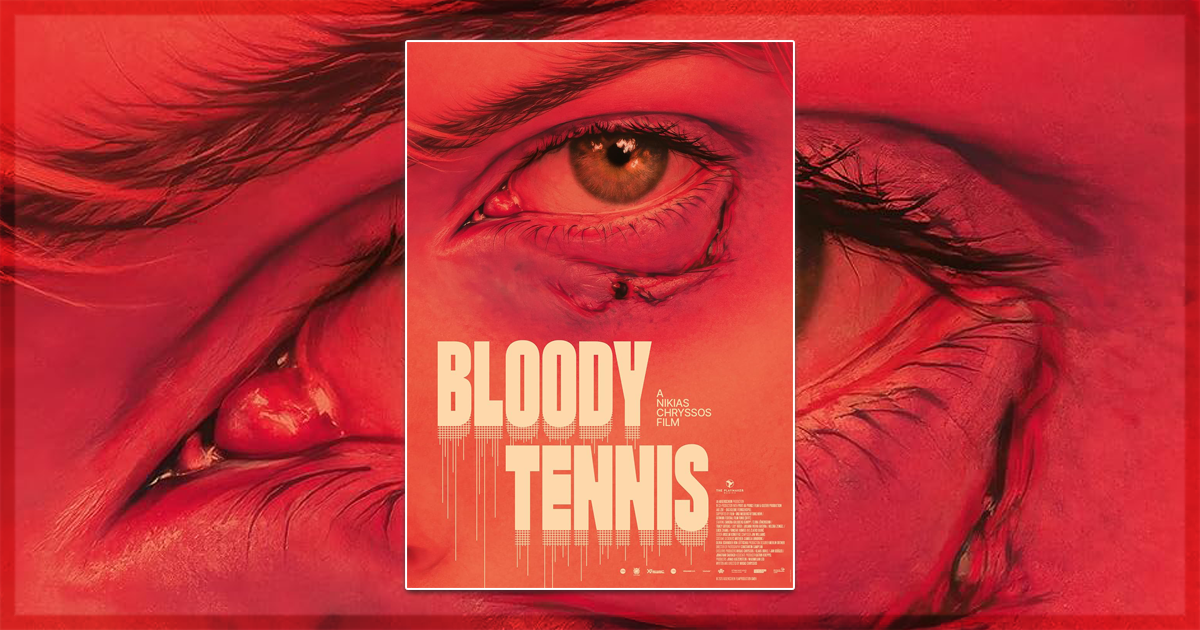
The director Nikias Chryssos presents in his Bloody Tennis a tale of competitive sports. Sophie (Sandra Guldberg Kampp), an American tennis player, is offered the opportunity to attend a camp in Europe. It is a highly exclusive club, where six players practice at a high level. Mary (Elina Löwensohn) is the commandant of this bootcamp; she is responsible for recruiting, training, and keeping the girls on a routine that leads them to the top. She also practiced the sport in the past, even playing against Sophie’s mother. The leader of the group holds a passion for the game and also returns to the contest what it gave her: trauma, violence, and mental wounds. The film presents us with the reality of a young potential sportswoman and the crazy reality of training regimens, led by the coach Stavkos (Zlatko Burić), who demands the most of the girls, both physically and mentally.
Structurally, Bloody Tennis is a film about the hidden mysteries of this place. From the get-go, it never hides that it is a vengeance by its manager. Mary decides who gets the chance to become a top player, which she stimulates through a board on which she ranks the six players and forces competition between them. At first, the film has a thrilling aura that suggests that something bigger is happening on the margins of the tennis court. Soon, we meet the other five girls: Bana (Tracy Gotoas), Nelly (Lily Taïeb), Frida (Juliana Vieira-Guerra), Xue (Lucie Zhang), and Heidi (Helena Zengel). The latest, played by the actor who became famous for her performance in Paul Greengrass’ News of the World, is the first girl to befriend the lead character, offering a helping hand.
In this sense, Heidi is the most engaging of the supporting characters; she does not want to play tennis, but her family forces her to, leading her to live in a place she characterizes as hell. She is the one who begins to unveil the bizarre nature of that place, including the drinking of blood and a diet composed of insects and other ingredients of obscure origin. Heidi is the timid flame to a fire; her disappearance suggests the unhinged nature of the events in that venue. Indeed, Helena Zengel shines as this aggressive but good-hearted individual. It benefits her as a performer to have characters like this in her oeuvre, since most people know her as the child from the Greengrass movie, or Nora Fingscheidt’s System Crasher (Systemsprenger). She has grown up, and Heidi is someone who embodies the nuances of adulthood, which differ from those in most of her filmography. On a different note, the other four girls do not have as much material to work with as the German actor.
The director and writer attempt to create a proximity between Sophie and the other girls, her rivals, even within the sexual intimacy with one of them. Yet, it does not work because the filmmaker is trying so much at once; there are too many elements: Mary’s personal vendetta, the diet’s cannibalistic nature – such as the shake made of blood they drink daily, Heidi’s sudden disappearance, among other subplots. There is too much happening alongside the film’s main thread, which is the dispute among the six girls for the top spot; the prize is the winner’s survival and a spot at Wimbledon, a Grand Slam. Of course, Chryssos is commenting on the aggressive, competitive nature of professional sports, especially the step up to the circuit. He utilizes the genre codes, in this case, the horror/body horror, as his form for the commentary. The problem is the execution of those ideas, the excess of motifs, and the poor stretching of them. Even Sophie lacks substance as a protagonist, someone who moves the needle.
The violence, which is the central element of the picture’s entertainment value, loses impact as the story approaches its end. It is not exciting, and the need to justify their friendship loses even more momentum to the awkwardness the director is attempting to utilize here. Hence, the film becomes a fascinating tug-of-war for attention to the subplot that makes more sense to the public, and, at the end, after the final fight or tennis match, it does not culminate in catharsis. On the contrary, it ends on a bittersweet note. Bloody Tennis delivers on its title’s violence, and it has moments that aim to comment on the bloodbath of professional sports through the literal violence on screen. But it lacks cohesion and narrative control to work as a whole. When the credits roll, the disappointment lingers, while the thrilling ride it promises fails to materialize. On to sports allegories: it promises a grand slam match but ends up delivering a WTA 250 after all; there is sport; it is just not as good.
Bloody Tennis recently played at the Locarno Film Festival. It will be in theaters on September 25, 2026.
Learn more about the film at the IMDB site for the title.
You might also like…