
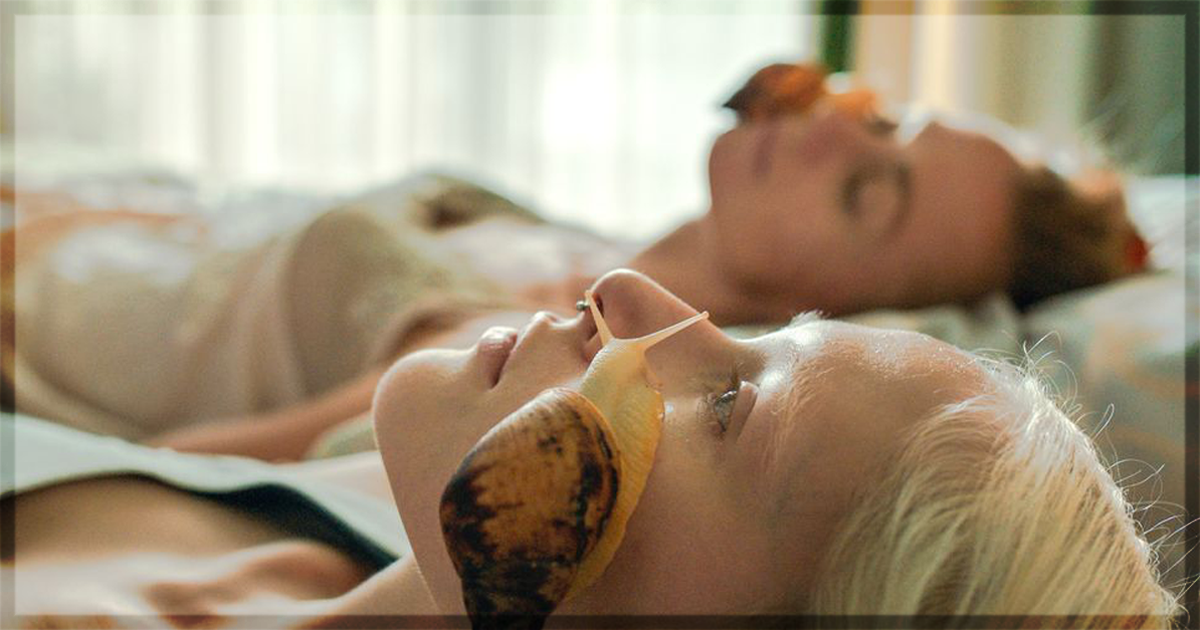
The Austrian director Elsa Kremser and the German director Levin Peter are known for their documentaries Space Dogs and Dreaming Dogs, which approach the reality of stray dogs in Moscow. In Kremser’s fiction debut, they present White Snail, a romantic drama set in Belarus. The film narrates the story of Masha (Marya Imbro), a young model preparing to move to China to star in multiple fashion campaigns in the Asian giant. Yet, she deals with a heavy case of depression, attempting to take her own life a few times. In one of those days in a hospital ward, she watches the presence of a man wearing scrubs and receiving the dead body of a patient. Suddenly, Masha obsesses over Misha (Mikhail Senkov), a quiet and silent hospital mortician responsible for that hospital’s morgue, and a lover of the arts. They bond over their differences in observing life and their realities.
The directing duo develops a morbid romantic drama, and it does not deploy the conventional structures to create its romance. The film is an exercise in emphasizing their differences and how death becomes the connection point between two contrasting individuals. Masha is a beautiful woman, tall, with delicate skin, and adequate posture for posing and photoshoots. Still, her father is in Poland due to the political situation in the region, the ongoing Russian invasion of Ukraine, and the constant threat of escalating the conflict. On the other hand, Misha is a man in his forties, overweight, and has been working at the morgue for the last twenty years of his life. He is a painter who gets inspiration from open bodies, skin cuts, and the anatomy of the inner organs. In a sense, Misha borrows from Leonardo da Vinci‘s techniques from the thirteenth and fourteenth centuries, which the Renaissance genius would perform autopsies to enhance his precision in portraying bodies and organs.
The directors display the leads as antagonizing towards how they feel about life. Masha is at the peak of her suicidal desires, lacking the interest to engage in activities that require social skills, as she is not welcome by her colleagues from the modeling agency. Misha is the opposite; he tried to kill himself when he was younger, but the inability to cause harm to himself made him alive. In this sense, Misha is the one who deals with the dead and has the most awareness of the meaning and opportunities of life, as he is confronting the ending point of human beings daily. In one of their conversation, he stipulates that he has performed an autopsy on six thousand bodies. The constant process of dissecting bodies to discover why their lives ended made him aware of life as a whole, and it is the guiding voice to Masha in her battle with depression.
Although it discusses life and death as central pillars of its thematic axis, White Snail features an apathy that contradicts the topics it portrays. The distancing between the characters does not achieve its intention of creating an emotional impact through affection; indeed, it bridges a span that contributes to the film’s coldness. The result is an emotionally cold film; the structure and storytelling do not provide an efficient arc for the love story. In this sense, the directors develop an essence of weirdness in the first act, in which the snails transform into means of expurgating the devil from Masha’s body, a common assumption regarding the depression debate, especially in Christian countries, such as in Belarus’ case. However, this intentional oddness does not cohere with the tone of the rest of the film, which is a melancholic and cold portrayal of a slight romance that the film does not entirely develop.
Ultimately, the directing duo does not decide which lane they want to cross. There is an uncertainty whether the film is a study of death and the contradictions between two individuals, and how they envision life, or a quirky and odd romantic drama about energy, death, and snails as leeches that drain the negative vibrancy. Finally, White Snail is a middling effort at studying romance and emotional distress in an uncertain reality. Misha is the stereotype of a perfect human, as she is gorgeous and has potential in her career as a model. Still, the film’s sound design suggests a loud and abrasive environment to her and those living around the chaos of the Belarusian geopolitics. In the end, the film is unsure of where it wants to land and falls in the middle of apathy, the opposite emotion of what it discusses.
White Snail recently played at the Locarno Film Festival.
Learn more about the film at the Locarno site for the title.
You might also like…
‘Tóc, giấy và nước…’ Film Review: Trương Minh Quý and Nicolas Graux on the Differences in Generations