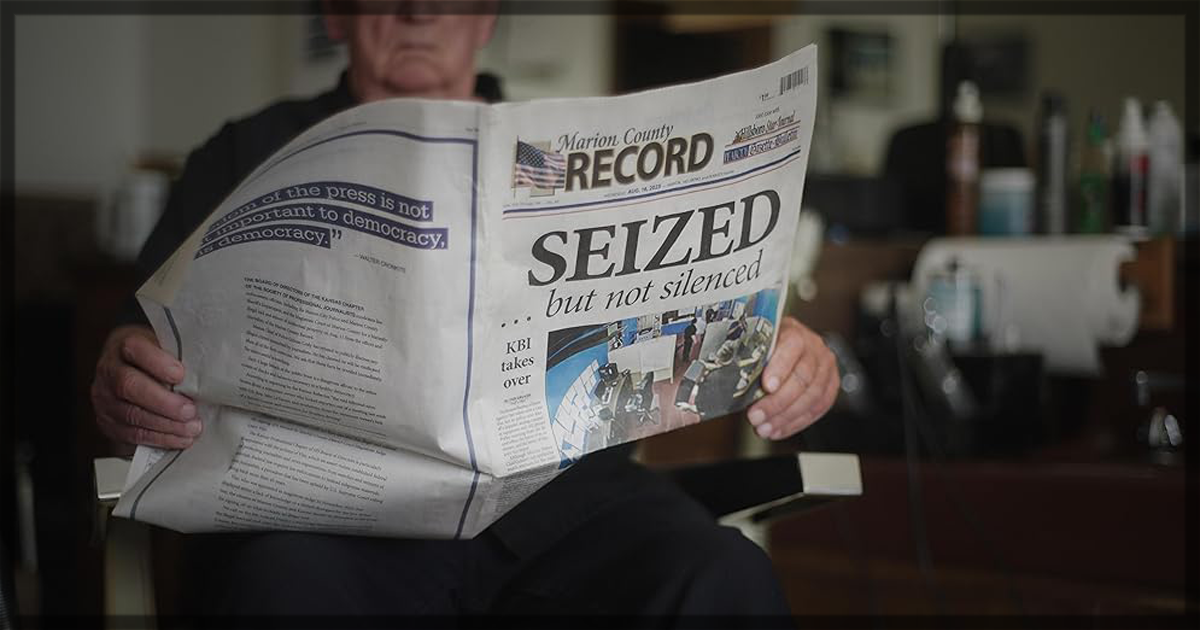
Since Seized showed at the Sundance Film Festival, news has dropped about the dismantling of the Washington Post by its billionaire owner. The ability of a free and fair press to hold power to account is something that it seems the seat of American government is about to lose, probably by design. Of course the stakes are the same for journalists whether they’re in Washington DC or Marion, Kansas (pop. 1890). In August 2023 the homes and offices of the local weekly paper in Marion, the Marion County Record, were raided, not quite legally, by police. The story of this shocking behaviour in this little town continues to have national and global implications, just as the Washington Post does. Seized does an excellent job of examining all the facts of the case. It is not a particularly groundbreaking documentary, but especially in the current American moment, telling the truth to shame the devil is more than enough.
You might well have heard about the raid, because the day after it the paper’s 98-year-old co-publisher, Joan Meyer [pronounced Joanne], died of a stroke. Her death was undoubtedly brought on by the stress of the raid, turning what might have been a local scandal into an international one. Her son and fellow copublisher Eric Meyer was therefore gifted both the righteous cause of standing up for the freedom of the press but also the anger sufficient to fight the unpleasant fight to honor the legacy of his mother, who had worked at the paper for over half a century. It becomes clear the raid only happened because none of the public officials (some elected, others civil servants) who were supposed to check and/or balance the police bothered to do their jobs. The inciting incidents which led to the raid were also so juvenile and inappropriate it would have been embarrassing at a high school paper, much less for choices made by grown adults. Over the two years documented in Seized Mr. Meyer remains damn sure he will hold everyone responsible to account.
Of course, in a small town, this is easier said than done. There are several talking-head interviews with local residents who’ve been embarrassed by true facts about themselves printed in the paper, and who blame the paper generally and Mr. Meyer personally for the resulting consequences. (Someone who also blamed journalists for consequences they experienced thank to true facts about themselves printed in my old hometown’s daily paper shot up its offices and killed five journalists in 2018.) What’s more, a surprising number of Marion’s residents just don’t care that a whole lot of public officials had to fail at their jobs in order for the raid to happen. One of the policemen who participated in the raid cries some crocodile tears during his interview about how he’s the real victim in all this. The current mayor of the town, Mike Powers, also even goes so far as to tell Mr. Meyer on camera and to his face that the entire situation is his fault. Director Sharon Liese is to be commended for her achievements in getting those interviews on tape. Mr. Meyer is to be commended for the calm certitude with which he repeatedly and routinely stands up for himself, his mother, and for the importance of journalism, too.
Ms. Liese also followed around the Marion County Record’s newest hire, Finn Hartnett, a millennial cinnamon roll from New York City who joined after the raid and gradually learns just how difficult journalism can be in such a highly visible position in a small town. His sensitivity to how disliked the paper, its work and its workers can be in the area draws a lot of the documentary’s focus. Fortunately, when the chips are down, Mr. Hartnett makes a clear and polite distinction between journalism and public relations, and underlines the importance of the former in a way that should be taught in schools. Just as fortunately, the way other journalists in Kansas made it their business to investigate the story, and the way national organisations have backed up Mr Meyer’s work is heartening indeed. The Meyers also had security cameras in their home and the paper’s offices, meaning the entire raid was recorded by themselves instead of relying on police body cameras, which also means there’s an ability to show what happened that’s only recently been possible. Documentary films such as the spectacular Everybody to Kenmure Street, which also made a zeitgeist-level appearance at this year’s Sundance, are really starting to benefit from these habits.
But perhaps more should have been done to interrogate why so many people in Marion have chosen to blame Mr Meyer instead of the police and the judges for what happened, and why no one except the police chief, Gideon Cody, has been personally held responsible. Our propensity for victim blaming is something that American culture gives itself a free pass on, just as we don’t know how valuable a free and fair press is until it’s gone. Several Marion residents do also speak in praise of their paper specifically and journalism more generally, but it’s the dissenters who have the louder voices. It’s maddening to see so many residents of a town that has multiple professional journalists reporting on the facts and uncovering abuses of power in their area not appreciate how lucky they are! Fortunately Seized lets the rest of us value their hard work and professionalism, and let’s hope it’s not the last time American journalism has so much to be proud of.
Seized recently played at the Sundance Film Festival.
Learn more about the film at the IMDB site for the title.
You might also like…
