
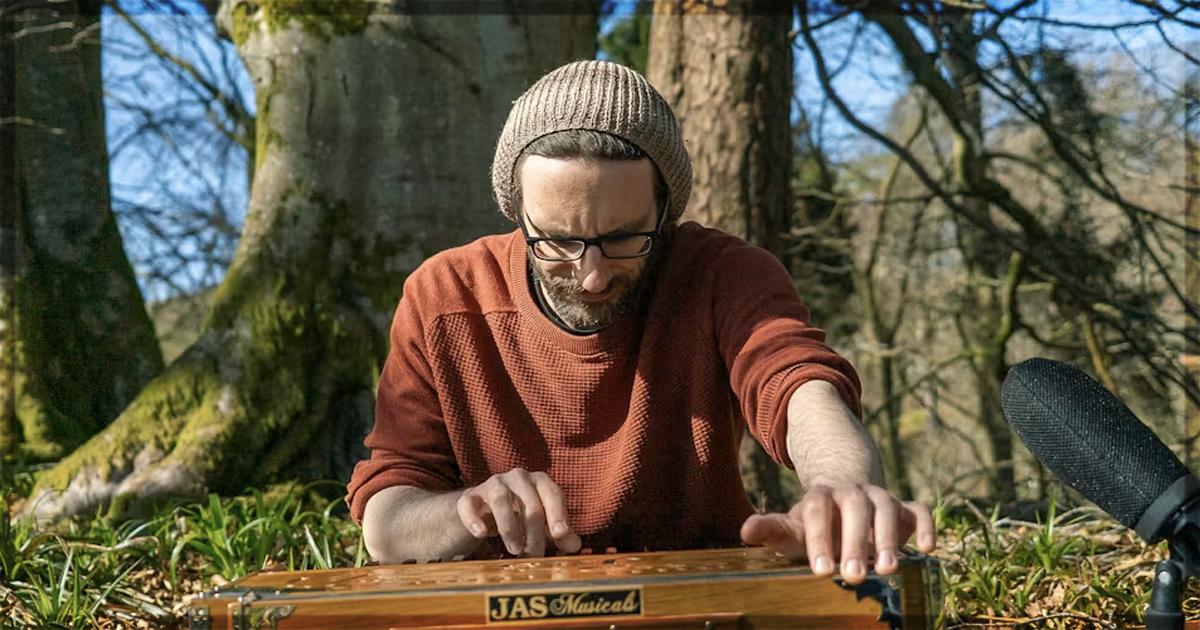
This documentary is about the power of community in healing from grief, through the method of Gaelic psalm singing. The dialogue is almost entirely in Scots-Gaelic – the indigenous language of Scotland and a cousin to Irish Gaelic, the indigenous language of Ireland – and centers the journey of one Rob MacNeacail (the anglicized version of his surname is McNicol) through sound and music. It has a fierce yet limited power but if you are inside the community it portrays Psalms of the People is a wonderful paean to the power of belonging.
In 2022 Mr. MacNeacail’s father, renowned Gaelic poet Aonghus Dubh MacNeacail, passed away, and it’s clear that this loss continues to weigh heavily on him. As part of his father’s memorial service there was a singing of the psalms, which is done very differently from any religious singing previously known to me. How it seems to work is that everyone is given a lyric sheet but the lead singer, called a precentor, sets the melody themself. The rest of the singers then harmonise on that melody, in a call-and-response fashion, with a focus on maintaining separate songlines through the melodic whole as the psalm is sung. So each singer has their own distinct sound within the larger song. This is a pretty great metaphor for finding your place within a community while remaining entirely yourself.
Mr. MacNeacail therefore set up a group of singers in his hometown of Carlops, which is south of Edinburgh near the English border, and therefore not a place where Scots-Gaelic language and traditions have been allowed to thrive. There’s an unusually relaxed outlook to both existing language skills and musical talent, even as one of the group’s members lives in a house so filled with unusual musical instruments he has his own harpsichord. But documentarian Jack Archer took the angle that Mr. MacNeacail’s commitment to psalm singing might also find a place in more established Gaelic language settings, which are mainly in more remote and northern Scottish places, further away from the English. So the documentary follows Mr. MacNeacail – a kind but clumsy and awkward man – as he brings his skills as a precentor to other Gaelic-language communities in Scotland and Ireland.
Now, Psalms of the People does fall down in not adequately addressing the faith issues here. Various interviewees repeatedly insist their love of psalm singing comes from the sense of community and well-being its provides, which has nothing to do with religion. But psalm singing cannot be separated from Church of Scotland/Protestant traditions, so for all the talk about inclusivity it’s disappointing there’s no discussion of the huge historical issues with sectarianism that continue to plague Scottish and Irish society. This lacuna is stranger still when the documentary diverts to Belfast for a psalm singing session, led by Mr. MacNeacail, in the only Protestant Irish-language organisation in the city. The existence of this group is something of a political hot potato in the Irish language community, not least because Irish language issues are a major hot potato in Northern Ireland as a whole. The end of the movie was filmed at a major Gaelic music festival down south, where a psalm session in a Catholic church is filmed with unusual attention to the trappings of Catholicism. So the documentary’s blind spot for how religion and historical issues have impacted the language and music Mr. MacNeacail finds such solace in is the coward’s way out.
That said, Psalms of the People’s purpose is to show how this little-known musical art has enabled one man to come to terms with his grief. It’s not particularly fair to complain that it doesn’t look at the bigger picture. On its own level Psalms of the People paints a remarkable picture of the kindness and understanding that comes from being welcome in any community, no matter how small. It’s just a shame that its limited purpose limits its power.
Psalms of the People (Sailm nan Daoine) recently played at the Glasgow Film Festival.
Learn more about the film at the Glasgow site for the title.
You might also like…
