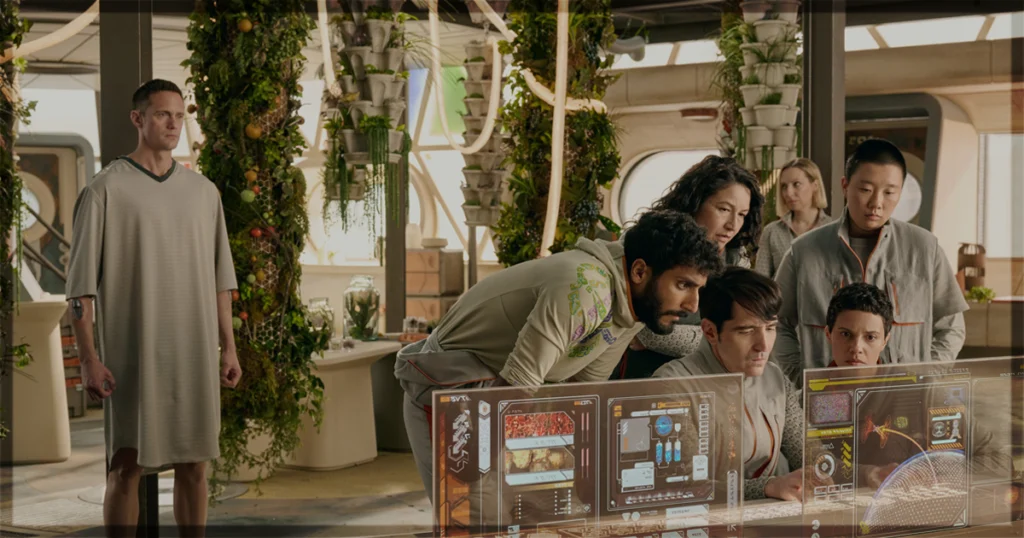

This mid-series run of Murderbot is some of the tightest episodes of television in a while. This episode also contains a great deal of humour, backrubs, some awfully graphic surgery, and then some even more graphic violence. The tonal shifts flow more naturally than that description sounds, which is especially surprising since the team, though split up, is in equally serious peril. How serious? Serious enough that Murderbot (Alexander Skarsgård) regrets that it wiped some essential documents from its memory banks to make way for season 19 of “Sanctuary Moon.” (The work John Cho and DeWanda Wise do here in the show-within-a-show is not only screamingly funny, but also the kind of meta-commentary that a sentient construct like Murderbot would really appreciate.)
But the point of Command Feed is two-fold. It is to establish the closeness Murderbot is able to find with its humans, but also the unbreachable distance between them. This is done literally, when Murderbot and Mensah (Noma Dumezweni), alone on the disabled hopper, make the gross discovery that Murderbot and the hopper are made from similar materials, including cloned human flesh, meaning one can be used to repair the other. It happens figuratively when the rest of the team back at base learn just what Leebeebee (Anna Konkle, doing excellent work as someone losing their patience but never their calm) is fully capable of. Unfortunately they are not quite equal to the knowledge. Ratthi (Akshay Khanna) throws up, Gurathin (David Dastmalchian, the secret MVP of the series) gets angry, Pin-Lee (Sabrina Wu) laughs hysterically, Bharadwaj (Tamara Podemski) goes into shock and only Arada (Tattiawna Jones) keeps her cool. Even Mensah is shocked into stammering silence before her leadership training kicks in. While Murderbot was not expecting them to throw it a parade for how it resolves the situation, it was expecting them to react more like the people in its shows. But such stereotypes are much too simple, and simplistic. Complicated humanity never lets anyone rely on such cliches for long.
The fact that Pin-Lee reacts to this life-threatening event with laughter has been discussed in some depth on social media, as that is the emotion of the ones expressed that struck the most people as the least relatable or appropriate. And yet one time in college my friends and I, driving in Seattle, had a very near miss with a tractor-trailer, and once we realised we were all unscathed we all burst out laughing. It was an expression of relief at not being dead, of disbelief that we’d come so close to it, and of gratitude that we were all okay. It’s difficult to articulate such complicated emotions in words, but Mx. Wu’s laughter expresses this same precise swirl in one simple gesture. It’s somewhat of a surprise to see audiences needing this spelled out for them as clearly as a sentient construct does, but that is the point of Murderbot. It is here to help modern-day people who do not always know what to do with their humanity figure out how to express themselves in appropriate and healthy ways. And if it takes a genderless entity to teach them, well here we are.
For its own part, Murderbot is disturbed that it ends the episode feeling so pleased with itself for what it did. That’s in spite of knowing that the team is badly upset. It’s completely clear now that their lives are in real danger and there’s no time for stalling childishness like the gagging and whimpering Mensah did when undertaking the repairs. And yet of course they won’t quite manage that. Their lives may well literally be in Murderbot’s hands, and none of them know anymore quite how they can feel about that. Certainly the sense of safety that Ratthi and Arada were discussing in the backrub circle is gone.
But everyone is learning things in this perfectly paced episode: at one point Murderbot cracks a joke. A joke! Mensah is beside herself with the realisation that this sentient construct is not only capable of humour, but also capable of briefly understanding her emotions better than she does. It’s only through the subtlest of body language that Mr. Skarsgård conveys Murderbot’s satisfaction at knowing how to do something better than a human does. The deadfall that Mr. Skarsgård does is an expert piece of physical comedy, too. The confidence with which Murderbot has come together is really quite spectacular.
Murderbot is now streaming on Apple TV+.
Learn more about the show, including how to watch, at the Apple TV+ site for the title.
You might also like…