Whenever a filmmaker with the pedigree of Andrew Stanton (Finding Nemo) ventures into the realm of live-action, my attention levels are immediately raised. Stanton is one of the foundational architects of Pixar, a master at finding the soul in inanimate objects. Approaching In the Blink of an Eye, my expectations were marked mostly by curiosity. I expected to find that characteristic emotional sensitivity of the director applied to a sci-fi premise that promised to explore the scale of human time through an intimate lens.
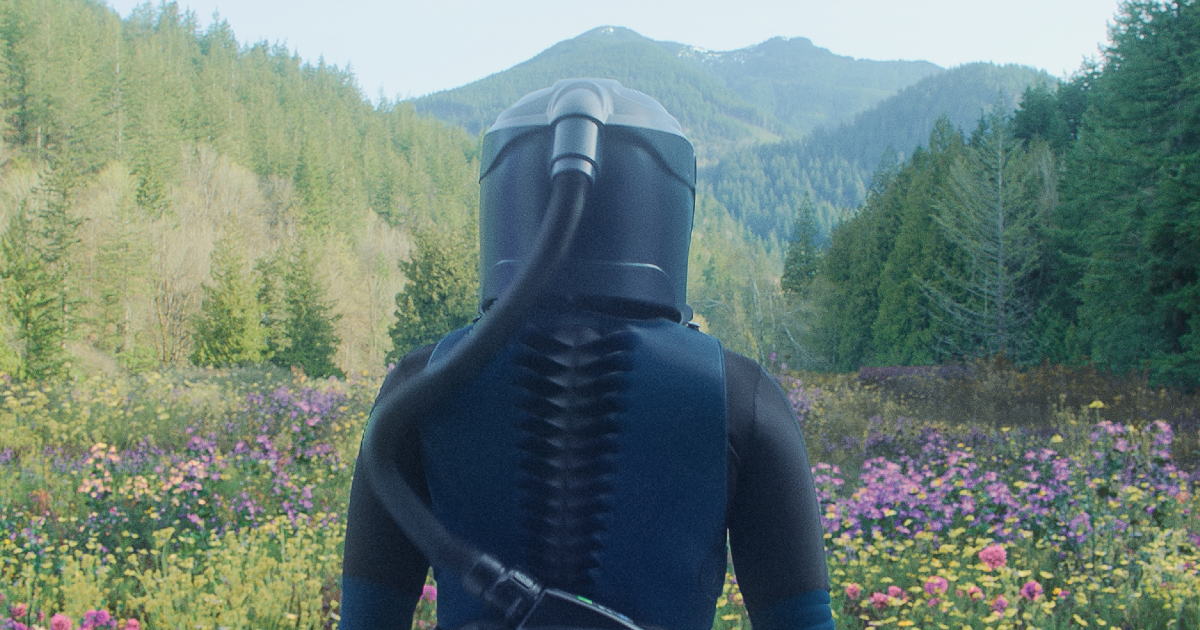
In the Blink of an Eye is directed by Stanton with a screenplay by Colby Day (Spaceman). The story is structured through three cyclic timelines: Thorn (Jorge Vargas, Snowpiercer) and his Neanderthal family in 45,000 BCE facing extinction; Claire (Rashida Jones, On the Rocks), an archaeologist in the present processing grief while studying traces of the past; and Coakley (Kate McKinnon, Barbie), a pilot on a spacecraft in the future, tasked with carrying the hope of humanity.
The film focuses on what Stanton defines as the persistence of what’s small and seemingly irrelevant: the idea that our lives are just a blink of an eye in a vast universe, but every connection carries an eternal weight. However, it’s in this thematic ambition that the first imperfections appear. There’s a sincere intention in every shot, but I feel that the themes ultimately became so overwhelming that the story and characters suffered as a consequence. Instead of real people, I’m faced with vehicles for philosophical ideas, which creates an emotional distance that’s hard to ignore.
The fragmented structure of In the Blink of an Eye conveys a sense of forced slowness, resulting in a movie that’s both short and slow. The thematic message becomes clear very early on, removing the sense of discovery or the anticipation of a climax that connects the dots in a surprising manner. It isn’t necessary to wait for the end to understand what Stanton wants to convey to the audience, as he reiterates the same note continuously. This repetition causes interest to fluctuate, although the prehistoric segment works best due to its simplicity and absence of dialogue, allowing Vargas‘s performance to communicate fear and hope in a fascinatingly human way.
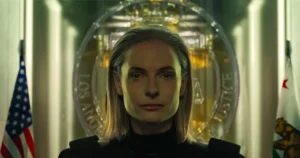
Keeping in the area of performances, McKinnon is a pleasant surprise. In a restrained and melancholic dramatic turn, the actress conveys an existential weariness through lingering gazes that denote an invisible weight. Similarly, Jones and Daveed Diggs (Hamilton) possess a natural chemistry that holds the modern segment together, though the script doesn’t give them enough depth for their trajectories to feel resolved — Claire seems to always be on the verge of a revelation that never satisfactorily materializes.
Technically, the absolute standout is the score by Thomas Newman (1917). His work is the true emotional engine of In the Blink of an Eye, filling the silences with a melody that connects the different eras more effectively than the editing itself. The music gives the film the necessary solemnity, unlike the visual aesthetic, which can’t avoid a “streaming look” that strips away the epic scale the story demanded, making the movie feel visually small for the gigantic themes it tries to tackle.
The use of an acorn as a physical symbol across the ages is a poetic detail that symbolizes how the most fragile element can survive time. It’s a metaphor for the film itself: a seed trying to grow in a ground that proves too shallow for its roots. With only 94 minutes, the stories don’t have time to breathe, and the transitions feel like labored editing rather than a fluid dance. This exercise in restraint ends up limiting the expansion of the most interesting characters, leaving us with the sketch of something that could’ve been grand.
Comparisons with 2001: A Space Odyssey will be inevitable, but I refuse to go down that path. A movie must stand on its own two feet, and no one expected a definitive masterpiece. The problem isn’t a lack of originality, but rather the fact that the execution is unable to transform the theoretical potential into something that sweeps us away. In the Blink of an Eye is one of those projects I admire more for the courage of its existence and the sincerity of its creator than for the pleasure of watching it. There’s dignity in the way Stanton approaches the evolution of human companionship, but it lacks the spark of genius that turns a good idea into an unforgettable film.
Final Thoughts on In the Blink of an Eye
In the Blink of an Eye lives in the dichotomy between the purity of Andrew Stanton‘s vision and the weaknesses of an execution that prioritizes theme over character. There’s courage in addressing existential questions, as well as a magnificent score by Thomas Newman and a couple of surprising performances that try to elevate the narrative. However, the fragmented structure prevents the human connection that Stanton so strongly defends from deeply materializing, resulting in a sincere visual essay that’s admired more for its intention than its final result. In the end, what remains is the image of a vast universe where, despite our temporal insignificance, the act of caring for one another remains the only light capable of piercing through the millennia.
Rating: C+
In the Blink of an Eye is now playing on Hulu/Disney+.
Learn more about the film, including how to watch it, at the official website for the title.
You might also like…