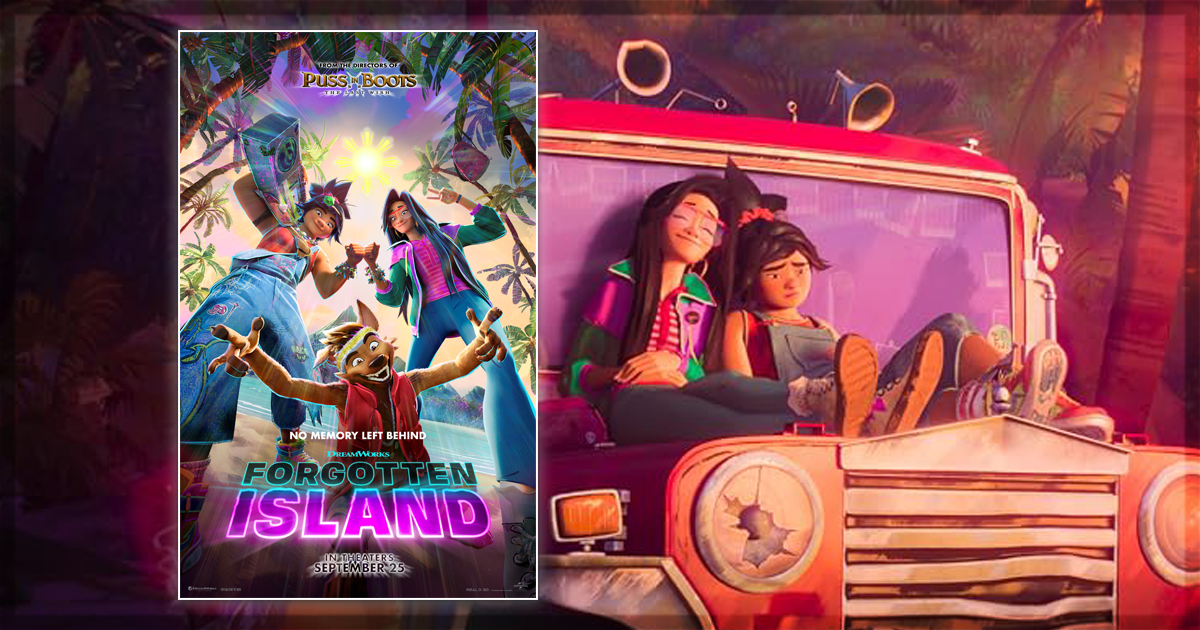
The language – and structure – of animated films needs to be reinvented within Hollywood. Stale stories are unfortunately plaguing our screens, despite formal inventiveness at almost every turn. Hollywood has released plenty of great animated offerings this year, but has any given the audience something truly different? Hoppers was full of visually mind-melting sequences, but its story was quite familiar. Toy Story 5 was, well, the continuation of a billion-dollar franchise to make another billion at the box office. Joel Crawford and Januel Mercado’s Forgotten Island seems to be the first animated film released in Hollywood this year to actively offer something different to audiences, both aesthetically and thematically, even if it doesn’t always work.
In the first hour or so, the co-directors tread familiar ground. A friendship that has lasted a lifetime begins to fracture when one of them wants to leave her country of origin for Caltech. The other friend is a boisterous, almost troublemaking presence who brings out everyone’s “wild side” but doesn’t seem to have a set future ahead of her. You can already tell where the film is heading even before you get a true sense of Jo’s (H.E.R.) friendship with Raissa (Liza Soberano). Even an Up-esque montage at the beginning of the film suggests that Pixar undoubtedly inspired how Crawford and Mercado will depict the core friendship at the heart of Forgotten Island’s story.
But then something unexpected happens. The two friends are transported to a world they thought only existed in legend when a portal opens before them and brings them to the forgotten island of Nakali. They wake up, not knowing what happened the night before, and try to piece their memories back together to find the key to return home. And that’s where the film begins to activate itself as a thoughtful reminder of the power memories hold in our psyche, with aesthetics that continually shift into often jaw-dropping, emotive territory. On the island, Jo and Raissa meet Raww (Dave Franco), a hybrid weredog who guides them through all things Nakali, but a group of people they accidentally harmed the night before quickly chases them.
And just when you think the film has defined everything you need to know, especially in the introduction of two antagonists who attempt to steal what’s most precious to Jo and Raissa – the agoraphobic Batiba (Jenny Slate) and Manannangal Manang (Lea Salonga) – Crawford and Mercado immediately dismantle what you think will happen. Some rudimentary beats remain, but the movie opens up into unexpectedly human, textured territory, especially as it interrogates the very nature of memory itself. We don’t often stop to think about what we’ve collected in our minds, and what ultimately follows us even as we grow up. Friends come and go, but memories don’t. They’re always repressed in the back of our minds and are subjective experiences no one can take away from being human.
A late person I knew always said that life is simply a collection of finite memories we hold onto for the rest of our existence. Memories shape who we are and how we see the world. Not remembering is not living. And there’s a scene in the movie where we’re transported into how Jo and Raissa’s bond solidified, through their subjective memories, that’s so profoundly moving and reads as true that it’s hard not to tear up, especially as we see them fade away in real time as our life experiences grow and make us forget what mattered the most when we grew up. It’s a powerful reminder of the most essential part of our lives, even if some memories are harder to revisit than others. They’re the driving force that lets us experience so many beautiful (and occasionally harrowing) things, as we collect them in our minds to shape who we are.
It’s the most potent reminder Crawford and Mercado leave us as the credits roll, showing young versions of the actors (and crew) of the movie with their childhood friends. After tackling the subject of death with immense maturity in Puss in Boots: The Last Wish, Crawford pulls back the curtain on our lives and discusses an understated – but essential – aspect that united all of us. He does so with real mastery of the filmmaking form, crafting a bevy of hyperstimulating and bracingly kinetic action that takes so many invigorating (and cinematically audacious) forms it almost trumps the Spider-Verse style that has inspired many of our current animated offerings. Forgotten Island’s visual language is clearly fed by comic book imagery, but it also takes a page out of anime in ways that feel so inventive it almost creates a palette of its own.
It’s the kind of thing I crave from Hollywood in an era when we rarely offer audiences anything new. Forgotten Island’s story might not be the most polished, but everything around it is so refreshing that it feels new. This should be the norm for animated films, because these movies should invite a brand-new audience to the cinema and show the seventh art’s potential to move and transport us to places impossible in the real world. Kids will undoubtedly enjoy Forgotten Island’s free-flowing aesthetics, while adults will reflect on the lives they carry after having collected decades of memories. It might just be the most important animated film made this year, and one I hope people flood to the theater, or else we’ll be stuck with more stale “content” in cinemas. Don’t let it fail; give it a chance. It just might surprise you. Wapoosh!
Forgotten Island is now in theaters.
Learn more about the film at the IMDB site for the title.
You might also like…
‘Practical Magic 2’ Film Review: Who Is This For?