
It’s only January but Scottish documentary Everybody to Kenmure Street is a very serious contender for best documentary of the year. It’s rare to feel a documentary so firmly plant the seed of possibility in the mind of its audience. But there are three things audiences need to know in order to fully appreciate Everybody to Kenmure Street. Firstly, the Home Office is part of the national government of the United Kingdom, which sits over top of the Scottish government thanks to the many wars which led to the creation of Great Britain. Secondly, the Scottish police do not work for the Home Office; they work for the Scottish government, which is its own, separate thing. The American analogy of nation vs state is close, but on Scottish land Scottish law comes first. Finally, police in the UK generally and Scotland specifically don’t carry guns. They might have truncheons or tasers, or ride around on horses, but for the most part policing here is ‘by consent’ – as in a mutually agreed part of society, not something imposed by force.
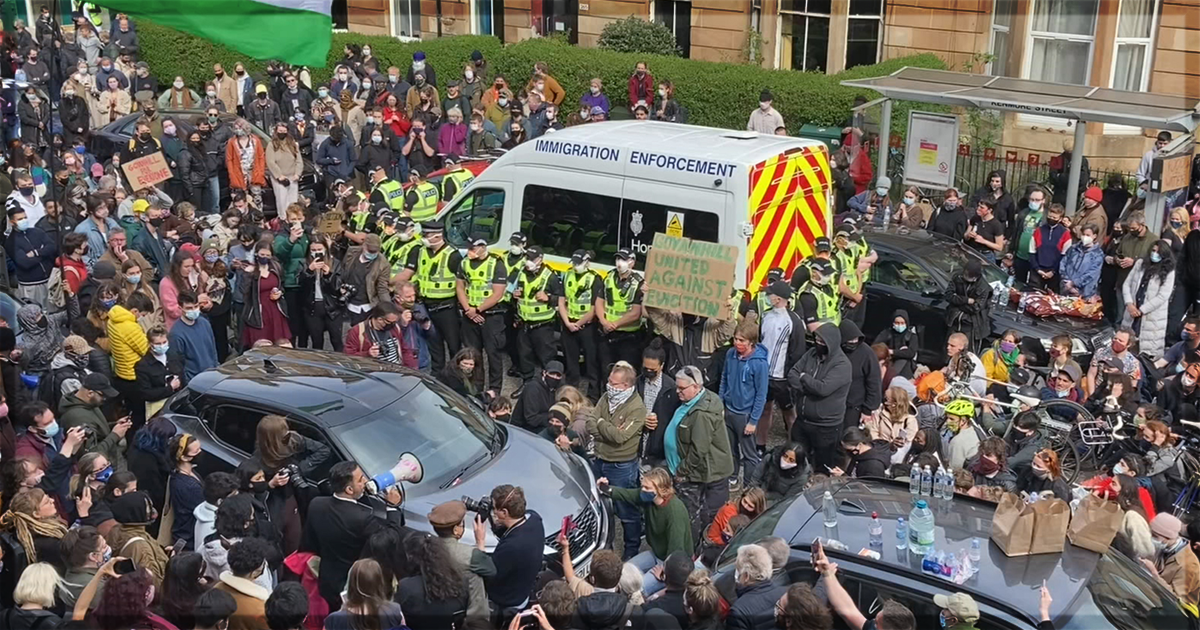
But even though the documentary takes these things for granted, you don’t need to fully understand them to appreciate the solidarity on display in this absolutely magnificent film. It tells the story of a day – Thursday May 13th 2021, to be exact – when two men, allegedly asylum seekers who had violated the terms of their visas, were picked up from their apartment on Kenmure Street by the Home Office in the early morning and placed in a van to be taken away. Director Felipe Bustos Sierra and editor Colin Monie stitched together the street footage filmed over the course of the day with talking-head interviews of the people present to discuss what it feels like when a group of people see something going on outside their windows and say, “No.”
For one thing, the men were detained on the morning of Eid (the major Muslim holiday) and Kenmure Street has a mosque on it, meaning this was an act of great provocation. For another, one of the neighbours who noticed the van had the courage and presence of mind to act instantly, crawling underneath it to wrap his arms around the axel, meaning the van couldn’t be started without injuring him. This was done as an act of principle, and ‘Van Man’ is portrayed by Emma Thompson, one of the executive producers, acting out his talking-head interview as another act of principle.
The Home Office called the local police to remove the man, and the delay gave time for the neighbours to notice the van and understand what it meant. People taking their kids to school, or cycling to work, or coming back from the doctor, all took a look at the fuss and decided to get involved. They helped block the van, they yelled at the cops, they brought each other snacks, they gave up their day to make it clear that the men in the van – whose identities are not shared, but who clearly were known to their neighbours – should be allowed home.
But what elevates Everybody to Kenmure Street above the average found-footage documentary is the decision to frame the day’s protests within the history of Glasgow. This not only goes back to the name of the street, the plantations owned by the street’s namesake and the fact that Glasgow’s prosperity, manifested in buildings like the apartment blocks on Kenmure Street, was funded by the labour of enslaved people. It also spells out the living-memory history of collective protest in Glasgow, such as the shipyard strikes of the 1970s led by trade unionist Jimmy Reid (whose daughter happens to live on Kenmure Street, and who witnessed the day from her windows) and the Glasgow Girls, the seven schoolgirls (one of whom was also present) whose activism in 2005 on behalf of one of their friends ended the detention of child asylum seekers in the UK. Various other participants discuss their memories of other protests, such as a grandmother’s stories about the Battle of George Square in 1919, to childhood memories of a local sit-in at a swimming pool violently ended by police. What is gloriously apparent is the connection everyone talking here has both with their city and with their neighbours. It’s their home, and the home of the two men who were placed in the van, and therefore their business.
Placing the day in such firm historical context shows how history is made, decision by decision, and adds the decisions made on Kenmure Street to the historical continuum. And of course no one from the police or the Home Office was interviewed: this is the story of Kenmure Street told by Kenmure Street itself. This places Everybody to Kenmure Street firmly among the own-voices storytelling that has exploded in documentary cinema in the last five years, and demonstrates the value of telling a story from only one side. Does it matter what the Home Office wanted, when nobody on Kenmure Street wanted it?
As the day unfolds, the protest gets a little more organised: instead of livestreaming on Facebook and panicked messages in the group chat, bullhorns are brought in and lawyers are called, but increasing numbers of police in riot gear also surround the street. There are occasional acts of aggression, generally police shoving people out of the way, but when a protestor (played by Keira Lucchesi) attempted to block another car with her body she was immediately arrested. For the most part the mood is congenial – there were people present with babies strapped to their chests – and it’s clear no one is interested in being the one who tips the situation out of control. A nurse (played by Kate Dickie) keeps an eye on the man under the van, and discusses the risks everyone is facing. And slowly the focus becomes how to end the standoff without the situation becoming violent or the police losing face.
The overall impression Everybody to Kenmure Street creates is that it’s really worthwhile to stand up with your friends and neighbours for something you believe in. It will certainly strike a chord with anyone who’s been watching the recent news out of Minneapolis. Everybody on Kenmure Street was just an ordinary person who stopped to help a neighbour in trouble. Everything they did was ordinary too, but so many of them joined together it became extraordinary. With Everybody to Kenmure Street Mr. Bustos Sierra has created an extraordinary testament to what ordinary people standing together are capable of. It’s made its world debut at the Sundance Film Festival and will be the opening film of the Glasgow Film Festival next month, where home audiences will undoubtedly embrace it. The picture painted here of the power of collective action and community is downright inspiring.
Everybody to Kenmure Street premiered at the Sundance Film Festival.
Learn more about the documentary at the IMDB site for the title.
You might also like…