Movie revisionism runs on a very simple premise: give a flop enough time, and somebody will eventually decide it was misunderstood. The bombs of yesteryear will be embraced as bold pieces that were ahead of their time. There are many avenues through which revisionism takes place: a key anniversary that paves the way for internet discourse, the rediscovery of a title by those who manufacture content for social media, and the most direct one: a documentary about the production and subsequent failure of the movie. Boorman And The Devil, the David Kittredge-directed documentary that aims to give John Boorman’s Exorcist II: The Heretic a belated reappraisal, belongs to the latter category.
Boorman’s ill-fated movie always had some heavyweight vocal advocates, such as influential film critic Pauline Kael and director Martin Scorsese. It has often been quoted as one of the first titles of the 1970s, alongside Argento’s Suspiria, to have kickstarted the neo-expressionism movement, one that puts artifice above all aesthetic considerations. However, the well-intentioned documentary backfires on its mission to promote the 1977 sequel as a work of art for which audiences were not ready to experience. Kittredge‘s documentary, though comprehensive and entertaining, undoes a lot of the myth-building that took place around this movie.
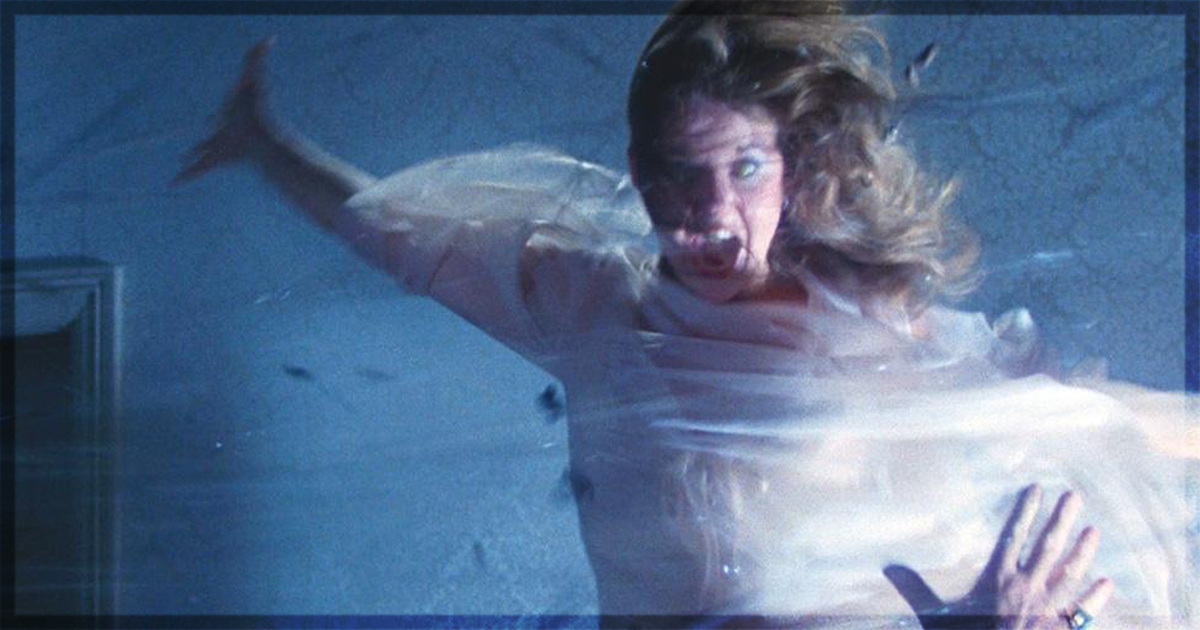
The documentary takes its time to set up the scene: explaining the rise of New Hollywood and how William Friedkin‘s The Exorcist became a hit. It also takes a look at the rise of sequels and the fascinating practice of blind bidding, the way movie theatres would bid for the right to screen a movie before a single frame had been shot. And yet, much like the infamous synchroniser scene in The Heretic, it all falls apart rather quickly. The praising and reassessment of the movie kicks off immediately, glossing over some of the most glaring concerns. Boorman’s pre-1977 career is praised and described as a successful one. The documentary focuses heavily on both Point Blank and Deliverance, and not enough on the fact that 1974’s Zardoz received a mixed to negative reception and barely broke even.
The original avant-garde aspirations of the movie are also questioned when you are reminded that the original plans favoured location shooting, the antithesis of neo-expressionism. Only after the Vatican refused permission to shoot the movie there and the then-ongoing civil war in Ethiopia made it impossible to safely bring the production to the country, did Boorman and the producers opt for a stage-based shoot. Had it not been for these restrictions, the director would have carried out his original plan, and the argument the movie’s supporters rely on the most collapses entirely.
The other point the documentary makes against the positive reappraisal sits with the constant rewrites. For years, general consensus led us to believe that Boorman contracting San Joaquin Valley Fever and the delays his illness caused to the production were behind the constant script revisions. Kittredge‘s documentary demonstrates that Warner Bros., the studio behind the production, was quite laissez-faire when it came to delays as long as the release deadline was met. So once again, the responsibility for delivering the incomprehensible fever dream that is Exorcist II seems to sit solely with Boorman and his close associates.
Louise Fletcher and Linda Blair also approach the 1977 production with rose-tinted glasses. There is deference to Boorman and his vision and clear gratitude for the opportunity to be part of the project. But other than indirectly being critical of Richard Burton‘s off-screen antics and his phoned-in performance, they seem to attribute the movie’s demise to unfortunate and unforeseeable aspects rather than a weak script and stale acting, including, one might argue, their own.
Still, for all the affection and generosity the interviewed participants pour over Exorcist II, which effectively dilutes the fact that the movie just isn’t that good, we are reminded of the few positives we encounter in this title: fantastic technical aspects, incredible cinematography, and, perhaps most importantly, the ambition to do something different. Boorman and Warner may have imported the dual timeline narrative frame from The Godfather Part II, and the dropping of the definite article from French Connection II, but the desire to create something different from the predecessor is very much their own.
And when you think about the four entries of the franchise (I refuse to acknowledge the existence of the Blumhouse entry), they are all very different from each other, while tackling the notion of evil. The 1973 original posited the notion of understanding evil from both a faith and rational/scientific angle, whereas this first sequel is anchored in Pierre Teilhard de Chardin‘s theory that the battle between good and evil is a part of the natural human evolution towards the oneness of consciousness. The Exorcist III would focus on the identity of evil, and Dominion/The Beginning inquires about the coexistence of free will and why humans choose evil. Much like Boorman‘s movie, there was no direct or clear plan to build the series. It is all just a great happy coincidence.
And maybe that is exactly what this documentary tries to remind us of: that underneath the benefits of hindsight and unearned praise lies a technically ambitious but ultimately flawed movie that earns its keep not because some people suddenly decided it is a ‘good’ movie, but because it integrates surprisingly well with a series that was always operating without a clear focus, making it up as it went along. And because creative decisions and practical constraints turned it into a surreal, dreamlike movie with a convoluted message. At least that’s how I felt after having revisited the movie a couple of years ago and right after sitting through Boorman And The Devil. For iff the road to hell is paved with good intentions, then Boorman‘s Exorcist II is the toll booth and respect for his vision is the toll fee, we as cinephiles must pay.
Boorman and the Devil played at the 2025 Venice Film Festival.
Learn more about the film at the IMDB site for the title.
You might also like…