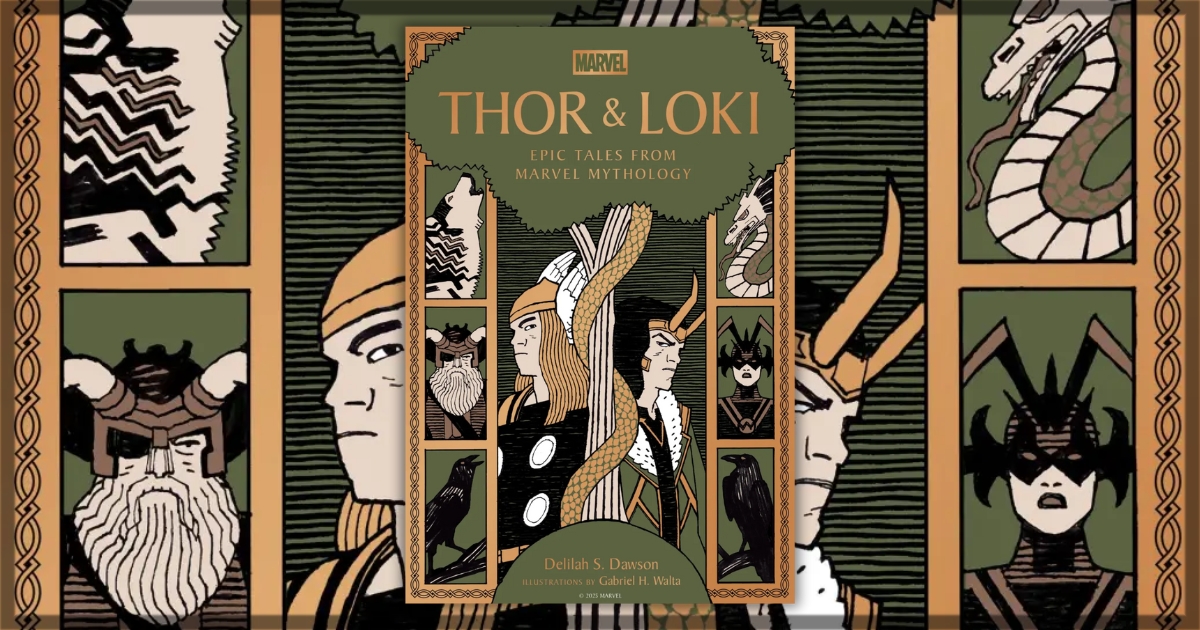
It’s Spiderman’s birthday, and the Avengers are set to celebrate in Central Park when suddenly a giant blue arm takes out the bounce house. Arriving with the gigantic blue arm are Thor and Loki. Thor begs his fellow heroes to help him come and stop Ragnarok, but Loki insists that there is no stopping it. The Avengers are alarmed and confused by the two brothers’ dueling declarations, so Dr. Strange freezes time, and they head to Stark Tower to get all the details. Which, for Norse gods, means starting at the beginning, the very beginning, because you can’t tell the story of Ragnorok without starting at the beginning of time… So come get the full story of Ragnarok from Delilah S. Dawson in Thor & Loki: Epic Tales From Marvel Mythology.
[Note: While I am reviewing this novel independently and honestly, it should be noted that it has been provided to me by Black Dog & Leventhal Publishers for the purpose of this review. Warning: My review of Thor & Loki: Epic Tales From Marvel Mythology contains some spoilers!]
The end of the world…maybe?
So here come these epic characters crashing into the middle of New York, declaring the end of the world again. Thor insists that the end can be averted, and the Avengers, especially Tony and Nat, want to jump right into the fight and save the day. But Bruce Banner and Dr. Strange want more information before they rush off. And since Dr. Strange can pause time indefinitely, they decide to go with the gather more information plan.
So Thor and Loki begin to share the mythologies of their people. They start at the very beginning with the first Frost Giant. The Avengers keep interrupting the storytelling, which drives Thor and Loki both crazy because in their culture, the Bard is the most important person, and when they are telling a tale, no one should stop them. So with increasing annoyance, Loki and Thor share story after story with their friends.
The Avengers have a hard time following the stories, and they have an even harder time understanding why they’re listening to them in the first place. Loki and Thor keep insisting that the only way to understand Ragnarok and how to stop it (or why you can’t stop it) is to hear the whole story, which means all the stories. So they continue to tell one story after another. It might not help save the world, but it sure is an entertaining way to pass the time until Ragnarok arrives.
A Marvel take on ancient tales in Thor & Loki: Epic Tales From Marvel Mythology
Marvel has never shied away from “borrowing” material from cultures all over the world. Obviously, Thor and Loki have been snatched up out of Norse mythology. Marvel has actually used quite a lot of Norse mythology to flesh out their universe, especially surrounding these two characters. It’s not a faithful use of the material, of course, but it’s inspired by the old Norse tales for sure. With all the “borrowing” that Marvel has done, most people, at least outside of the Nordic countries, probably only know these characters from their Marvel versions. So it seems only natural that Marvel should make a mythography to present more of the Nordic myths to the greater world.
Most of the tales the Dawson shares are very close to their accepted traditional forms. What some people might not realize is that the original Norse culture didn’t write down its stories. All tales were passed down orally through the bards (which is why they were so respected and revered). So that means that there isn’t really one definitive version of the tales. That gives Marvel lots of wiggle room when using the myths, and even in the mythography, Dawson works in some things that obviously weren’t in the original versions (like the Avengers, multiple times). Her mix of old and new comes together to create something totally new and fun that made me look at the myths with new eyes (I’ve loved mythology from a young age and had heard most of these tales before).
Ragnarok provides the framework for this classic storytime
Saying that Marvel should make a mythography of Norse myths is all well and good, but finding a good way to present it is another. You can just put all the tales in a book and tell them one after another. But these tales weren’t really meant to be read; they were meant to be heard. Making a book that feels like it’s being heard instead of read presents its own difficulties. By having Loki and Thor share the stories, it shifts from being a collection of tales to being a presentation of tales, an important distinction.
But what’s the reason for Thor and Loki to suddenly share their culture? Bedtime stories for their kids? Maybe, but we don’t even know they have kids at the start of the book, so the reader is left behind from the start. A drunken bragging session? Better, but Marvel tends to lean towards a cleaner image nowadays. Sharing information that might save the world with their hero friends? Bingo! That’s the winner. This storyline keeps the reader interested beyond the tales themselves. And with all their friends around (their loud-mouthed, smart-assed friends), there are lots of interruptions to clarify story points and keep readers engaged.
The framework is where much of the humor we’re used to from Marvel comes in. There’s also a lot of social commentary during these asides. Both Thor and Loki own up that their past behavior wasn’t really acceptable by modern standards. There is a fair amount of “it was a different time” used to excuse their actions. But they do seem to understand that the myths don’t show the Asgardians in a good light. Thor especially seems to understand this and feel remorse (or at least guilt) for his past.
Considering just how awful some of the things that happen in the old myths are, it was inevitable that Thor, at least (Loki is a villain, we don’t expect him to do good things, so we can move past his despicable choices more easily), would have to apologize for his past actions and assert that he’s a changed man. And since he’s had a few thousand years to do that, we can hope that he has.
Thor & Loki is a fun way to introduce ancient stories to a modern audience
The Norse myths have been around for thousands of years. The fact that they’re still here and relevant in pop culture speaks to the basic human truths that they capture. But while parts of them are entombed in modern media, plenty are slowly being forgotten over time. Dawson seeks to pull these stories back from the void that they’re in danger of falling into. The names are sometimes hard to get your head around (I don’t even try to get my tongue around them), but the adventures are funny and exciting. And often rather awful. The Asgardians really were horrible in a lot of ways, a lot of very human ways, though. And there are lessons in these tales that we still need to learn today. So if you enjoy Marvel, I highly recommend checking out Dawson’s take on Norse mythology. And you’ll get to see if Ragnorak can, or should, be stopped.
Rating: 7/10
Thor & Loki: Epic Tales From Marvel Mythology is now available to purchase at your retailer of choice.
Learn more about the book at the official website for the title.
You might also like…