
I still feel the disconcerting echo of the ending of the previous film in this saga. I confess that my approach to this new chapter was cautiously nervous, the result of that highly dissonant conclusion of 28 Years Later that left me, at the time, not quite knowing what to feel. Not being the number one fan of the saga, I admire how it redefined the genre and injected raw ferocity into the world’s collective nightmares, although I can’t claim to have a chapter I adore much more than the others.
However, upon entering the theater to witness 28 Years Later: The Bone Temple, I carried with me the hope that the singular vision of Nia DaCosta (Candyman) and the incisive writing of Alex Garland (Ex Machina) could right the ship, balancing visceral horror with the human substance that has always been the beating heart of these movies.
The narrative transports us to an unrecognizable Britain, where the rules of civilization aren’t even a distant memory anymore. 28 Years Later: The Bone Temple centers on Dr. Ian Kelson (Ralph Fiennes, The Grand Budapest Hotel), a man who built a macabre sanctuary dedicated to death, and the inevitable collision of his world with the cult led by Sir Lord Jimmy Crystal (Jack O’Connell, Unbroken).
It’s imperative to start with the elephant in the room, or rather, the artistic triumph that is the tone of this film. Where the predecessor stumbled, 28 Years Later: The Bone Temple runs with audacious confidence. It’s an incredibly bold movie, exhibiting exquisite tonal balance, mixing absolute chaos with moments of unexpected dark humor and surprising narrative richness. DaCosta demonstrates immense courage in subverting many of the worn-out formulas and clichés of the zombie genre, delivering something that’s both refreshing and captivating. The filmmaker isn’t afraid to fail, embracing the madness of this new world without ever losing the emotional thread, transforming what could be disorder into a symphony of violence with meaning.
In the center of this storm, we find a performance by Fiennes that can only be described as fascinating. The actor strips himself of any vanity to embody Kelson, a figure oscillating between the tragic and the comic in a world that despises etiquette. His arc is one of palpable spiritual erosion, starting as a man clinging to science and art as shields against barbarity, covering his skin with iodine in a desperate attempt to isolate himself. The way Fiennes navigates Kelson’s transformation, from a stoic observer to an active participant in the madness, culminating in a “diabolical” performance in the third act, is a true tour de force, if you’ll allow me the hyperbole. Alone, he manages to convey the pain of a man who built a temple dedicated to death not out of madness, but out of reverence.
On the other side of the moral spectrum exist the chaotic energy of O’Connell and the grounded presence of Erin Kellyman (The Green Knight). The former is absolutely terrifying as Jimmy Crystal, channeling a manic, hateful, yet magnetically repulsive energy. His antagonist isn’t just evil; he’s an artist of violence, a man who treats the apocalypse as his personal playground, serving as the perfect counterpoint to Fiennes‘ stoicism. In contrast, Kellyman, in the role of one of the “Jimmys”, functions as the necessary bridge between these two extremes. Her performance is subtle but powerful, carrying the weight of conscience in a group devoid of it. The character represents the generation that never knew the old world but refuses the cruelty of the new one, with the actress navigating this internal conflict with impressive maturity, serving as the moral compass in a land without a true north.
High praises also for Chi Lewis-Parry (Rebel Moon) as the alpha infected Samson, a revelation that challenges all the rules established by the saga so far. Dedicating a single paragraph to Lewis-Parry is too little for the impact his character has on the thematic structure of 28 Years Later: The Bone Temple. His shared arc with Kelson represents evolution. The actor brings an imposing physicality that’s softened by painful vulnerability, especially in interactions with Fiennes. He’s the “noble savage”, living proof that biology can be overcome by the spirit. Lewis-Parry manages to convey, without words, the internal struggle between biological rage and the human soul residing beneath, becoming the strongest emotional vector of the film and challenging our own perception of who the true monsters are.
Thematically, 28 Years Later: The Bone Temple is extremely rich. The narrative moves away from the usual Man vs. Nature struggle to focus on the conflict between resilience and nihilism. While previous installments focused on surviving — finding the cure, a refuge — this fourth chapter focuses on dying. The titular temple is a monument to the end, erected by those who stopped fearing the infected and started worshipping the concept of extinction. There’s a fascinating exploration of the Latin phrase memento mori, contrasting religious extremism with scientific hope. Garland‘s screenplay suggests that, after 28 years, hope is a finite resource and, when it runs out, is replaced by a death drive. This philosophical density elevates the movie far above a simple festival of cheap scares.
This depth extends to the biting critique of the corruption of nostalgia, personified by the “Jimmys” group. They cling to the aesthetics of the past — tracksuits, catchphrases, wigs — without understanding the context, or worse, embracing the predatory nature underlying these figures. It’s a clear warning that looking back is dangerous; nostalgia without memory is a weapon. 28 Years Later: The Bone Temple suggests that, in the absence of law, humanity didn’t revert to an animal state; it evolved into performance artists of violence. The infected kill because they must — it’s a biological necessity — while humans, led by Crystal, torture because they choose to do so. It’s in this dichotomy that Samson shines, challenging the definition of “human”: if a monster chooses to save a life while a man chooses to destroy it, labels lose their meaning.
For lovers of the genre, I bring good news: this is, by far, the nastiest, bloodiest, and most violent chapter of the saga. DaCosta spares no details, delivering tons of practical effects, makeup, and prosthetics that result in authentic visceral horror. Whether it’s skin being ripped off or other types of torture that test the stomach, nothing ever seems gratuitous; there’s always the goal of underlining the brutality of this new world. It’s a return to form in the horror aspect, reminding us that the virus and human cruelty result in devastating physical consequences.
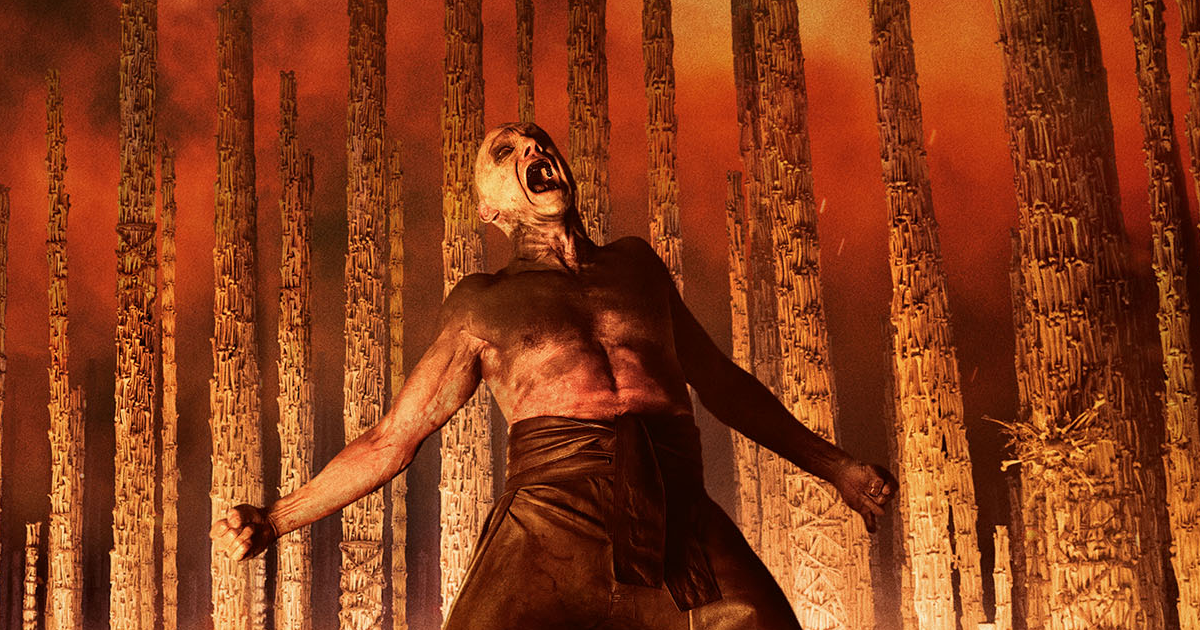
All this carnage is elevated by the absolutely divine cinematography of Sean Bobbitt (12 Years a Slave). 28 Years Later: The Bone Temple is visually stunning, creating a beautiful contrast between the lush green of British landscapes and the somber, skeletal imagery of the temple. Bobbitt creates the most immersive and cinematic experience of the entire series, with phenomenal interplay of light, especially in the use of fire, candles, and night sequences during the third act.
And what about this third act? It’s, without a doubt, one of the most satisfying conclusions I’ve seen recently, elevating the film to a new level. Everything converges into a devilish dance sequence to the sound of Iron Maiden, where the production design, music, and Fiennes‘ devilish performance merge into a grotesque and magnificent spectacle. Every storyline and character development finds a coherent and impactful resolution here. It’s not just sound and fury; it’s the emotional culmination of the entire journey, executed with technical and narrative mastery that left me glued to the seat.
Final Thoughts on 28 Years Later: The Bone Temple
28 Years Later: The Bone Temple asserts itself as an audacious triumph that revitalizes the saga with unexpected ferocity, balancing the franchise’s most repulsive graphic horror with biting narrative intelligence. Elevated by magnetic performances — especially by Ralph Fiennes — and dazzling cinematography that transforms the grotesque into art, the movie is both a spectacle of blood and a deep thematic study on memory and survival that leaves us with the unsettling certainty that, in this new world, evolution is the only alternative to extinction.
Rating: A-
28 Years Later: The Bone Temple is now playing in theaters.
Learn more about the film, including how to buy tickets, at the official website for the title.
You might also like…