
In a small Romanian town, Marius (Adrian Văncică) is the medical chief at the local hospital. He just lost his wife, and his son, Ioan (Teodor Butănescu), is almost finished with high school. This is the setting of You Don’t Belong Here (Nu e locul tau aici) by Florin Şerban. At first, the film is a depiction of a calm city in the interior of the Eastern European country. Yet, the serenity there ends when multiple crimes start happening – a masked gang begins to vandalize cars and households and steal bicycles. In this sense, what starts as a small-scale drama becomes a moral observation of a struggling father, who spends too much time working rather than paying attention to his child. Classically, the man, who has just become a widower, pours everything left in him into the long hospital shifts. Still, he neglects the last years of his child’s development.
Slowly, the film by Şerban introduces fascinating elements about how the son is attempting to fill his mother’s absence with something else: the criminal activity. In that aspect, this project frames itself within the currents of the new wave of Romanian projects, alongside Cristian Mungiu and Cristi Puiu, whose cinema questions the morality of the country. In a sense, You Don’t Belong Here is much more an exercise reminiscent of the first projects of that generation rather than the highly political current of local filmmaking that includes names like Radu Jude. Positioning them within the group, the Şerban leans more towards the earlier names than the absurdist Jude. Factually, there is an interest in the results after its socialist era. The filmmaker wants to discuss the moral corruption of that society and the effects of the political choices on individuals.
In a sense, formally, You Don’t Belong Here is close in style to Mungiu, using long shots to frame space and time, with the director approaching its scenarios through utter realism. It is a fascinating construction of that reality, crafting a dark and cold place. Most of the time, the camera does not move, staying static, similar to its characters, probably in a corner. The result is dubious; it creates a morally dark tale that unveils slowly but feels bloated in some spots. It takes a lot of time to establish these characters and their dynamics, especially because we observe the daily moments of that reality – the long shifts, the conversations at home, among other moments. Even the criminal arrangements take time to develop, while the gang talks under a water dam and discusses their plans.
In this sense, the film, in its second half, works fluidly as the tone has been set. There is a ghostly atmosphere in that city, a vagueness marked by the historical wounds, and the confrontations between the police, the son, and the father are highly dramatic. In one of those crimes, a man died. There lies the dramatic axis of the film; still, it is slowly introduced to the audience. The moral dilemma is built through a slow-burn construction. Despite the overlong nature, the portrays the tedious aspect of the relationship between two individuals suffering from grief and the uncertainty of the moment. In this sense, the film is a complicated work that demands patience, an investment in its narrative, and the intricate reflection on the corrupted society.
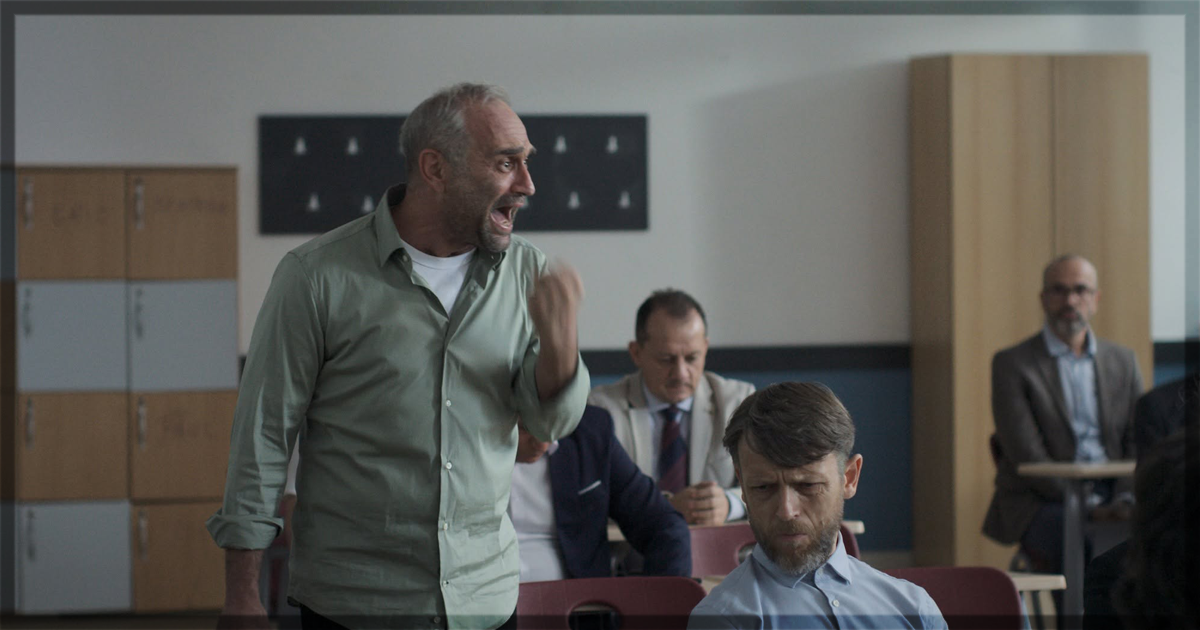
Furthermore, the director attempts to craft a film that depicts the growing danger of the vandalizing acts; yet, while it slowly creates its tension through the long sequences, the stronger moments land in the final scene, where there is a compelling resolution to the complicated quandary that Şerban develops. In the last act, even if it maintains the pacing of the other parts, the punch in that final moment creates a convincing conclusion to a film that takes its time to unwrap. Promptly, Adrian Văncică unravels in that moment, which is the dramatic peak of the film. The actor shifts from restraint to the outburst in a few seconds, delivering the most intense moment, the one that instigates the audience’s thoughts and opinions.
Finally, the new film by Florin Şerban, You Don’t Belong Here, is an intriguing slow-burn narrative that draws from the atmosphere of the Romanian New Wave filmmaking. There is a fascinating aspect of the moral confrontation that explores grief and the lack of attention in the post-loss moment. Ultimately, it does not fully work, but it lands a hard punch in the final moments, especially when Adrian Văncică has time to shine.
You Don’t Belong Hererecently played at the Locarno Film Festival, where it won the Pardo d’Oro.
Learn more about the film at the Locarno site for the title.
You might also like…

‘Titanic Ocean’ Film Review: The Visually Intriguing Debut by Konstantina Kotzamani