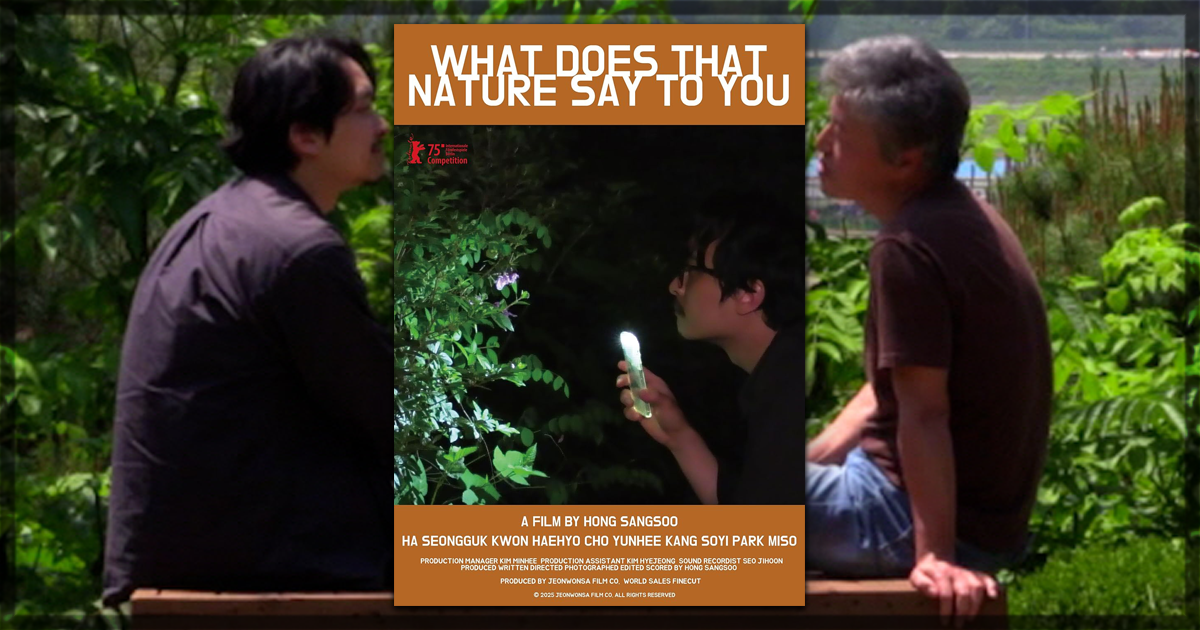
If you think Korean filmmaker Hong Sang-soo’s aesthetics will get more refined after his films have, over the years, preferred a more digitized (read: pixelated, desaturated, out-of-focus) aesthetic, think again! His latest film, within a corpus of slow cinema experiments, What Does That Nature Say to You, contains many of Hong’s recent formal impulses, creating a rather frustrating portrait of an absolutely terrible person meeting the family of the love of his life.
With a budget of five dollars and a dream, Hong creates images that feel as artificial as the façade of Ha Donghwa (Ha Seong-guk) gets unpeeled. He initially appears to be a friendly, supportive boyfriend to Kim Junhee (Kang So-yi), but he slowly reveals himself to be the exact opposite. If anything, What Does That Nature Say to You acts more as a cautionary tale of what not to do upon meeting the parents, because even if your intentions are benevolent, they’ll end up spectacularly backfiring when one too many drinks are in your system.
When he shows up at Kim Oryeong’s (Kwon Hae-hyo) doorstep, the initial vibe is friendly and courteous. Drawn-out introductory conversations give us an initial sense of who these people are, and, more importantly, why Junhee is fond of Donghwa. As Hong’s quest for more impure images continues (see 2023’s In Water, where he shoots his entire movie out of focus, and purposefully so), we get a sense that he isn’t so much looking for sincerity anymore in the static frames he creates with the cheapest cameras he can find.
Yet, there’s something so raw about the pixelated pinks, the blurry crash-zooms on the crackling inhales of a cigarette (which makes the ash feel much redder and less orange than the textures of “polished” digital photography), and the description of beautiful vistas without us ever seeing them at their purest extent that we slowly get swept up into Hong’s artificiality. After all, there isn’t a medium more artificial than cinema, an art form that’s entirely fabricated out of deception and trickery. That can also be an apt descriptor of who Donghwa is, which Junhee and Oryeong will come face-to-face with when day turns to night, and the family begins to speak at the dinner table.
Hong’s camera never judges anyone, but acts as an invisible observer to this tale of deception. The reason why the camera feels misplaced and intrusive is deliberate, and his consistent lingering on conversations we shouldn’t be privy to makes this entire picture uncomfortably confrontational. It feels very much in conversation with his latest foray into minimalism, far more than his most well-known and acclaimed features, On the Beach at Night Alone and Right Now, Wrong Then. In those films, the images were polished and alluring, even as his frames remained minimal and mathematically static.
As Hong grows older, the images he crafts seem blurrier and less certain. Slow cinema enthusiasts may appreciate this logical step into “late-stage,” but the viewing experience of What Does that Nature Say to You is equally frustrating as his previous works, By the Stream and A Traveller’s Needs. While the photography remains the most captivating aspect of his films, the improvisational dialogues seem less natural and captivating and more akin to the ramblings of an old man yelling at clouds. Sometimes, it’ll yield some moments of raw clarity, especially during Donghwa’s drunken monologue about the relationship he had with his father (the greatest showcase for Ha Seong-guk’s acting prowess), but they seem rare in a film that seems less interested in the core characters than it is trying to push Hong’s spontaneous style to the extreme.
It results in a middling affair that makes you question whether or not Hong Sang-soo’s image-making feels earnest when his films now have the tendency to exhaust rather than enlighten. Of course, his most fervent defenders will qualify his latest endeavor as a masterpiece, but he can literally film anything in the most pixelated and desaturated way, and none of them would bat an eye. Sometimes, a bit more distance in parsing what he’s actively doing in the digital world can help us figure out how a once-meaningful filmography, filled with richly layered works of slow cinema, has now become compelling experimental essays entirely devoid of meaning…
What Does that Nature Say to You is now in limited theaters.
Learn more about the film at the IMDB site for the title.
You might also like…