
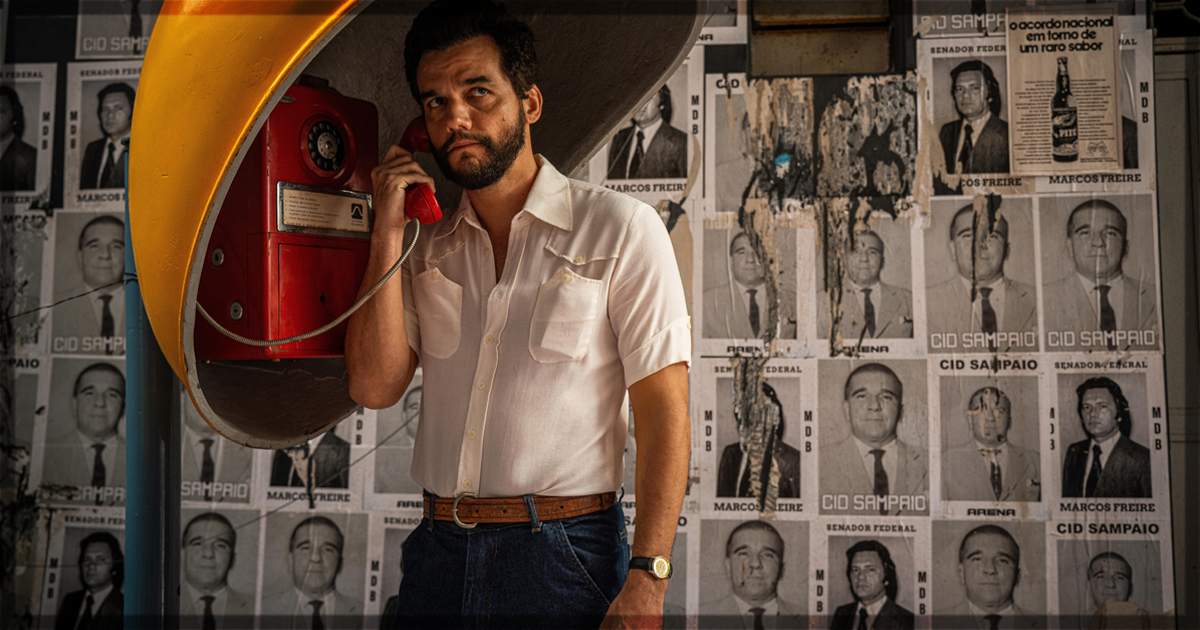
The Secret Agent won two major awards at this year’s Cannes film festival, Best Director for Kleber Mendonça Filho and Best Actor for Wagner Moura, an unusual and enormous compliment. The Secret Agent is a lot like Waiting for Godot, as it is two and a half hours of set-up with an unusual ending. It is still very much worth watching, mostly because of Mr. Moura’s appeal and the wildness of the seventies setting, but the choice not to provide the movie with a conventionally satisfying resolution will limit its appeal outside of its home nation of Brazil to the most committed cineastes. This is not a complaint, but if you’re new to this world it’s not easy at all to keep up.
Marcelo (Mr. Moura) is introduced getting gas at a remote station where the body of a robber shot dead several days previously has been left to be eaten by wild dogs in the heat. On arrival in Recife, Marcelo settles into an apartment building owned by the indomitable elderly Sebastiana (Tânia Maria), who introduces him to the building’s other residents with a remarkable amount of frankness. It’s carnival season, so the streets are full of music, dancing, and incredible amounts of mayhem, which the papers report on with sensationalist glee. Marcelo starts a job at the municipal records office, though on his first day the office pretends to be a police station so that a wealthy woman who caused the death of her maid’s small child can give her statement in comfort. Marcelo’s father-in-law Alexandre (Carlos Francisco) runs the local movie theatre, and has been raising Marcelo’s son since the death of his daughter, Marcelo’s wife. The little boy is obsessed with sharks and gaga to see the movie Jaws, despite him finding the mere concept completely terrifying. And if you think this is complicated and convoluted, just you wait.
For one thing, a huge amount of crimes in the city are committed by “a hairy leg” which hops around beating up people having sex in public. A lot of people have sex in public in this town. And when you’re living under a military dictatorship, crimes might as well be committed by a disembodied limb. Speaking of body parts, the local police chief Euclides (Robério Diógenes) tries to hush up the fact a shark being studied at the local university was discovered to have a human leg inside it. A lot of people go missing, with bodies occasionally thrown into the reservoir by Euclides’ bagmen. Other times they are disposed of by a pair of ruthless hitmen, Augusto (Roney Villela) and his stepson Bobbi (Gabriel Leone), who are on the hunt for Marcelo.
Marcelo is not his real name; in fact nobody in Sebastiana’s building is using their real names. Not that people are consistent about this; it’s hard to keep things secret and it’s lonely having to lie about who you are. Mr Moura walks through the movie with a calm confidence rare from even the most famous movie stars; his level of self-belief is essential to the success both of the character and the film. Marcelo knows he’s in a trap, but he also knows he can get out of it; there’s something about him, and he knows it. The reason he’s willing to take such a visible job in the records office involves an awfully sad (and awfully ordinary) story, and the reason he’s on the run is sadder still. There are people trying to help him, namely Elza (Maria Fernanda Cândido) and her network of ordinary people trying to stand up to the corruption all around them. There are also many more people watching, willing to sell the small amount of information they know, and or willing to do some very dirty work for almost nothing. It’s not that life is cheap here; life is never cheap anywhere. It’s just that, for the rich and powerful, there are no consequences for any of their behaviour. Whether that’s causing the death of one person or harming millions, if you have the money and the right friends you can do literally anything. If you get caught up in trouble, you’ve got nothing but your luck on your side. Fortunately Marcelo is a lucky man, but his luck will be tested to its limits.
The modern day framing is supposed to show the limits of memory and the difficulty of understanding a time if you haven’t lived through it, but it also removes the conventional hero’s arc for something more complicated and less satisfying. This is plenty realistic but it’s not traditional storytelling. And yet, since Mendonça Filho has established a career for himself as a fearless truth-teller in Brazilian culture, unafraid to stand up to government corruption within his movies, mine is perhaps not the most relevant criticism The Secret Agent will enjoy. It’s not out in Brazil for another few weeks but has already been at the center of a political firestorm over whether it would be put forward as Brazil’s nomination for an Oscar. It has been, but under the weight of these pressures it’s very hard to figure out how to respond to its merits and its flaws.
For those of us not attuned to the nuances of Brazilian culture and politics, it’s hard to understand why The Secret Agent cuts itself off at the knees. On the other hand, it’s very likely that home audiences will see this as such an accurate reconstruction of a terrible time that the obvious emotional power will carry the day. Its excellent period setting, which includes Evgenia Alexandrova’s gritty cinematography and Rita Azevedo’s extraordinary costumes, provides a palpably vivid world that must not have been any fun at all to live through. Except for all the fun: the dancing, the drugs, the casual attitude to sex, the personal frankness and the liberating freedom which comes from knowing death is around every corner. As a depiction of a way of life that’s not as dead as we would like it to be, The Secret Agent is unmissable cinema. But is that all there is?
The Secret Agent is now in theaters.
Learn more about the film at the IMDB site for the title.
You might also like…

‘The Choral’ Film Review