
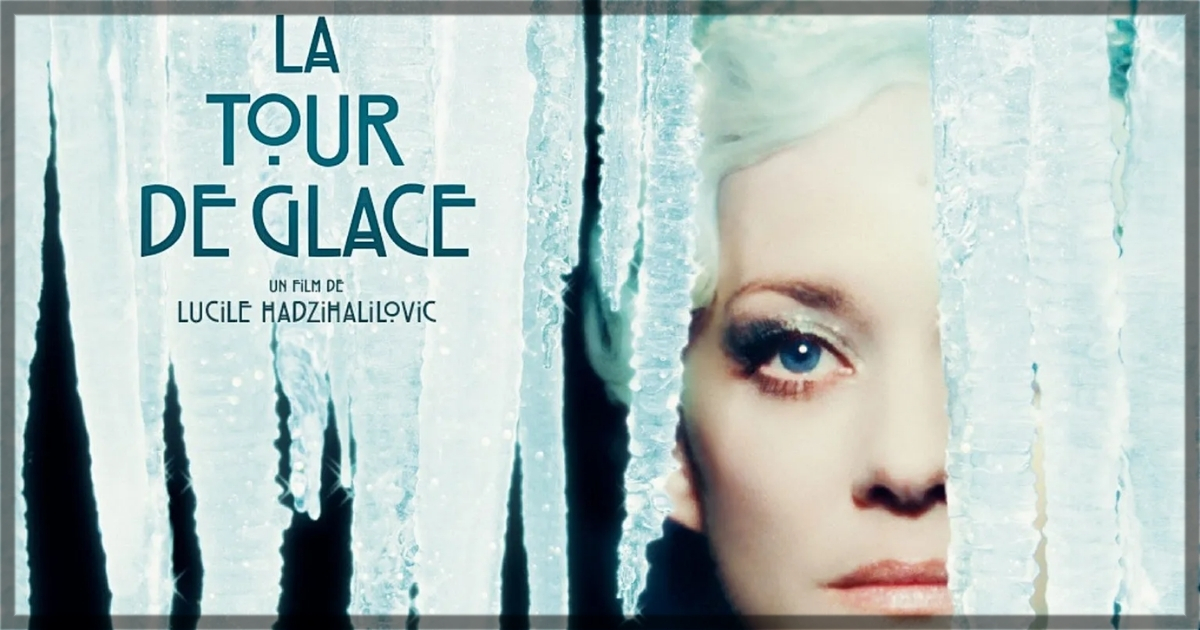
Lucile Hadžihalilović has only four works in her filmography, but each of her new releases draws attention from the audience. Directing her feature debut, Innocence, in 2004, starring Marion Cotillard, the Bosnian filmmaker established a connection with the Toronto Film Festival, where she premiered her subsequent two films: Evolution and Earwig. Yet, typically, people mention Hadžihalilović’s name alongside that of Gaspar Noé, her partner, the French provocateur. They collaborated on works such as Carne, Enter the Void, and Vortex. Four years after her last film, the director returns with The Ice Tower (La Tour de Glace), her first work to compete in a major European festival, premiering at this year’s Berlinale. After twenty-one years, the filmmaker and Cotillard collaborate again, at different career stages than when they last worked together. Hadžihalilović established a name for herself in the French and European industry, while the actor is one of the household names of this century.
The film narrates the notion of an actor’s ego. In the 1970s, Jeanne (Clara Pacini), a young orphan, lived in a foster home near the mountains. As the oldest in the shelter, she serves as a role model for the other children, even caring for them and reading stories to them. One of her shelter sisters asks her to read a story every night; hence, they read The Snow Queen, the tale by Hans Christian Andersen. Suddenly, Jeanne decides to leave the village and head to the city, where her parents used to live. Homeless, she invades a building, coincidentally, a film set for the adaptation of her favorite story. Therefore, Jeanne assumes the identity of Bianca, a girl she met, and loses her documents, allowing the orphan to bear another identity. Bianca is more outgoing than Jeanne, promptly wandering around the set and becoming an extra. For multiple reasons, Bianca and Cristina (Cotillard) grow fond of each other, developing a complex, intricate relationship.
At the same time, The Ice Tower is a coming-of-age and ego trip story. The central characters face similar situations, questioning the reality of the mundane, while they delve into the telling of a classic fable. Hadžihalilović, who penned the script with Geoff Cox, divides the film into two different moments. Firstly, it is Jeanne’s escape from being an orphan who spent her days in the cold weather around the mountain chains. Inherently, the lead character has a profound emotional connection to ice, whether in her village, in the story she tells, or in her flight to a city with an ice ring downtown. Hence, frozen water is arguably an element of the girl’s life. The event that precedes her escape is the accident while hiking the mountain, when she realizes her need to go away. Yet, it is a story element that lacks explanation, but works on its own.
However, the subsequent part, Bianca in the magical reality of filmmaking, is the opposite of the first. The girl is in unfamiliar territory, playing a character she is not. Nonetheless, it is fascinating to understand the psychology of this girl, whom we knew little about previously. Still, the script develops the relationship with the actor, a depressed star with an elevated ego and a poor work ethic. Despite the engaging mystery in that character, the enigmatic nature of her interest in the girl is not as fascinating as it seems. Cotillard is playing on a different note than the debuting actor, who employs a curious naivety for the protagonist. They seem like they are in two different films, one about the youth discovery and the other about an actor’s ego trip. Therefore, it lacks work surrounding the enigma, and even her interactions convey a sense of boredom.
On the other hand, Hadžihalilović creates a visually fascinating world. The set design emulates a reality that is contradictory to the one experienced by Bianca/Jeanne, in which the mysticism has a materiality. Hence, the hotel rooms and venues that Bianca visits have a throwback look, an antique aspect. In this sense, these venues represent a thoroughly different reality for the girl. She is not in the same place anymore; there is no comfort to her existence: home, foster siblings, and food. Bianca depends on the actor’s obsession, derived from her sexual desire for the young woman. Unfortunately, the last arch is not a landed punch as intended. The climax feels rushed and weightless, lacking substance to add force to the film’s final arc.
In the end, The Ice Tower (La Tour de Glace) has an engaging obsession dynamics between the young lead and the household presence of Marion Cottilard. Yet it lacks more to fully engage with the psychological thriller it introduces but never fully develops.
The Ice Tower has recently played at a number of international film festivals.
Learn more about the film at the IMDB site for the title.
You might also like…