South Korean cinema holds a prominent place in my cinematic preferences, being a passion that makes me follow almost everything coming out of that region with genuine excitement. Beyond that, disaster movies are my ultimate guilty pleasure. I didn’t have any prior knowledge of director Kim Byung-woo‘s work, nor was I familiar with the lead actress’s career, but the premise of seeing a city submerged by an apocalyptic deluge was enough to spark my immediate curiosity.
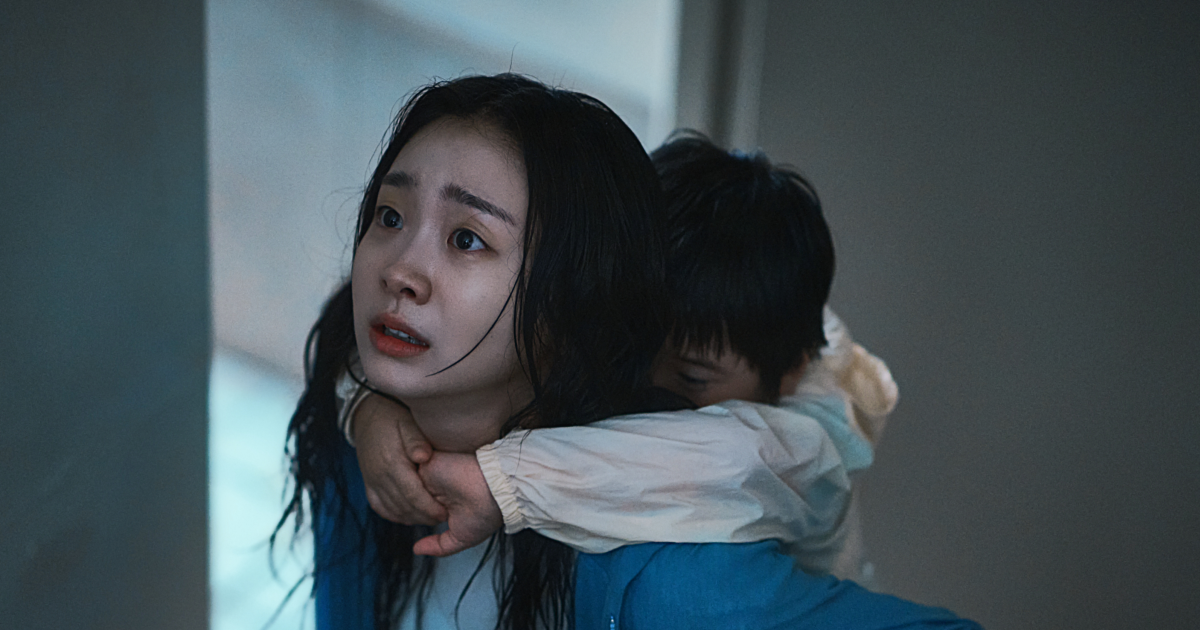
The Great Flood presents us with a world swallowed by an unprecedented inundation. In the middle of this massive catastrophe, water rises relentlessly inside a condominium, erasing every trace of hope. It’s within this isolated setting that the one person needed to enact a plan to help the remnants of humanity evolve and return to Earth decides, instead, to fight desperately to save her child from the rising waters. Written by Byung-woo and Han Ji-su, the film stars Kim Da-mi (Soulmate) and Park Hae-soo (Squid Game).
The element that truly prevents The Great Flood from drowning prematurely is Kim Da-mi‘s performance. The actress delivers an interpretation loaded with emotional authenticity, portraying maternal anguish and the coldness of someone who holds vital scientific knowledge, clearly standing as the beating heart of the story. In the scenes where water invades her space, Da-mi‘s eyes communicate a primal yet sophisticated fear, making us feel every frantic breath. It’s through her presence that the movie achieves its rare moments of genuine human connection. Unfortunately, the rest of the film rarely reaches this level of commitment.
Visually, the Netflix production presents competent digital effects and sets, yet far from revolutionary. The sequences illustrating the water rising in the corridors or the tsunamis slowly approaching fulfill the role of creating an atmosphere of urgency, allowing us to feel the weight of the disaster. However, it lacks that note of creativity that transforms a catastrophe into a memorable spectacle. There are no aesthetic elements that haven’t been seen before in other genre flicks, and the reliance on dark environments and murky water ends up camouflaging a certain lack of technical boldness in the cinematography, despite some interesting interior shots.
The biggest hurdle to success is the narrative incoherence that sets in from the middle of the movie. The transition from a survival thriller to a complex science fiction puzzle is executed in a clumsy manner. The Great Flood gets bogged down in theoretical explanations and conceptual leaps that, instead of deepening the human drama, only create unnecessary confusion that distracts from the immediate danger. This shift in tone breaks the initial rhythm, trapping the viewer in a tangle of half-baked concepts. The sense of danger dissipates, replaced by a cerebral exercise that tests one’s patience without offering a satisfying thematic reward.
This fragility is accentuated by a derivative nature impossible to ignore. It’s clear that The Great Flood seeks inspiration from Hollywood works, trying to mimic the blend of scientific grandiosity with deep family conflicts. However, it lacks the structural rigor needed to sustain such ambitions. The themes involving the future of humanity and the weight of memory feel wrapped in clichés that have been better handled elsewhere, such as in the movies of Christopher Nolan (Interstellar). Instead of building its own identity, the film feels like a collage of external references, getting lost in its attempt to be deeper than its execution allows.
Final Thoughts on The Great Flood
The Great Flood ends up being a bittersweet experience, promising an immersion into the human soul in the face of the abyss, but floating only on the surface of several ideas without truly diving into any of them. It benefits immensely from the talent of Kim Da-mi, but it’s pulled down by a script that can’t decide if it wants to be an action blockbuster or a philosophical essay. An ambitious project that forgot to solidify its emotional foundations before opening the floodgates of scientific complexity.
Rating: C
The Great Flood is now playing on Netflix.
Learn more about the film, including how to watch it, at the official website for the title.
You might also like…