The choice to film in black and white is the wrong one for historical dramas. It signifies to a modern audience that this story is happening in ye olden days and therefore none of the historical nuances matter, because we are watching the distant and irrelevant past. Thanks to an early reference to the Great War, the group behind me at the Berlinale thought Rose took place in the 1910s after the First World War, instead of the 1640s, after the Thirty Years’ War which caused famine and chaos in central Europe. It is difficult to understand how such a basic mistake could be made, both by the audience and by the filmmakers. That aside, Rose makes a complex story very easy to watch, with a lot to say about gender roles, how communities police themselves, and what people will do to survive.
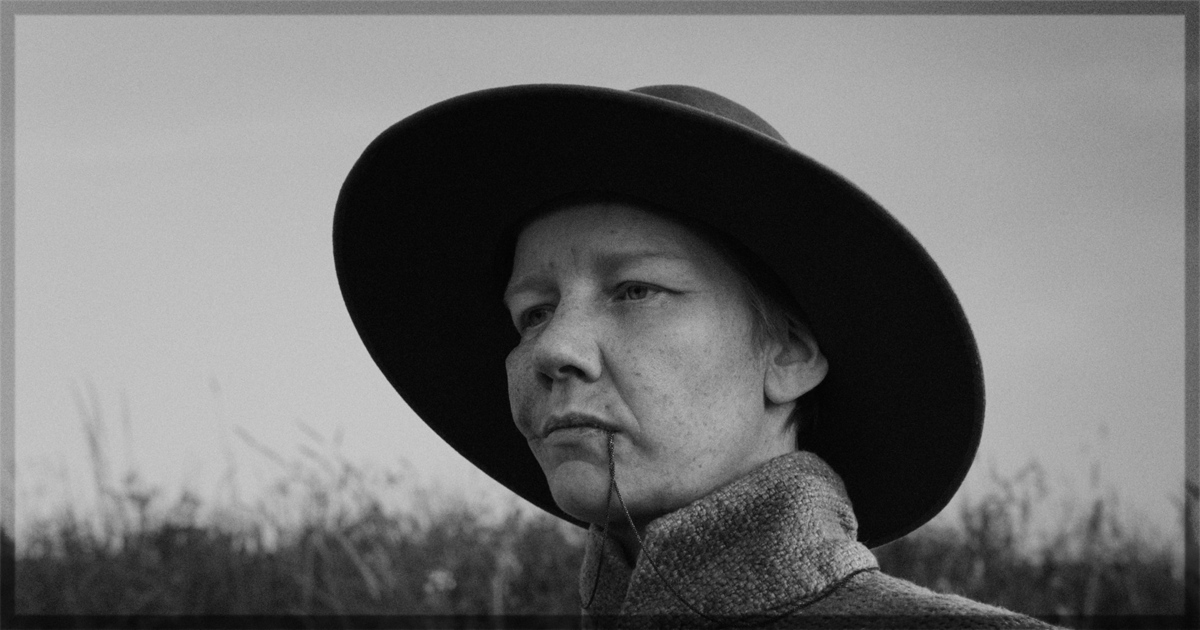
In a village in rural Germany struggling mightily since that great war, a soldier arrives with the paperwork and the gold which identifies him as ‘the master’ of a farm that’s been left to rot. ‘The master’ spent only limited time there as a child, so no one recognises him, but he knows some secrets, the paperwork is legit, and again, has enormous amounts of gold, so the keys are handed over. The fact he has no facial hair is put down to the scars he received from getting shot in the face. He wears the bullet which destroyed his face on a chain around his neck and chews it in times of stress. But the narration by Marisa Growaldt makes clear right away that the soldier is not ‘the master’ at all. The soldier is not even a he.
Her true name, kept secret from all, is Rose (Sandra Hüller, who justifiably won the Silver Bear for Best Leading Performance for her work here). She has been disguising herself as a man and fighting as a soldier for decades. A nice retirement on a little farm seems a due reward after so many years of war. Eventually ‘the master’ is largely accepted into village life – saving one of her workers from a bear attack goes a long way towards this – and makes the farm a thriving business. But when it comes to business, there’s only one thing a farmer really needs: a wife.
The offer Rose can’t refuse is Suzanna (Caro Braun), the uneducated and unloved eldest daughter of a nearby landowner, who understands perfectly that she has been sold as part of a business transaction. On their wedding night, Rose removes the bullet from her mouth and informs Suzanna that her purity is what she values above all and therefore the marriage will not be consummated. Suzanna is left to remove her spangled wedding headdress and crawl into the bed-shelf alone. But when marriage is a business, children are the greatest potential assets. Rose hasn’t survived this long without a few tricks up her sleeve, of course. But to her great surprise, Suzanna has a few tricks herself.
This is not a movie about homosexuality, and neither is it a movie about changing gender. It is about the limitations of gender roles and how strictly society enforces them. It is made clear that everyone can sense something is wrong with Rose – her mania for privacy and ‘his’ unusual physicality are obvious – but thanks to those gender roles, and to ‘the master’s’ money, anyone with questions keeps their mouths shut. It’s also made clear that gift for silence is the price of life in the village, of being allowed to live among people who provide you with safety and in return get to make your choices for you. The alternative is a life like Rose’s as expendable cannon fodder and surviving only by doing terrible things. But worse than that, Rose has been unable to trust anyone for a moment for decades in case her secret is discovered. Ms. Hüller does a wonderful job showing ‘the master’ doing her best without ever acknowledging the price being paid for her success. It’s a careful and quiet tightrope walk in an unflattering role but Ms. Hüller ensures we understand the constant dangers of her choices and why she has continued to make them.
Director Markus Schleinzer, who co-wrote the script with Alexander Brom, is to be commended for how expertly the film makes these complicated topics clear, and how thoroughly we are enabled to understand Rose’s feelings. The sounds follow the seasons, with a vibrant sense of the work needed to run the farm, and how hard Rose, Suzanna and their team must work to keep themselves fed and warm. Gerald Kerkletz’s cinematography does provide a sense of the weather and the seasons, with a feeling of cold that ebbs and flows. But lovely as it is, the choice to film in black and white really was a mistake. Issues of gender are not locked in the distant past, and questions about of how people care for each other, the secrets within any relationship and how a society protects its values are still extremely relevant. A major misstep, but the power of Rose lies in how easily we are able to sympathise with its central struggle. The past is never as out of reach as anyone might like, and the limitations of our bodies are something we must reckon with until the moment of our death. It’s always been tough to survive, but Rose knows the importance of everyone finding their own way.
Rose recently played at the Berlin International Film Festival.
Learn more about the film at the IMDB site for the title.
You might also like…
‘Dua’ Shows What War Feels Like for a Girl (Cannes 2026 Film Review)