
Like a large portion of the audience, I walked into the theater without any familiarity with the literary work by Andy Weir that the film attempts to adapt — yes, the majority of viewers have never read, played, or known the source material on the vast majority of these occasions. Furthermore, I managed to (easily) avoid every single clip of Project Hail Mary until the moment I sat down in the IMAX theater, which I can already state is the only screen where this movie deserves to be seen. However, my expectations were at a stratospheric level. On one hand, I had Phil Lord and Christopher Miller (Spider-Man: Across the Spider-Verse), a duo I deeply admire in both direction and writing; on the other, screenwriter Drew Goddard (The Martian), whose work I also follow with enormous enthusiasm. Add to this the casting of Ryan Gosling (La La Land), a true star who rarely misses, and a sci-fi adventure premise tailor-made for the largest screen in cinema, and the perfect recipe for a major cinematic event was created. Even ignoring the usual noise of hyper-positive digital reactions — frequently exaggerated to obtain the much-coveted “pull-quotes” and the like — I felt I was about to witness something truly special.
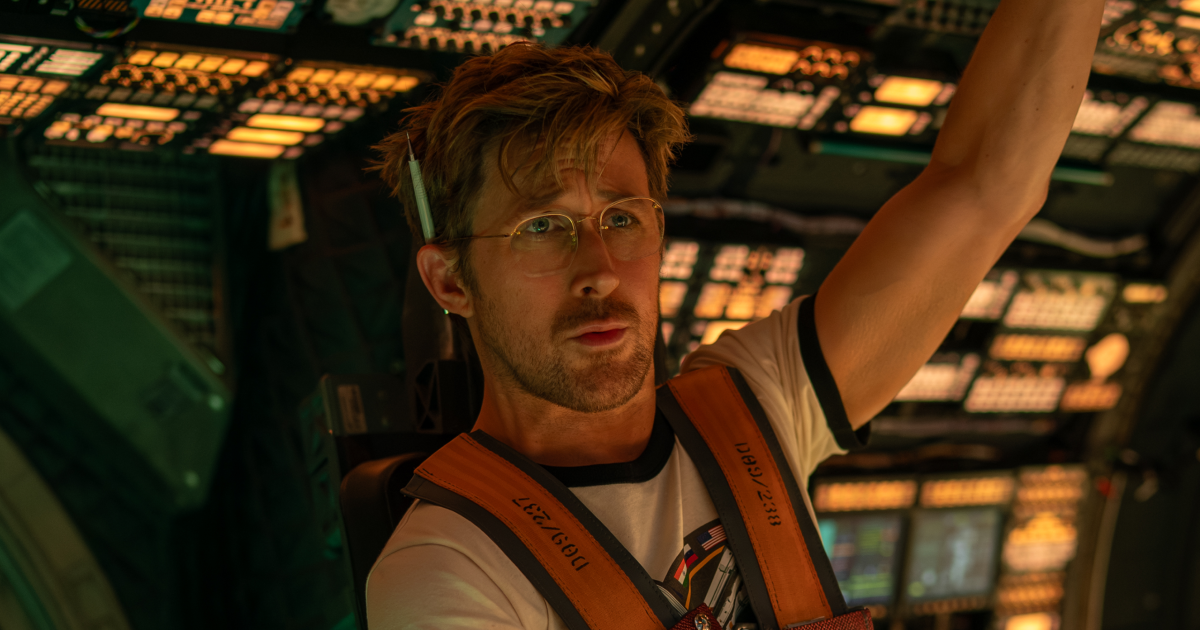
In Project Hail Mary, I follow the journey of Ryland Grace (Gosling), a science teacher who wakes up on a spaceship with no memory of who he is or how he got there. As fragments of his memory return through fragmented flashbacks, Grace realizes he’s the last survivor of a desperate mission to save Earth from an unprecedented solar catastrophe caused by an organism that consumes the Sun’s energy. The lead actor is joined by Sandra Hüller (Anatomy of a Fall) as the relentless and pragmatic Eva Stratt, his superior and the top official responsible for the global project, and James Ortiz (The Old Man and the Old Moon), the voice, master puppeteer, and designer responsible for bringing Rocky to life — an alien who creates an unexpected friendship with Grace.
The pillar of this adaptation’s success lies, without a doubt, in Gosling‘s monumental performance. It’s difficult to choose a single role in his career already filled with successes, but here Gosling delivers one of his best interpretations by balancing the vulnerability of a terrified man with the ingenuity of a brilliant scientist, in addition to the tremendous burden of being, for much of the runtime, the only human character on the big screen. Grace isn’t the classic hero; he’s an ordinary man with deep flaws and a past marked by a certain escape from responsibility. His redemption arc is the emotional engine of the narrative: from being a self-proclaimed coward, who was forced to accept a mission he never wanted, to transforming himself into a hero of two worlds. Gosling ensures that every discovery or scientific resolution and every moment of absolute despair is felt, making the loneliness of space almost palpable through his physical expressiveness and emotional delivery.
That said, Project Hail Mary gains an extraordinary dimension when it introduces Rocky. The chemistry between Gosling and this alien creature is absolutely fantastic, proving to be more authentic and moving than many human relationships in contemporary cinema. The credit goes to the brilliant decision to use practical effects and puppetry instead of relying solely on heavy and sterile CGI. This choice lends a realistic and tactile touch to a sci-fi adventure that could easily have been lost in digital artificiality. Rocky isn’t just a visual feat or a biological curiosity, but he’s also the moral compass of the story — a being of pure altruism whose “humanity” and sense of duty transcend any basic instinct for self-preservation. The way they communicate, initially through music and mathematics, is a lesson in the patience and empathy required to understand what’s different from us.
Visually, Project Hail Mary is nothing short of breathtaking, raising the genre’s standard even higher for this decade. The space imagery, captured by the masterful lens of Greig Fraser (Dune), is magnificent and — I’ll repeat and emphasize — deserves to be experienced on the largest IMAX screen possible. The creative use of infrared sequences and the impressive scale of the ships and planets create an immersive experience that truly transports the audience into the vacuum of space, not forgetting a truly beautiful use of silhouettes. Accompanying this visual prowess is a score by Daniel Pemberton (Spider-Man: Across the Spider-Verse) that stands out as a technical and emotional triumph, hitting the right notes in moments of highest tension and aiding the flow of tears when the narrative reaches its dramatic peak. When it comes to the supporting cast, Hüller offers a deadpan performance that works exceptionally well. Her Stratt is the cold and necessary counterpoint to Grace’s powerful journey, representing the weight of utilitarian decisions that ignore the individual in favor of the species.
The ethical tension between collective utility and individual will is, in fact, one of the most fascinating thematic pillars of Project Hail Mary. Through the complex relationship between Grace and Stratt, the story questions how much of our own essence we’re willing to sacrifice to ensure the continuity of the human race. While Stratt personifies the cold calculation of someone carrying the fate of billions on her shoulders, Grace is the human element that reminds us that survival, by itself, is an empty prize if it’s achieved through the abolishment of freedom of choice. This moral conflict serves to elevate Grace’s eventual heroism: it’s not a blind act of duty imposed by a superior authority, but rather a conscious and voluntary decision by someone who learned the value of sacrifice through empathy rather than fear.
Furthermore, Project Hail Mary proposes an inspiring vision of curiosity as the ultimate tool for unity. The narrative suggests that science is a universal language, but friendship is what serves as its fundamental translator. The encounter between these two civilizations isn’t marked by panic or conquest, but by a mutual recognition of fragility. It’s fascinating to observe how the film uses the isolation of Grace and Rocky to underline the biological need for connection, regardless of the planet of origin. The protagonist doesn’t grow just because he solves equations, but because he becomes responsible for someone who doesn’t share his DNA but shares his loneliness. This radical openness to the “other” is what makes the movie so relevant in an increasingly fragmented real world.
As an engineer myself, I admit to a very particular kind of special delight in how Project Hail Mary approaches the heavier scenes in scientific developments. It’s a delicate and dangerous balance, as the constant focus on technical dialogue and conflict resolution through math, physics, and molecular biology can eventually alienate or bore an audience less familiar or simply less interested in these areas. However, the creativity in exposing complex concepts is to be praised. Lord and Miller rarely resort to merely expository dialogues to “explain” what’s happening, often using clever visual cues and the protagonist’s own trial-and-error process. At no point do they underestimate the intelligence of those watching, inviting the audience to solve the cosmic puzzle along with Grace, which makes the scientific victories much more satisfying and rewarding.
In the end, I found very small edges to be smoothed out. I felt some tonal inconsistency in specific passages, with certain attempts at humor appearing in moments of extreme gravity. Although most of Gosling‘s typical “quips” work within the context of the character, there were instances where silence or pure tension would have benefited the atmosphere of imminent danger much more. It’s also impossible not to notice certain aesthetic and rhythmic influences from previous works like Interstellar, The Martian, or even Arrival. However, these similarities never reach the point of taking away from the originality of this adaptation, which manages to establish its own independent arcs and thematic merits. The narrative structure, which constantly alternates between the “present” in space and the “past” on Earth, is well-executed and maintains the rhythm, although one or two transitions could have been more organic had they occurred at a different point in the editing. All minor issues that in no way change the fact that Project Hail Mary is, as of the date of this review, my favorite film of 2026.
Final Thoughts on Project Hail Mary
Project Hail Mary stands as a triumph of narrative over technique, where the redemption of a man who believed himself a coward becomes the symbol of hope for an entire civilization. It’s a beautiful exploration of how genuine communication and personal sacrifice can tear down the most unthinkable barriers, uniting two beings from opposite worlds in a common purpose. Leaving the theater, my thoughts weren’t focused on orbital physics or alien chemistry, but on the profound lesson of altruism that Rocky and Grace leave to the real world. It asserts itself as one of the most immersive and emotionally rewarding sci-fi experiences in recent cinema, joining the technical grandeur of an IMAX production with the intimacy of one of the purest friendships ever seen on screen through a memorable performance by Ryan Gosling. It reminds us that, in the deafening silence of the cosmos, our greatest strength doesn’t lie in the problems solved, but in the courage to reach out to the unknown to discover that one is never truly alone. In the end, what really lasts aren’t the cutting-edge visual effects or the scientific rigor, but the soul of the story.
Rating: A-
Project Hail Mary is now playing in theaters.
Learn more about the film, including how to buy tickets, at the official website for the title.
You might also like…