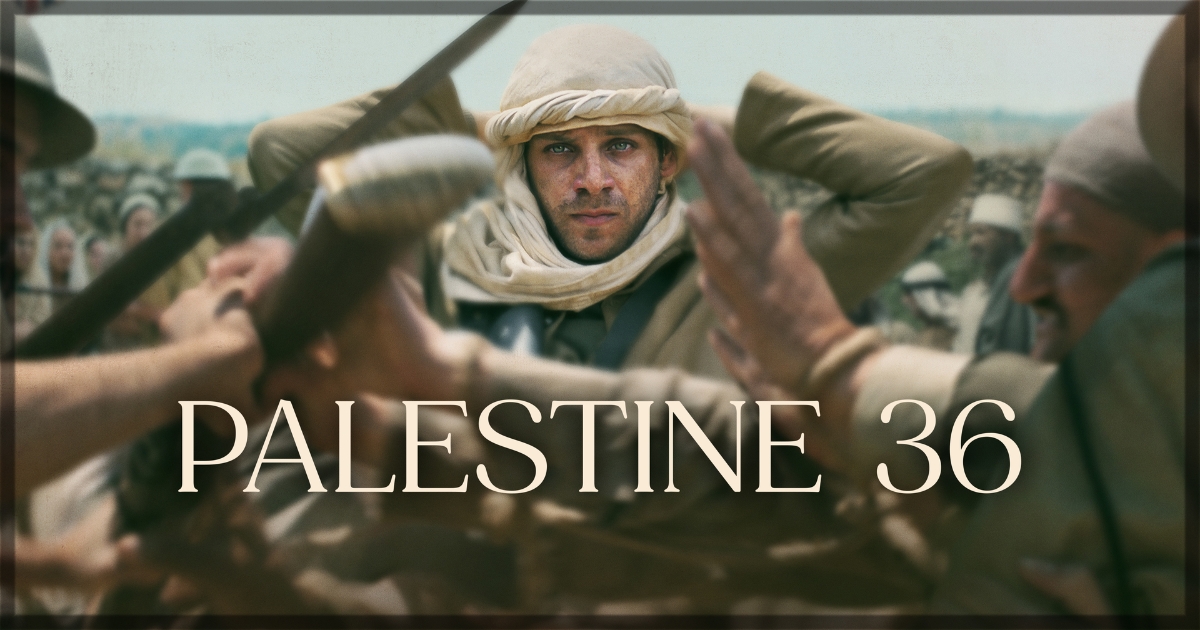
Annemarie Jacir is a crucial filmmaker to understand modern Palestinian cinema. In 2003, she made history with her short film, Like Twenty Impossibles, the first Arab short selected at the Festival de Cannes, and later earned an Academy Award nomination. In her subsequent efforts, Jacir reached the principal international stages. She presented her films Salt of the Sea, When I Saw You, and Wajib at Locarno, Cannes, and the Toronto International Film Festival. However, after those releases, the Palestinian filmmaker took a six-year hiatus to produce her long-gestating film, Palestine 36. The director returns to a pre-Nakba setting in 1936, when the Palestinians were under British colonial rule. However, suddenly, the Zionists began to settle more and more land occupied by the Arab population, and revolutionary groups decided to fight the occupation by force. Hence, Jacir creates a historical epic about colonialism, the first steps of the Palestinian genocide, and the preparation for the Nakba.
Firstly, the director and casting directors, Gary Davy, Luna Mouallem, and Samaa Wakeem, assemble a cast comprising veteran actors, both Arab and British, such as Saleh Bakri, Hiam Abbass, Jeremy Irons, and Liam Cunningham, alongside a new generation of Arab actors like Karim Daoud Anaya. In this sense, the casting sums up the film’s overall sentiment: a clash between the locals and the foreigners. The British contingent features more mature actors, such as Irons, a well-known performer who has acted in a hundred films. In the film’s structure, the older population is the British administration, and the Zionists who control the decision-making of that region. Yet, those few members of the bourgeois elite in the 1930s, with their extravagant parties and social gatherings, were opposed to the harsh reality of the Palestinians. Hence, the youth are present on the lands and farms, working on the ground to produce the basic supplies they need to survive, while they pay absurd taxes and wages.
Consequently, Jacir positions an us-versus-them narrative, where the Arabs confront their colonizers, who pressure them more daily, and escalate the violence. Yusuf, the character played by the newcomer Karim Daoud Anaya, represents the dichotomy of that society. He is a young Palestinian man who must help his family in the land, but also works as a servant in an elite household in the British village. Yusuf observes the opportunity of growing by working for the colonizers, but they are the same ones who murdered members of his family and jailed his whole village. He is the perfect individual for the Zionist institutions, one who serves them and does not rebel against their aggression. Therefore, he is the stereotype of the ideal colonized, different from his peers, who support the uprising and revolution in that community.
The director releases her film at TIFF during a historical time. While the world watches a livestreamed genocide of the Palestinian population, filmmakers attempt to document the brutalities of zionism throughout history. Plenty of voices highlight the absurdity of the Israeli aggression, even contextualizing the precedent of the settlers in that region. Jacir designs an epic that portrays the revolutionary insurgency of an oppressed group. Through her cinematography committee, composed of Héléne Louvart, Sarah Blum, and Tim Fleming, the film travels back to the 1930s, re-creating a bygone era. Consequently, the director approaches a crucial element of epic dramas, the scale. The film has an immense scope, shifting from well-designed sets that paint a picture of Palestine in that era.
Furthermore, the narrative has a density that slows the pacing and requires attention to the events and dialogue. Regarding the theme, it is a heavily political film, especially in the current context, stretching the genocidal history, demonstrating that it began even before the Nakba. Yet, the film has an impressive production, including the costume designs, which carefully replicate the British army suits. Therefore, the film is evident in its cautious respect for history, visually and narratively, remembering a few of the events that led to a popular manifestation against the British Council. Despite the bloat in its script, the film incorporates elements of the political background of that territory, a crucial aspect to a deep understanding of those events and the history it narrates.
Unfortunately, Palestine 36 has a more profound meaning upon its release. It is not solely a representation of the colonial violence against the Palestinian population, but also a testament to a genocide that began pre-Nakba. Hence, Annemarie Jacir delivers a film that speaks profoundly to the present, but most importantly, eternizes the Palestinian struggle in cinema.
Palestine 36 has recently played at a number of international film festivals.
Learn more about the film at the IMDB site for the title.
You might also like…