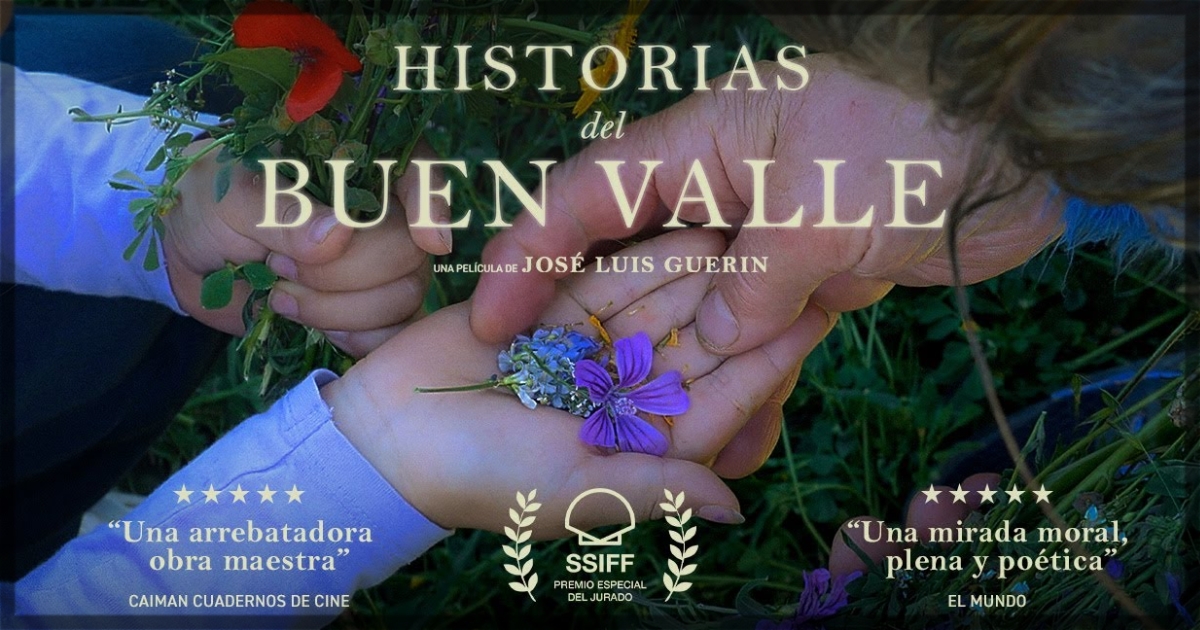
Few countries in the world have invested in documentary filmmaking as much as Spain. In recent years, films like Tardes de Soledad by Albert Serra have impacted the festival circuit with their gut-wrenching observations of bullfighting. Also, there are new names in the Spanish non-fiction community, such as Patricia Franquesa in My Sextortion Diary. The secret to the prolific identity of their documentary production is the balance between newer names and veterans, who approach Spanish culture from multiple perspectives, each offering a distinct viewpoint to each work. One of those veteran household names is José Luis Guerín, whose filmography alternates between fiction and documentaries. He has well-known films like En Construcción and Tren de Sombras. Hence, Guerín returns to filmmaking with Historias del Buen Valle (Good Valley Story), a documentary about the outskirts of Barcelona. The director presented his latest release at the San Sebastián International Film Festival, a quintessential event for Spanish cinema.
In his new project, the Spanish veteran approaches the district of Vallbona, outside Barcelona, one of the country’s most vital cities and universally known for its football team. Guerín portrays the neighborhood as a character. In a sense, we meet that part of the city as an alternative to the gentrification in Barcelona; therefore, it is an affordable place for the working class. Yet the director frames the worn-out bricks of the streets, which welcome immigrants, migrants, and those who need a decent, reasonable place to live. The director films the relationship between the inhabitants of that location and the physical space. Most of them moved there for a limited time but found a home, a community. They are a group that sought temporary shelter. However, they discovered a lifelong refuge. Mostly surrounded by other individuals who pursued the same.
In this sense, the director, in its first minutes, interviews different groups of individuals from that area: children, women, and men. They are elderly, infants, and middle-aged individuals who have settled in that region. Promptly, he asks about their favorite activities and experiences, or how they ended up in this place. Were they immigrating from other countries, moving to Barcelona to work, on temporary rental, or born there? Consequently, we get multiple answers that summarize what the neighborhood is. There are stories from individuals who came from other Spanish regions or from Portugal, for example. Yet there is a cohesion to the multiple stories present; they are heartfelt.
We forget how the environment around us affects who we become; thus, Guerín wishes to comprehend the level of atmospheric interference on that group of people.
Furthermore, the Spanish director sits and observes the community in the center of his film. He wants to comprehend the actions and behaviors of each group. In a gorgeously shot scene, which applies to the whole of Alicia Almiñana’s work, the director sits and contemplates the beauty of the social interactions. There are tons of neighbors sitting in the streets, around tables, singing and playing a guitar, echoing Spanish popular songs. In a sense, it outlines the whole film: a trip to the Vallbona valley, outside Barcelona, where people reject the logic of our post-capitalist era. In a period when rents skyrocket, there is a constant exodus from the urban centers to the outskirts, peripheries, and inner sides.
In a sense, Guerín observes through its loose structure the possibilities of the communal building. Yet, the director attempts to paint the importance of the communities in a neoliberal world, where individuals come before groups. The planting of flowers, singing in the public squares, and collectively gathering, imprint a different logic on the 21st Century, which is the celebration of individualism and consumerism. In a particular sphere, the director writes his anti-real state letter, contradicting the lifestyle philosophy of the new generation of entrepreneurs and consumers.
In the end, José Luis Guerín utilizes the current timeline to understand the ancient costumes that we are losing as a society. When he points his camera at the Vallbona community, he observes the beauty of collectiveness. Historias del Buen Valle (Good Valley Story) is a crucial document of the past and present of that neighborhood, an essential district in Catalonia that served as a shelter for immigrants, migrants, and the working class. Yet, when Guerín films a singing group in the streets, he captures the collective spirit of the community, which reaches beyond just living next door to each other. Happily, the director immortalizes those stories, which are too relevant to stay solely in oral form.
Historias del Buen Valle (Good Valley Story) recently played at the San Sebastian International Film Festival.
Learn more about the film on the IMDb page for the title.
You might also like…