
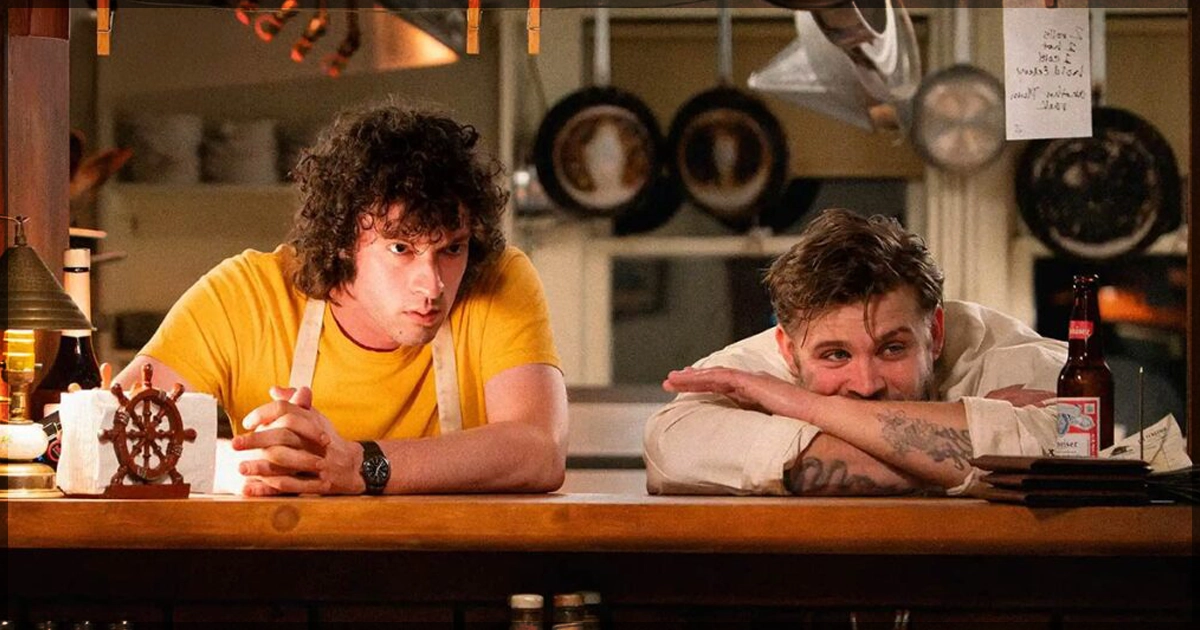
Tony is a love story, but not the kind we are used to. It is about the love a young man has with his wide-open future, supported by slightly older roughneck men who understand 1) exactly how this young man is falling in love 2) and that he has no idea everybody can see right through him. The kid thinks he’s smart, and that being smart makes him special. Smart or not, those other men did exactly the same things when they were his age: vomiting into the dishwater, accidentally cutting themselves with knives and sharing out “sharpeners” to help them get through a shift. So they’re amused, and sympathetic, but the kid still has to do the work. The question is whether he has the fire in him to do it. The entire joy of Tony is watching that fire bank and start to grow.
Tony (a wonderful Dominic Sessa) is identified right from the start as being Anthony Bourdain, the utterly beloved chef, writer and TV personality whose death in 2018 remains an open wound. The reason he remains so missed is because of the element of his personality which made him so good at his work: he was curious. Put him in front of almost anything and he was interested in it, and that interest was interesting. On his cookery TV shows he wanted to know how the ingredients were grown and how they were prepared, and who did the work. Above all he wanted to share that the experience of hard work and delicious meals were kind of the same all around the world. But Tony is not about the celebrity (and more on that later). It’s 1975 and Tony is an arrogant little jerk at the end of his freshman year of college, convinced his fantastic career as a writer is right around the corner whether he’s doing any writing or not. Obviously this imminent fantastic success means the slightly older girl named Nancy (Emilia Jones) on whom Tony has a wild crush will swoon into his arms. Lol. Lmao, even. Instead Tony has some disappointing news and then a fractious conversation with his mom (Dagmara Domińczyk). So there’s only one thing for it: rob his dad (Rich Sommer, a delight) and head to Provincetown, Massachusetts, the beach resort where Nancy is spending her summer running a pizza joint.
On arrival Tony gets drunk and behaves badly in a seafood place, meaning he is physically thrown out. When that’s not enough to improve his behaviour he’s knocked out and robbed himself before the owner of the restaurant, whose name is a closely guarded secret (Antonio Banderas), takes pity. Chef lets Tony sleep in the hammock on his porch and in return for this hospitality puts him to work in his restaurant. Chef’s place is cheap and cheerful, doing lobster rolls and oyster plates, with a kitchen full of sweaty, sweary men who laugh at the kid sleeping standing up at his sink. Chef expects Sal (Leo Woodall, who only gets better-looking the rougher he gets) to look after young Tony, which actually works out pretty well. Tony’s presence sands down Sal’s roughest edges, and even though he’s a mess Sal is an OK guy. The kind of guy who needs only two minutes at a party before finding a girl to take upstairs, but still. Tony is thrilled to be his disciple, though he parrots Sal’s pickup lines without understanding why they won’t work for him. Nancy kind of slides into the background as Tony begins learning everything Chef and Sal can teach him, most of which isn’t in any cookbook. And because these are all guys being dudes, the question of Tony’s personal hygiene when he’s sleeping outside for months never even comes up.
There’s been some dismay that Canadian director Matt Johnson, who co-wrote the script with three other men using Bourdain’s OG memoir Kitchen Confidential as the framework, made this a “generic” coming-of-age story instead of one which leaned into Bourdain’s adult celebrity. This dismay is both incorrect and insulting. This summer was the turning point of Bourdain’s life, the one which set him on his adult path, and therefore the most full of dramatic potential. Too many recent biopics have simply recreated famous moments, which tend to make you wonder why you are watching the movie instead of the original clips on YouTube. There’s absolutely none of that here; Michael Bauman’s camera keeps a sense of vibrancy without a huge amount of movement.
More to the point, you don’t need to know a thing about Bourdain to enjoy this story about a young man, with a tendency to lie, who learns how damaging that tendency is. It’s relatable – who amongst us wasn’t an idiot teenager – but it’s rarely a good idea, because there are always consequences. Mr. Johnson’s work tends to specialise in the bonds between men using a highly improvised, casual-seeming style, but all wrapped around a rock-solid core of what needs to be achieved. Kind of like working in a restaurant kitchen! You can get away with quite a lot as long as you deliver the goods, but you absolutely have to deliver.
Mr. Sessa, who was discovered for The Holdovers because he was a student at one of the schools where it was shot, makes it clear here he’s the real thing. He is a charming movie star, expert at holding the attention and with a wonderful capacity for making his characters’ thought processes clear. Mr. Woodall and Mr. Banderas both expertly play the kind of men you don’t often see onscreen outside of war movies: they let their actions do their talking for them. They shuck oysters, gulp beers, throw punches, or dump buckets of water on someone’s head because they want to, not because they need to. Because they can, and because they like it. There are more men like this out there than movies would normally have us believe, but we don’t normally know how to depict them without guns in their hands. But men can be just as good at taking care of people as killing. It’s even easy for men to be kind and thoughtful, though it’s normally under a barrage of obscene jokey teasing that’s the cover stereotypical masculinity requires. Mr. Johnson is usually good at making the camaraderie in that kitchen felt.
And yet the appetites of these men are much more than the stereotypes would have us believe. Mr. Bourdain was one of the public figures whose endearing thoughtfulness and curiosity helped us change our ideas of masculinity, and Tony is a fantastic showcase for demonstrating how he got to be that way. It will probably help an awful lot of young men figure out who they want to be when they grow up. As an interested and interesting work of art, Tony completely delivers.
Tony is now in theaters.
Learn more about the film at the IMDB site for the title.
You might also like…
‘Coyote vs. Acme’ Makes Everything Better (Film Review)