
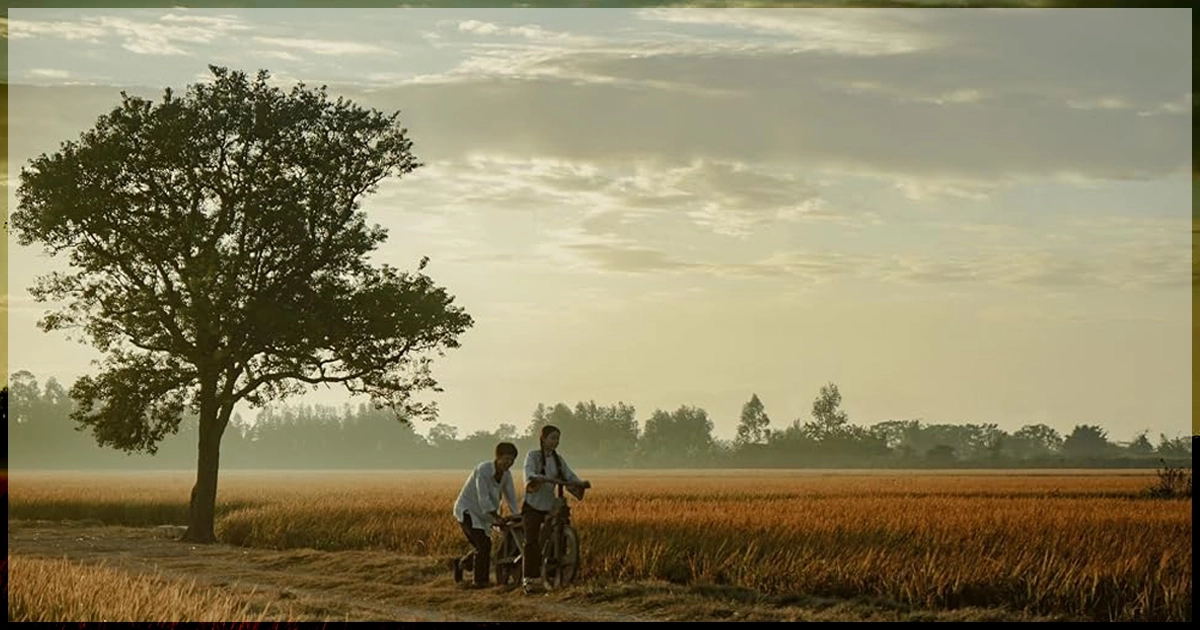
It’s still somewhat unusual for movies out of China to be made in one of their quote-unquote minority languages, and it’s a bit odd to refer to Teochew, which has approximately 20 million speakers, as a minority language. But within the context of the one billion people in China, that’s more than fair. But hearing this rare language spoken is not why Dear You was an unexpected smash hit in China, such a smash that it’s earned widespread international distribution, a very rare achievement indeed for Chinese movies designed for the home market. But since Dear You was designed for both the nostalgia and the “I love my grandmother” markets and those can be found everywhere in the world, it’s a wonderful opportunity to see this unusual love story in this unusual language for yourself.
A young man in Guangdong named Hiou-ui (Zheng Runqi) is in a bunch of debt; since close relatives will no longer lend him any money, he starts to shake more distant branches of the family tree. The obvious choice is his grandfather Den Bhagseng (Wang Yantong), who abandoned his grandmother Iap Songriu (Wu Shaoqing) and her three children in the 1960s for a new life in Thailand. And if he’s not wealthy, then why are there schools named after him? So Hiou-ui goes to demand what’s his in person. Instead he finds the family of a woman named Zia Lamgi (Li Sitong), who explains his grandfather’s story was not so simple.
The majority of the film takes place in flashback in 1950s Bangkok, where Chinese immigrants live semi-legally and precariously in a society that is not remotely interested in making it easy for them to stay. Bhagseng originally fled China with Songriu’s blessing so as not to be forcibly conscripted into the army during the communist civil war. After some false starts, he ends up renting the worst room in the rooming house Lamgi runs with a rod of iron while also looking after her kind but alcoholic father (Fang Peisong). The Teochew immigrants in the area cling together mainly out of desperation, since their solidarity is about the only kindness they enjoy in a world designed for relentless work. They are not even allowed to educate their children in Chinese. What makes things tougher is pretty much all the immigrants are illiterate, and therefore must trust the local qiaopi offices (think Western Union, but shipping physical cash) when dictating messages for the envelopes containing said cash. The connection that Bhagseng and Songriu have is largely one-sided thanks to the difficulties they have in communicating, though they do the best they can. The way in which the connection was severed should not be spoiled, but suffice to say it’s the kind of tragic love story that could wring tears from the hardest of hearts.
Director Lan Hongchun, who co-wrote the script with Zheng Xuanxuan, Yang Leng, and Zhu Liyun, has almost single-handledly made Teochew culture a topic of discussion in modern Chinese culture. The writers worked from an archive of 120,000 qiaopi letters to make the details of the plot as authentic as possible – for example, the end credits show one from a man begging his wife to use the enclosed cash to buy back their daughter – and there certainly is an lived-in feel to the cluttered rooms and streets of Bhagseng’s world in Bangkok. Hai Tao’s camerawork is bright and colorful, swerving many of the visual cliches often used in a story with this much potential for schmaltz, but the music does make absolutely sure no one misses the potential for a single sniffle. The choice to use a cast of non-professional actors – although many of them are Teochew-language influencers – is clever because of the air of unpredictability which this allows.
But the major achievement of Dear You is its emphasis on the importance of kindness, which is not meant as the kind of kindness that might directly benefit you. (Another and better word for this is love.) Most societies only value women, and especially older women, because of the love they provide younger people, but somehow Dear You goes past that and shows how we should value someone kind and thoughtful just for being themselves. Ms. Li was found on social media and does wonderful work as someone whose life has been bound up in her caretaking responsibilities without ever losing her sense of herself – well, no spoilers. Considering how so many people these days have been made to feel kindness is a weakness, it’s really delightful to see movies like Dear You which know that it’s actually a superpower.
Dear You is now in theaters.
Learn more about the film at the IMDB site for the title.
You might also like…