
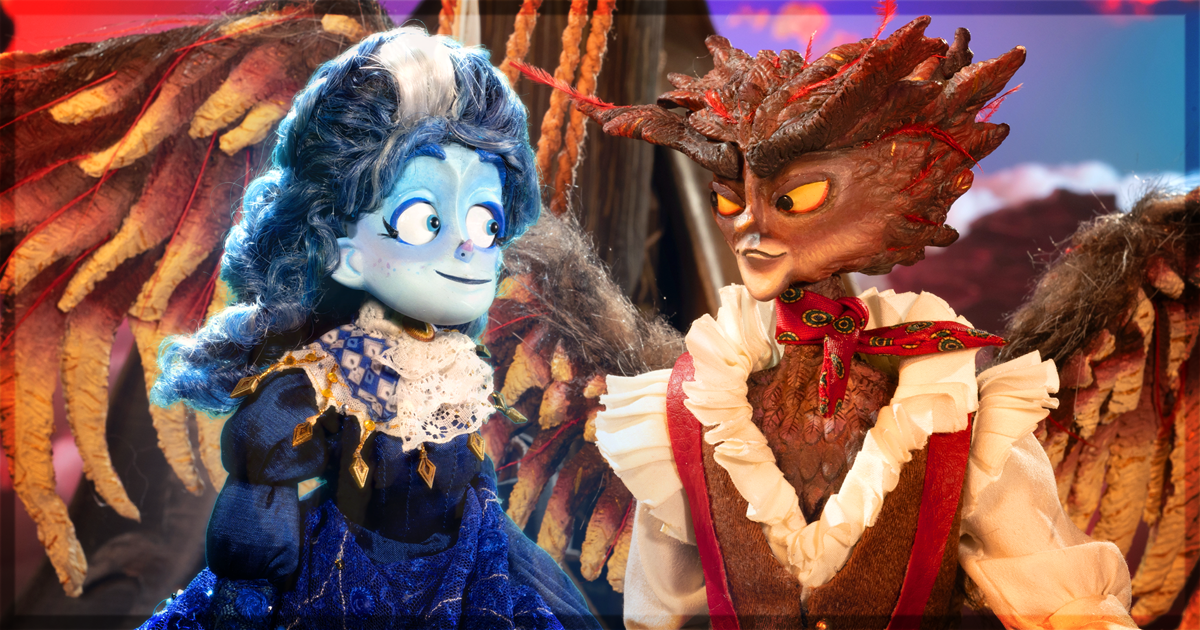
I Am Frankelda (Soy Frankelda) is the debut feature by Arturo and Roy Ambriz. It is also the first stop-motion animation feature ever produced in Mexico. Mexican cinema has a growing animation industry, it is internationally recognized, with names such as Jorge R. Gutierrez (Book of Life & Maya and the Three) and Guillermo del Toro (Pinocchio). It is a pioneering work. It marks a new cycle for animation in one of the principal growing global cinema markets. This fact alone makes it a very influential film for the history of Mexican filmmaking. Additionally, the directors dive into the canon of local mythology through the grand background of parallel universes between the living and the dead. The film is also a feature development of the 2021 Cartoon Network and HBO Max TV show Frankelda’s Book of Spooks (Los Sustos Ocultos de Frankelda).
The film narrates the story of Frankelda (Mireya Mendoza), an orphan who lives with her grandmother, a cruel woman. The girl finds comfort in writing stories, and she starts to observe her characters in her daily life. She sees Herneval (Arturo Mercado Jr.), the prince of the realm of fiction, a world that lives through the energy of nightmares. The prince meets Frankelda when he is a young boy. As his parents, the king and the queen, are getting sicker, the safety of the kingdom relies on him. Hence, he has to fight against the power thirst of Procustes (Luis Leonardo), the royal nightmarer, responsible for scaring the human children. However, the writer seeks to surge to the throne and govern the seven realms that compose the universe of fiction.
Firstly, the mythology of Frankelda is rich and fascinating. It has multiple different characters and scenarios that enchant with their visual appeal. Ana Coronilla and Bruce Zick, responsible for the art direction and production design, achieve an impressive result in world-building. The realms of fiction and reality are equally gorgeously crafted and thoroughly different from one another. The references to the nineteenth-century architecture and the Gothic style provide a thrilling visual identity to the film. In this sense, the film develops multiple set pieces to introduce each of the different realms and the motivations behind each of them. Consequently, the animation medium allows the art department to expand their ideas on the Gothic designs through the immense passages that surround this universe. The royal palace, the cemetery, and Frankelda’s house are detailed sets that transmit the mythological backstory of that universe.
Accordingly, the Ambriz brothers aim to merge the horror with a playful element. The puppetry design borrows from the calavera art style, which, in the context of the Día de los Muertos (Day of the Dead), represents the skulls and the dead. The puppets have layers in their faces that allude to this style, which is highly characteristic of a particular type of Mexican folklore. There is an exciting and beautiful attention to detail in the character’s design, which enriches the look of this groundbreaking picture. Each of the realms has different creatures, such as spiders, witches, and owls, which possess their own special powers and abilities. It also reflects the color palette, as each has a darker tone, particularly the spider, Procustes, the main villain. Meanwhile, the titular character is blue-ish and translucent, which refers to her emotional state, the pain of losing her parents, and feeling like a ghost in the spaces she occupies. It is an artistically sharp and astute design work in puppetry.
Nevertheless, the rich backstory of this mythological universe is also its principal defect. There are plenty of characters, and constant shifts between the two realms demand a ton of time, which results in a lack of development for the supporting characters, and even Frankelda. In the meantime, the film is also a musical animation; therefore, blocks of dialogue interrupt the characters’ motivation to sing. Unfortunately, the songs are not engaging enough to make us care for them more than the dialogue and actions. It interrupts the flow of the story, and the final act feels bloated and rushed at the same time.
Ultimately, I Am Frankelda is an unprecedented film in the history of Mexican cinema. It is the first stop-motion animation ever made, and it expands the canon of already introduced characters from the TV show. Arturo and Roy Ambriz present a charming and artistically breathtaking effort, which enchants with the character’s design and the beautiful crafting of this universe. However, the grand mythology is too inflated and takes plenty of time to deliver a musical subplot that is not as fascinating as the rest. In the end, it is an uneven result in a captivating universe that dives into Mexican folklore to narrate dreams and the pains of growing.
I am Frankelda (Soy Frankelda) recently played at the Fantasia International Film Festival.
Learn more about the film at the Fantasia site for the title.
You might also like…