
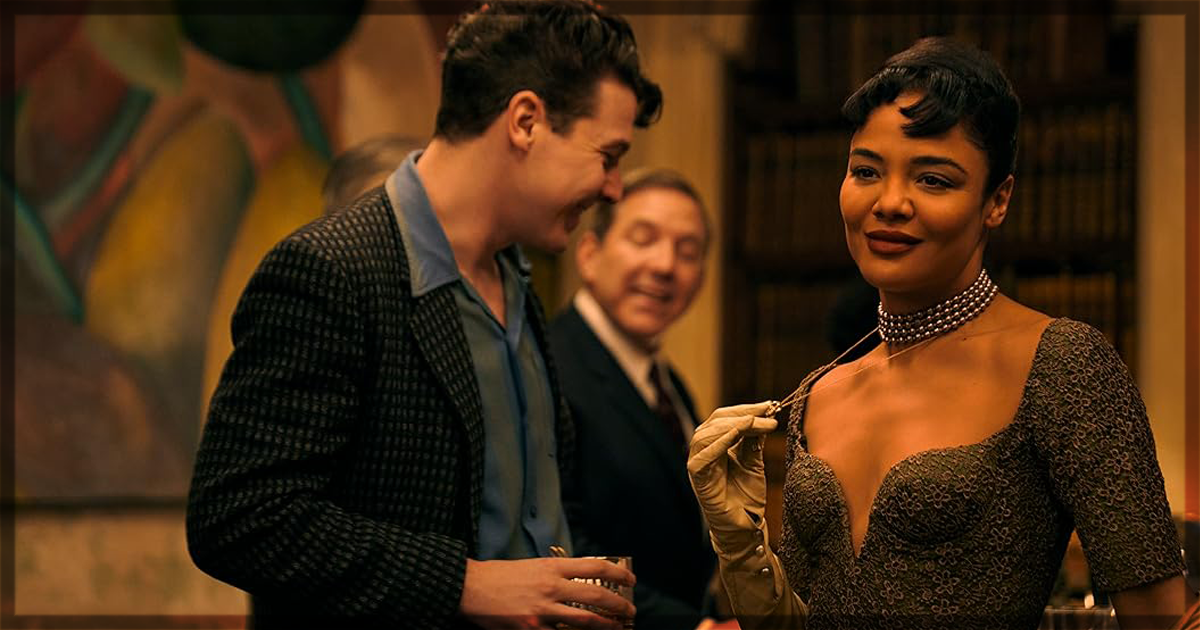
“Just Hedda is fine.” With these prickly, precise words, Hedda (Tessa Thompson) immediately establishes her self-image and control thereof. Hedda is the recently married wife of up-and-coming scholar George Tesman (Tom Bateman), but the legacy left by her father General Gabler – including his guns – is one she takes fierce pride in despite her illegitimacy. She and George have just returned from their honeymoon to take up residence in a grand country mansion she insisted they buy (on a whim, she counter-insists) and are throwing a lavish party to announce their return to society. This is not the only motive; if they wine and dine Professor Greenwood (Finbar Lynch) to the right degree, a prestigious position and endowment at the university is all but guaranteed to George. Their money woes and debts to Judge Roland Brack (Nicholas Pinnock) would be yesterday’s news. Of course Hedda is happy. Why wouldn’t she be?
If the stakes were not high enough, however, two unexpected guests promise to make appearances. The first is Eileen Lovborg (Nina Hoss), a brilliant scholar who has a chequered past with boozing and bad company, and, now reformed, she may be out for George’s job. The second is Thea Clifton (Imogen Poots), a shy young woman determined to save her beloved Eileen from any temptations that might threaten the publication of a brilliant new book – and from a mysterious former lover who threatened to shoot her during their tempestuous break-up. Hedda, of course, cannot help but resume some dangerous games.
Hedda revolves around its title character in all her enigmas and contradictions, and Thompson’s performance is a tour-de-force that enriches and deepens her endless varieties rather than smoothes them out. With a cut-glass mid-Atlantic accent and a penchant for true melodrama, Hedda becomes the film’s central vortex, and were it not for Hoss matching her toe-for-toe it would be impossible to look away. Hoss’ Eileen is all acerbic composure and fierce intellect until – as the plot progresses and her battle of wills, wits, and hearts with Hedda dominates all else – a desperate vulnerability emerges. These women do not need their histories and motivations explored; they are complete as presented in every barbed glance and half-uttered sentence. Both should rightly be nominated for the top honours this awards season.
Ibsen’s 1891 play Hedda Gabler has been reimagined and rewritten by director Nia DaCosta, its title dropping the central character’s surname to denote that this is not going to unfold as it always has before. Setting Hedda in 1950s England, with the prosperous class committed to forgetting the recent World Wars and establishing Britain as a modern, forward-thinking yet traditional nation, permits some subtle commentaries on gender, class, and race to emerge that are not (all) present in Ibsen’s original. Admittedly, these changes are not consistently fully realised within the implication of their time: while Hedda’s status as a mixed-race outsider is a compelling touch among her many mysteries, Judge Brack’s status as a prominent Black public figure is less commented on. Similarly, Eileen’s semi-out status as a lesbian career woman – let alone academic – are barely impediments as she challenges George for the job. Even among the open-minded “liberal elite” of DaCosta’s historical world, these feel underbaked. But ultimately, these are minor quibbles; Hedda does not need to justify all its changes in reality, and playing in the what-ifs allows new possibilities to emerge from a familiar story.
Gender-swapping the male Eilert Lovborg (in the original play) to become the female Eileen – and thus queering her relationships to both Hedda and Thea – feels like a fresh, modernising choice, though fans of the original may be slightly puzzled as to how certain events will work out. Without spoilers, DaCosta keeps the spirit of the original while pushing its inevitable conclusion to something familiar yet new. More on this later, as the most important aspect of the gender swap is felt far before the denouement. As a woman, Eileen becomes a far more tragic figure than the vaguely pathetic Eilert is. She might have lost herself to carousing and drink before returning to the straight-and-narrow through Thea’s devotion, but the hints point towards a deeper sadness and ostracisation fuelling both her sadness and self-confidence. Eileen has so much more to lose, and Hedda’s thanatonic compulsions take on new complicated shades.
Most importantly, changes in setting and gender aside, this play-turned-film is a grand, all-guns-blazing (sometimes literally) good time. Kathryn Hunter is slightly wasted as the Tesman’s housekeeper Bertie, only appearing in two short scenes, but DaCosta’s script and Jacob Secher Schulsinger’s editing keep all actors playing in the same heightened realm. Sean Bobbitt’s kinetic cinematography and Hildur Guðnadóttir’s edgy, dissonant score turn the screws of Hedda’s machinations to the breaking point. Special mention must be made of the production design, where the Tesmans distinguish themselves as forward-thinking modernist through the cubist artwork hanging on their walls – safely acclaimed by the 1950s, but establishing themselves as the tastemaking vanguard.
Back to the ending. Mileage may vary depending on one’s willingness to see a nearly perfect play tampered with, and a few pulled punches and missed poetic symmetries fall short of satisfaction. DaCosta, however, does not succumb to literal explanations, leaving new ambiguities when the screen cuts to black. After hell has broken loose, the idea of picking up the pieces may be the more terrifying – and exciting – option.
Hedda is barrels of fun and easily one of the best semi-modernised takes on a classic to emerge from recent cinema. While not all of DaCosta’s narrative divergences pay off, she and Thompson make a strong case for the continual reinvention of the theatre’s most fascinating antiheroine.
Hedda is now playing on Prime Video.
Learn more about the film, including how to watch, at the official website for the title.
You might also like…
‘Viva Verdi!’ Documentary Review: A Loving Tribute to Artists’ Final Acts