I watched Dust Bunny without much baggage. I read the premise, knew this marked the feature directorial debut of Bryan Fuller, but I don’t carry with me a deep familiarity with his acclaimed television work. Thus, I was motivated solely by curiosity to see a film that attempts to balance on the tightrope between innocent fantasy and brutal reality, relying on quite an interesting cast.
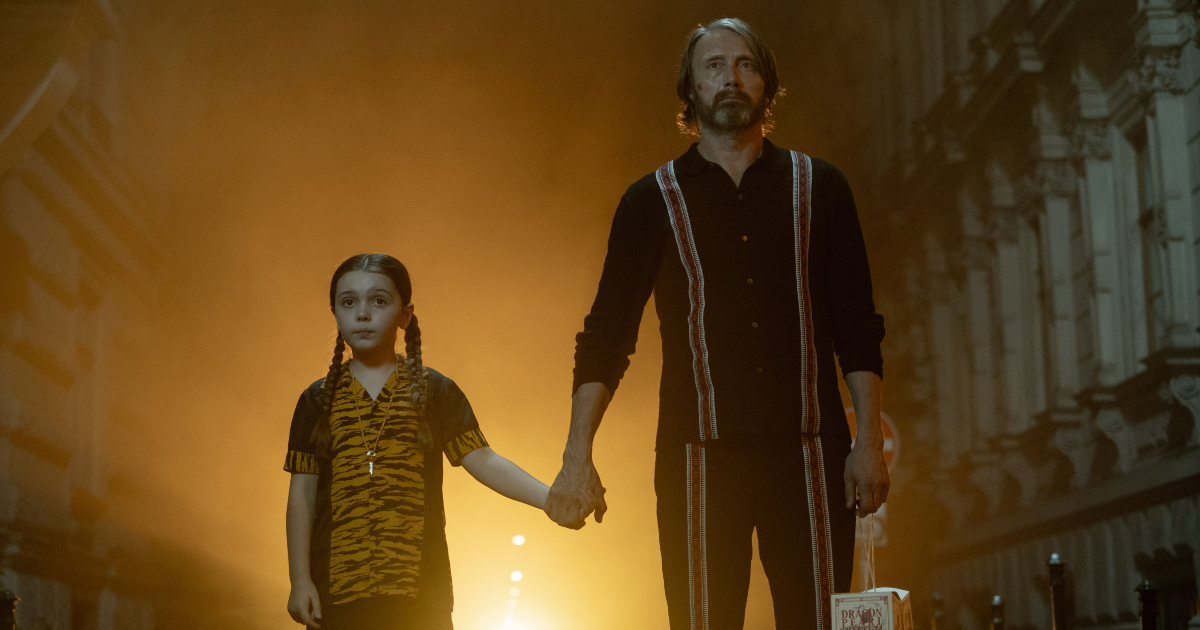
The narrative introduces us to Aurora (Sophie Sloan, Annika), a ten-year-old girl convinced that a monster lives under her bed. For her, this creature isn’t the fruit of a passing nightmare, but a tangible entity responsible for the disappearance — or, in her view, the consumption — of her family. In her pragmatic ingenuity, Aurora decides to hire her neighbor (Mads Mikkelsen, Another Round), a professional assassin, to eliminate the beast.
The structure of Dust Bunny unfolds like a bedtime story gone wrong, starting in a realm of purposeful, silly, fantastical possibilities, to gradually — and expectedly — land in a raw reality, as palpable as the world of contract killers. It’s a situation of narrative déjà vu. Despite the thematic richness inherent in stories about childhood trauma, the movie navigates familiar waters, anchoring itself in the usual “found family” trope. The dynamic between the reluctant assassin and the precocious child isn’t new, but here it serves as a vehicle for a poignant exploration of how we learn to live with our scars.
Thematically, Fuller manages to extract gold from the simple premise. The monsters we carry with us are merely manifestations of our traumas. In Aurora’s case, the creature under the bed — the titular dust bunny — is the physical representation of her loneliness, abandonment, and messy emotional state. The film intelligently suggests that childhood trauma, when ignored or swept under the rug, doesn’t disappear; it accumulates, grows teeth, and becomes something quite serious. The monster acts, paradoxically, as her protector against “bad people,” a barrier erected by fear to justify loss and pain. It’s an effective metaphor, even if the narrative execution sometimes seems to follow a pre-established formula without major deviations or original risks in its development.
Visually, Fuller‘s debut in the director’s chair is marked by whimsical and colorful production design. There’s a dreamlike quality to the settings, a fun mix between the dreadful and the vibrant that gives the movie a distinct visual identity. However, it’s precisely in this mix that one of its biggest inconsistencies lies…
The tone oscillates somewhat irregularly; the movie presents itself with a cover of “accessible horror”, almost family-friendly, yet it’s punctuated by moments of violence and shootouts that might be too heavy for younger audiences, creating a dissonance regarding who this film is actually for. Furthermore, while the practical visuals are laudable, the VFX leave something to be desired, appearing at times with questionable quality that strips away some of the immersion the practical sets build so well.
The true heart of Dust Bunny, and what saves it from its structural flaws, is found in the central performances. Mikkelsen sheds his usual aura of untouchable villain to deliver a subtle performance, balancing an assassin’s cynicism with a reluctant tenderness that never feels forced.
But the real revelation is Sloan. In an absolutely remarkable debut, the young actress holds the screen with disarming naturalness, establishing palpable chemistry with Mikkelsen. The relationship between the two is the engine of the movie, elevating the formulaic material through genuine interaction that moves between dry humor and sincere emotion.
Final Thoughts on Dust Bunny
Dust Bunny doesn’t reinvent the wheel or say something profoundly new about grief and trauma, but it manages to be a satisfying experience. It’s a “silly” film in its conception, and its VFX might not dazzle, but it’s all executed with evident affection and clarity of purpose. There’s a positive and clear message about sensitive matters, wrapped in a somewhat humorous and innocent layer that, with the due warning about “accessible violence”, can be appreciated by various ages. Bryan Fuller reminds us that the monsters under the bed are as real as the pain that feeds them, and that true courage lies not in having no fear, but in finding someone who believes in our truth enough to help us turn on the light.
Rating: B-
Dust Bunny is now playing in theaters.
Learn more about the film, including how to buy tickets, at the official website for the title.
You might also like…