
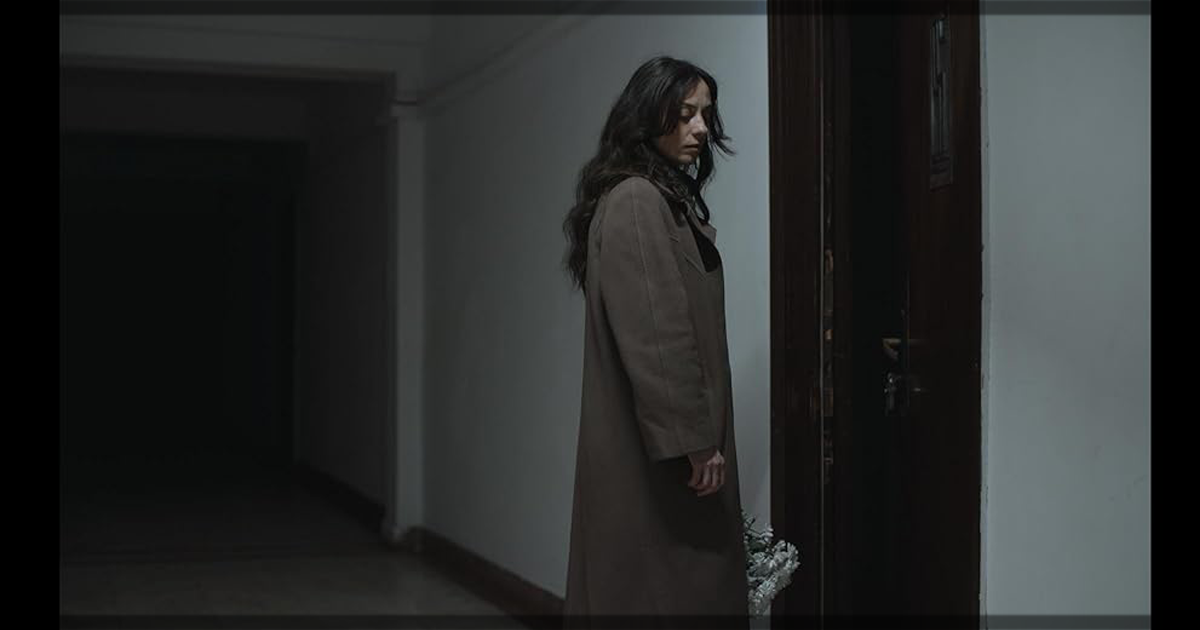
Romanian writer-director Andrei Epure already tested the premise of his feature debut Don’t Let Me Die, which premiered in the Filmmakers of the Present section of the 2025 Locarno Film Festival, in his 2021 short film Intercom 15, an entry in Cannes’ Critics’ Week. In fact, exactly seven minutes into Don’t Let Me Die, those who have seen the 22-minute short will be reminded of its premise as well as the same apartment building that opened the previous title. The director even retains Cosmina Stratan, who plays the same lead character in the short, alongside other cast members.
Co-written by Ana Gheorghe, the movie’s story hinges on a young woman named Maria (Stratan), who, along with her neighbors, finds Isabela (Elina Löwensohn) lying unconscious by their apartment building’s entrance. Isabela, at first glance, seems like she’s just taken a rest in the most unexpected of places after an exhausting workday, but that assumption swiftly dissipates as she’s formally declared dead. Throughout the narrative, little is known about Isabela. She lived in the apartment complex, in Unit 8 on the first floor, to be exact. She died of cardiac arrest caused by hypothermia. She worked as a cleaning lady, after she got fired in her previous job as a Latin teacher for allegedly talking to trees. She had a son, but he’s long been away and no one practically knows him. The two neighbors tell Maria, as if to absolve themselves of guilt after finding excuses to leave, not to abandon the dead woman by the entrance. Maria then speaks with emergency responders and the police. Soon, she assumes the responsibility of providing the deceased a proper burial, but it’s not as easy as it seems. They’re not blood-related, and she barely knows the woman despite living in the same building for years. Yet, for someone who appears just as detached from the world as her neighbors, there’s this strange impulse, either a function of grief or genuine care, that propels her to extend Isabela the dignity she deserves, to keep the woman’s unit clean, to practically adopt and walk her dogs like her own, and to put with authorities who are indifferent to gestures of basic humanity.
There is an air of ambiguity that permeates the film, in that we rarely get access to Isabela’s backstory; if anything, she remains as a spectral presence throughout the story, treated more as a function of the film’s rhetoric about larger societal ills and cruel bureaucratic structures than a character we can actually connect with on an emotional level. In other words, Epure elides details for mere pathos. That is, of course, to the film’s detriment. But the ambiguity also gives the movie a kind of psychological allure half-operating between measured horror and absurd comedy. The rich soundscape, courtesy of Nathalie Vidal, featuring odd intercom noises and persistent screaming at nightfall, as well as a character who’s afraid of sleep, and the nearly therapyspeak strangeness of lines like “We believe in continuity and empathy” all contribute to this jarringly eerie and subtly funny atmosphere. Cinematographer Laurențiu Raducanu, meanwhile, leans on a chiefly static mounting and subdued palette—at times total darkness—featuring hallways and interiors whose sheer emptiness and lack of flourish deftly enunciates not just the shifting psyche of the protagonist but also the mundane, almost purgatorial, cruelty that dominates the film. This is not just a movie about grief and isolation, but, more crucially, about how institutions that we expect to be in our service routinely fail us.
As Maria proceeds to arrange the funeral obligations—such as securing a death certificate, finding the right coffin or burial plot, or figuring out what to include in the tombstone inscription—and later deals with Isabela’s son, who only shows up after six years, she begins to absorb the insidiousness of legal procedures and mourns a sort of personal ache that’s largely left unspecified by Epure, which is to say that a little more depth could elevate the film’s emotional heft. Be that as it may, Stratan delivers terrific work as someone whose humanity gradually shines through, despite the overwhelming apathy that surrounds her. She comes up with a performance that’s so affecting and quietly explosive. Overall, Don’t Let Me Die is hard to pin down narratively and emotionally, but there’s a poetic appeal in its slowness and blend of genres that engines Epure’s vision of death beyond the physical. This is the kind of movie that perhaps would yield more meaning upon another viewing.
Don’t Let Me Die recently played at the Locarno Film Festival.
Learn more about the film at the Locarno site for the title.
You might also like…
