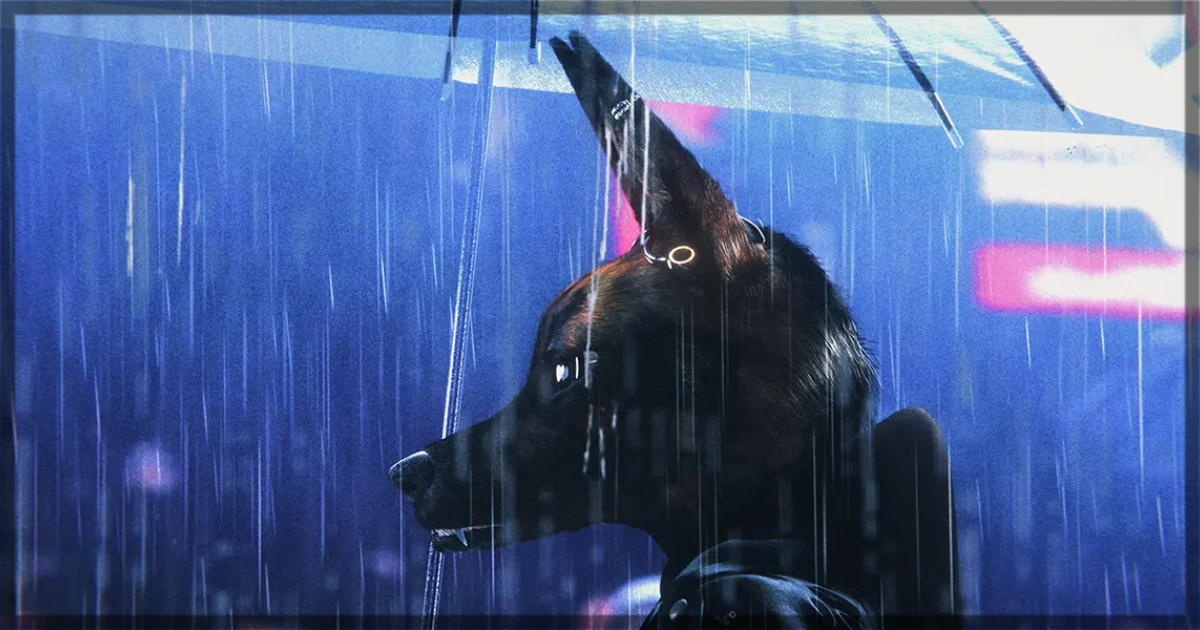
The animation medium allows a plenitude of experimentation. In this sense, it is possible to represent and narrate any story the writer’s head wishes to, using the technique and animation conventions to develop that specific story. One of the most popular and eccentric subcultures in the world is the furry community, centered on anthropomorphic animal characters. Online communities, forums, and conventions welcome thousands of individuals interested in fur animals and who even wear costumes based on them. Hence, there is a whole new universe in the behavior of these creatures, which appear to be animals but behave like humans. Nevertheless, there is an opportunity for storytelling through the visual uniqueness of the furries. The duo Orian Barki and Meriem Bennani debut into the world of feature presentation with Bouchra, a film about a furry Moroccan filmmaker who lives in New York and is writing a project about her life.
In the film, the coyote Bouchra (Bennani) moves from Casablanca to New York, where she works as a filmmaker. After breaking up with her girlfriend, she suddenly offered her a job at Sony, prompting her to question her life as she travels to her hometown to draw inspiration for her film. Similar to many other filmmakers, their own background is the central source of inspiration for their movies. The film presents a fascinating and underrated aspect of creative output: living before telling a story. On multiple occasions, a work feels restrained by the repetitive nature of its discourse or by a lack of awareness of the societal climate at that moment. Artists must live, then transport their experiences to their canvas. It is a welcome hierarchy that benefits the audience and the artistry, expanding the breadth of each work and the ability of each artist.
The most engaging virtue of Bouchra is the film’s mundane elements. The lead character is constantly moving around New York City while listening to the Pour Your Heart Out radio show, a program hosted by one of her friends. There is a regular connection between Morocco and the United States; she feels the need to keep in touch with your local culture while also being immersed in the regional scene. In this sense, the film is more about her experiences while brainstorming and writing it than about the work itself. Yet it is an exercise in a young individual figuring out her place in the world, particularly as a queer woman of Arab descent. Hence, it has a specific resistance from her mother, a cardiologist in the African country. In this sense, we understand Bouchra’s challenges in communicating with her family due to cultural differences between New York and Casablanca.
Furthermore, the furry animation is a creative choice that justifies the experimentation in this story. In multiple sequences, the directors allude to the fetishist niche of furry practice, either domination or sex in costumes. They introduce a rawness and sensuality to the intercourse of these furry animals, who are women challenging the status quo. One of the principal discussions is Bouchra’s difficulty in dating women in her mother language, the French, predominantly because of the culture, which is not that queer-friendly. Thus, Bouchra encloses a realism even through its hyper-characteristic characters, primarily due to the design of its characters and environments. The world around them features multiple colors and distortion of shapes, but it is a highly similar universe to the one we live in. Nevertheless, there is an uncanny valley in the first moments, but promptly, we comprehend all the visual information displayed on the screen. Correspondingly, the film is a graphical experiment in its nature, using the furry subculture to distance itself from realism, yet it implies the specifics of this community.
Alike Meriem Bennani’s work as a visual artist, both on social media and in galleries, the film is a fascinating study of a subculture and community, and it expands to corroborate the directors’ ideas across multiple topics. It follows up on their interests from hyper-exaggeration in the visual forms; consequently, they use the anthropomorphic nature of the furries to comment on kinkness, racial differences, and LGBTQIA+ relationships. This approach is a statement of the materiality of the animation medium as an experimental format and an open door to mature contents, leaning towards the understanding the European animators have of the medium.
Finally, Bouchra is a fascinating debut by Orian Barki and Meriem Bennani that comments on the importance of experiencing life before producing art. It uses the furry visual aesthetic to narrate the complex process of an individual’s emancipation, but it is a remarkable first directorial effort.
Bouchra has recently played at several international film festivals.
Learn more about the film at the IMDB site for the title.
You might also like…