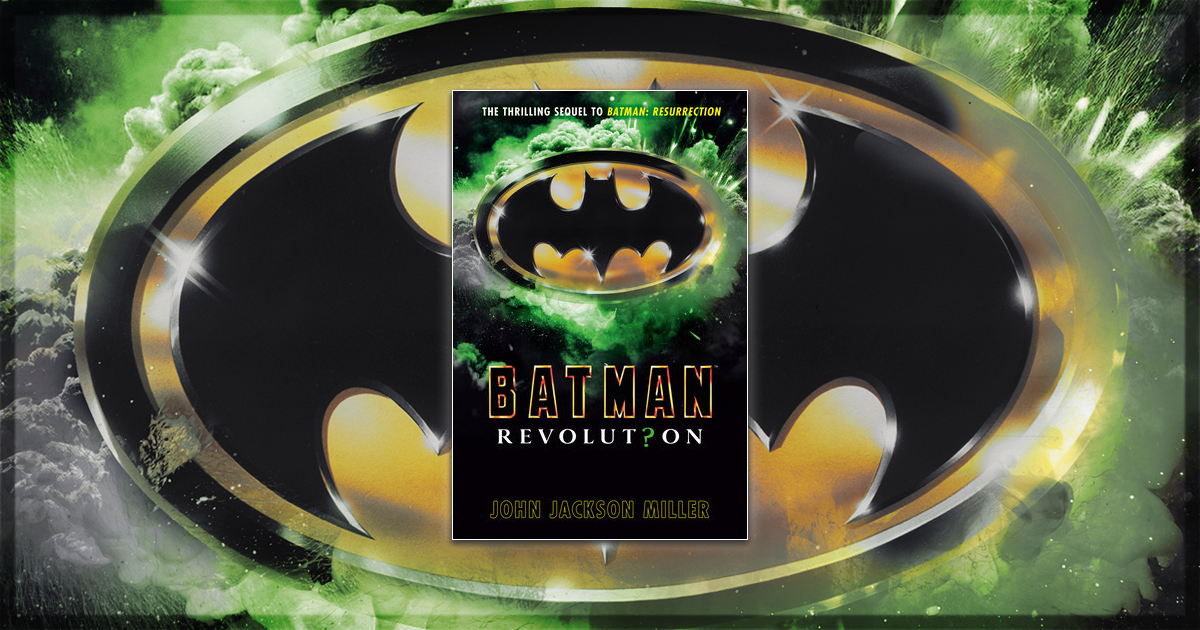
Gotham is still reeling from Joker’s attack on the city last year. Crime hasn’t gotten any better, even with Batman swinging around, and the city is like a fire looking for a match. And the Riddler is set to be that match. Backed by the Servants of Freedom, a paramilitary resistance group, the Riddler is tearing Gotham apart under the guise of social reformation. Can Batman stop them before they destroy the city he loves? That’s the question in Batman: Revolution, the sequel to Batman: Resurrection, by John Jackson Miller.
[Note: While I am reviewing this novel independently and honestly, it should be noted that it has been provided to me by Random House Worlds for the purpose of this review. Warning: My review of Batman: Revolution contains some spoilers!]
“Revolution is the festival of the oppressed”
“Revolution is the festival of the oppressed.” That’s a quote from Germaine Greer, an Australian writer and feminist. And Gotham is full of oppressed people waiting to party; they just need someone to start dancing. Norman Pinkus is one of those oppressed people. He’s been relegated to the sidelines his entire life, overlooked and overshadowed by those around him. Finally, he decides it’s his time to shine and tries to take what’s his, only to have his entire life implode in the span of a few hours. Shellshocked and lost, Norman is found by a revolutionary group hiding under the very library where he’s always found solace.
Camille, the leader of the group, sees the potential in Norman and manipulates him into joining their cause. Norman quickly loses himself in the movement and in his new persona, “the Riddler”. As the Riddler, Norman calls the citizens of Gotham to action through increasingly destructive acts disguised as pranks. Batman and Commissioner Gordon know that something bigger is coming; they need to solve the puzzle of the Riddler before someone gets hurt.
The accidental creation of a super villain
In Miller’s Batman: Resurrection, we saw the rise of the Joker, a super villain who is both insane and loves destruction. A real super villain. But in Batman: Revolution, we watch Norman Pinkus become a bad guy almost by accident. He spent his entire life trying not to be noticed, pushing himself into a little box. Finally, he has had enough and decides to try stretching himself, but the world doesn’t change so easily, and he loses his job and his mother within a couple of hours.
With nowhere to go and no one to turn to, Norman returns to the library that was a safe haven for him as a child. But even that safe haven is no longer safe. Norman finds it overrun by the Aeterna Militia, a group dedicated to the collapse of society. At first, it looks like they’re going to kill Norman, but in his panic, he starts talking, and the leader, Camille, sees an opportunity. She manipulates Norman into doing some “harmless pranks” that gradually become more and more destructive until, under the Riddler’s guidance (that’s Norman’s public persona now), the city becomes one huge pile of kindling just waiting for a match, a match that Camille is only too happy to strike.
But is that really what Norman wants? Ever since he was a kid, he’s been helping the police solve crimes. They didn’t know it was him; his tips were always anonymous, but that didn’t change the fact that he wanted to be good. And when he starts helping the Aeterna Militia, he believes what he’s doing will help others like him and his mother, who were left behind by society. His goal isn’t to hurt anyone; he just wants to help people. However, he’s naive and easily manipulated by those around him. The Riddler is an odd combination of extreme intelligence and emotional immaturity. What will he do when he realizes how his actions have been manipulated by those around him? Will he go completely dark, or will he try to make amends for what he’s created? The answers to those questions reveal whether Norman is another supervillain like the Joker or just a guy who was pushed too far and led astray.
The interesting question is, does the distinction matter when people are getting hurt? I think it does matter, especially when we ask the question “what’s next?” Does Norman keep hurting people as the Riddler once he knows what’s really going on, or does he try to rectify his mistakes? That’s what matters more in the end. Maybe not to those who are already hurt, but certainly when deciding if the Riddler is truly evil, or just misguided. I think that Batman: Revolution provides a satisfying answer to those questions, both as philosophical exercises and in the specific case of Norman Pinkus.
A strong second installment of a promising series
Batman: Revolution is the second in the series based on Tim Burton’s 90’s Batman movie. While it’s always better to read all the books in a series, the nice thing about Batman: Revolution is that it can be read as a standalone novel. The story mentions plenty about what happened in the previous book and sets up the next, but it is a complete story on its own. There is no actual need to read Batman: Resurrection before reading Batman: Revolution. This is nice for anyone just coming upon the book and intrigued enough to open it. Sometimes, having to read an entirely different book before the one you actually want can be a huge barrier to reading it. Of course, having more Batman adventures that you can enjoy after you read Batman: Revolution is nice too. Enjoy this fast-paced adventure and solve the riddle of what to do with your spare time for at least a few days!
Rating: 8/10
Batman: Revolution is now available to purchase at your retailer of choice.
Learn more about the book at the official website for the title.
You might also like…